What our fair-odds player lines mean
A fair-odds player line is the price you would get on a who-records-more-of-a-stat bet if the bookmaker's margin were stripped out, built from the two players' actual match records. FootyMetrics' Player Matchups tool works one out for you: pick two players and a stat, set the run of games to base it on, and it returns the fair odds for player one, the draw, or player two.
Team FootyMetrics
Updated Jul 2026 · 6 min read
- A fair-odds player line is a no-vig price for a head to head player prop, worked out from the two players' real per-game records rather than from a bookmaker's odds.
- Player Matchups builds it by comparing every one of player one's games against every one of player two's and counting how often each records more. That share becomes the fair price for player one, the draw, and player two.
- The comparison is scaled to a shared minutes baseline, so a player who is often subbed off or comes on late isn't penalised for playing fewer minutes.
- The fair line is a benchmark, not a bet you can place. If a bookmaker's actual price on the same matchup is longer than the fair price, that gap is where possible value sits.
What a fair-odds player line is
A bookmaker’s price on any market has two parts: an estimate of how likely the outcome is, and a margin on top so the book profits whatever happens. A fair, or no-vig, price is what is left once that margin is removed. It is the market’s best read of the true probability with no house edge attached. We cover the general idea, and how to devig a bookmaker’s odds, on what are fair odds and no-vig lines.
A fair-odds player line is that same idea applied to a player matchup: a head to head bet on which of two players records more of one stat in a match, whether that is shots, shots on target, tackles, fouls, goals or assists. Betfair lists these as Matchups, Kambi bookmakers such as BetMGM call them Player v Player, and Altenar bookmakers call them Player H2H. They are the same bet under three names.
The difference from a standard no-vig line is where the number starts. Devigging starts from a bookmaker’s own odds and strips the margin back out. A fair-odds player line starts from the players themselves: their actual game-by-game records for the stat. No bookmaker price feeds into it at all, so it is a genuinely independent estimate you can hold up against whatever a book is offering.
How Player Matchups builds it
Once both players and a stat are picked, the tool pulls each player’s per-game numbers for the matches you have filtered to. Then it compares every one of player one’s games against every one of player two’s games, one pairing at a time, and counts how often player one records more, how often it is level, and how often player two records more.
Say player one has 15 games and player two has 12. That is 180 pairings. If player one comes out ahead in 99 of them, is level in 18, and behind in 63, the shares are 55%, 10% and 35%. Those three shares become the fair odds: 1 divided by 0.55 is about 1.82 for player one, 1 divided by 0.10 is 10.0 for the draw, and 1 divided by 0.35 is about 2.86 for player two. Those numbers are an example to show the method, not a real matchup. The tool shows the same three outcomes as a split bar so you can see the balance at a glance.
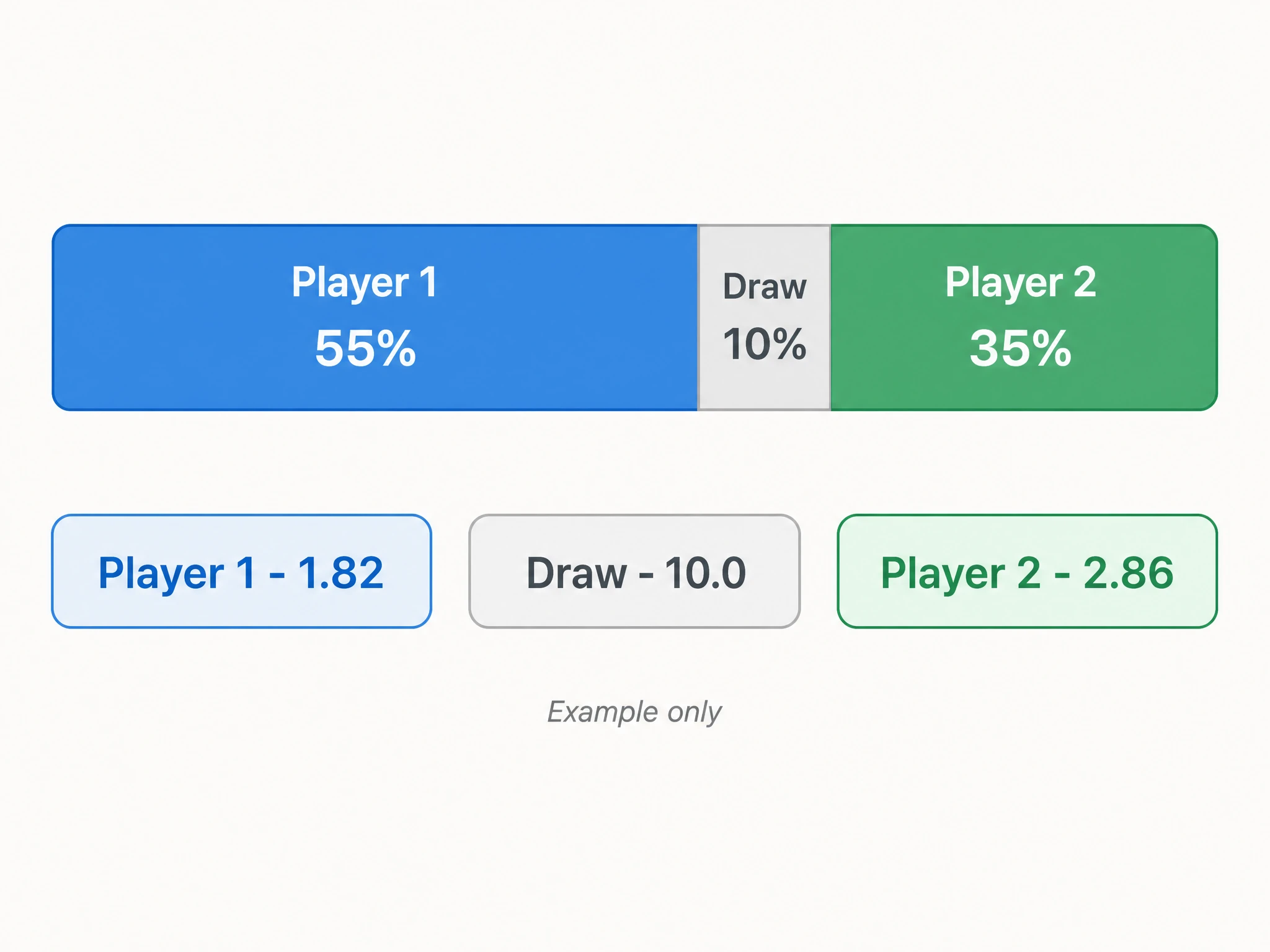
The comparison is scaled to a shared minutes baseline before it counts a pairing. A player who is regularly subbed off, or who comes on from the bench, plays fewer minutes, so each of their games is adjusted to the shared baseline first. Without that step a strong per-90 player would look worse simply for spending less time on the pitch. The adjustment is for minutes only. It does not account for opponent or league strength, so a striker’s shots against a weak defence and against a strong one are weighted the same.
There is a level, or draw, outcome because two players genuinely can record the same number in a game. A pairing counts as a draw when the minutes-adjusted difference between the two is small, which is what puts a real price on "they tie" rather than forcing every pairing into a winner.
Alongside the odds you get the numbers driving them: P90 (output per 90 minutes), the hit rate (how often the player cleared your line), the average per game, and blanks (games with none of the stat). Two players can average the same and still have very different hit rates and blank counts, and that is often where the value hides. For what those figures mean, reading a player trend card breaks down hit rate, P90 and the match-by-match history behind a line.
Why the fair line is a benchmark
The fair-odds player line is not a price you can bet at. No bookmaker offers a matchup with zero margin. It is a yardstick: it tells you what the two players’ records say the split should be, so you can judge whether a real price is generous or short.
The use is simple. Work out the fair line for a matchup, then look at the actual Matchups, Player v Player or Player H2H price a bookmaker is offering on the same pairing and stat. If the book’s price is longer than the fair price, for example the fair line came out at 1.82 on player one and a bookmaker is offering 2.10, that gap is where a possible edge lives. The book is paying out more than the players’ records suggest the outcome is worth.
A signal, not a promise
How to use the tool
Open Player Matchups and search a player into each of the two slots. Once both are in, the fair odds appear straight away, along with a chart of each player’s recent games. From there you shape the sample to match the bet you are looking at.
- Pick the stat from the dropdown: shots, shots on target, goals, assists, tackles, fouls, cards, key passes and more.
- Set the line with the plus and minus buttons. The line is the threshold the hit rate is measured against.
- Use "started only" to limit the sample to games the player started. It is on by default because bookmakers usually settle matchups on starters, so a substitute appearance doesn’t count.
- Toggle "super sub" on if you want the full output from that position, including whoever came on after the player was subbed off. Keep it off when you are pricing a real matchup bet.
- Narrow the run of games on the charts to a recent window, a single season, a club or national-team spell, or home and away only.
Then compare the fair odds the tool gives against the price a bookmaker is showing on the same matchup. If you are weighing several pairings, the popular and suggested matchups below the tool are a quick way in.
Get a fair-odds player line
Pick two players and a stat, set the run of games, and see the fair odds for who records most, ready to compare against a bookmaker's price.
Fair-odds player line FAQs
What is a fair-odds player line?
It is a no-vig price for a head to head player prop, the who-records-more-shots, tackles or fouls type of bet, worked out from the two players' actual match records rather than from a bookmaker's odds. It shows what the players' own numbers say the split between them should be, with no margin on top.
How is it different from devigging a bookmaker's price?
Devigging starts from a bookmaker's odds and strips the margin out of them. A fair-odds player line starts from the players' game-by-game records instead, so no bookmaker price feeds into it. That makes it an independent estimate you can compare a book's price against, rather than a rework of that same price.
How does Player Matchups work out the fair odds?
It compares every one of player one's games against every one of player two's games, counts how often each records more (with ties counted as a draw), and turns those shares into fair odds for player one, the draw, and player two. Each game is scaled to a shared minutes baseline first so a player is not penalised for playing fewer minutes.
Does a fair line longer than the bookmaker's price mean I should bet it?
The other way round. If the bookmaker's price is longer than the fair line, the book is paying more than the players' records suggest the outcome is worth, which is where possible value sits. It is a signal across many bets, not a guarantee on any single matchup.
Why is there a draw outcome?
Because two players can record the same number of a stat in a match. Player Matchups prices the level result as its own outcome rather than forcing every comparison into a winner, so the fair odds cover all three: player one, the draw, or player two.
Does the fair line account for the opponent?
No. It adjusts each game for the minutes played, but not for the strength of the opponent or league. A weak defence and a strong one are weighted the same, so read the fair line alongside the fixture rather than in isolation.