Unit sizing: how much to stake
A unit is a fixed slice of your bankroll that you treat as your standard stake, most often 1% to 2% of the pot. Sizing in units instead of pounds means three units carries the same relative risk whether your bankroll is £500 or £5,000, so you can size a bet by how much you rate it without ever thinking in raw cash.
Team FootyMetrics
Updated Jul 2026 · 6 min read
- A unit is one fixed fraction of your bankroll, commonly 1% to 2%, used as your default stake. On a £1,000 bankroll a 1% unit is £10.
- Bettors talk in units, not pounds, so a stake means the same relative risk to anyone, whatever the size of their bankroll.
- You set a unit by picking a percentage of your bankroll. The lower end, 1% to 2%, survives more losing runs before it does real damage; larger units grow and shrink the pot faster.
- Confidence staking sizes a bet at one to three units by how strongly you rate it. It only works if the rating is honest, and the bigger the top end, the more a wrong three-unit call costs.
Unit sizing is the step between deciding you’ll ring-fence a bankroll and actually placing a bet: it turns a percentage into a single, repeatable number you can stake without doing sums every time. Bankroll management is the wider habit of keeping a separate pot and betting a small share of it. This page is the narrower job inside that: what a unit is, how to size one, and how to bet in units rather than pounds.
What a unit is
A unit is one fixed fraction of your bankroll that you use as your standard stake. Set it once, and every normal bet is one unit. A bet you rate more highly might be two units; a smaller punt might be half a unit. The point is that the unit is defined as a share of the pot, not as a cash figure you decide on the day.
On a £1,000 bankroll, a 1% unit is £10. So “one unit” means £10, “two units” means £20, “three units” means £30. Nothing more complicated than that. The word just gives you a way to talk about stake size that doesn’t depend on how much money is actually in the account.
Why bettors talk in units, not pounds
If someone tells you they had £50 on a bet, that tells you almost nothing about the risk they took. £50 is a heavy bet for someone with a £500 bankroll and a rounding error for someone with a £50,000 one. Units strip that out. “One unit” is the same relative risk for both of them, even though the cash amounts are miles apart.
That’s why tipsters and record-keepers post results in units rather than pounds. A season that finishes up 40 units means the same thing to every reader: forty times the standard stake, in profit, whatever their own bankroll happens to be. It also keeps your own records honest. If you track in units, a good month and a bad month are measured on the same scale even though your bankroll, and therefore your cash unit, moved in between.
There’s a discipline benefit too. Thinking in units puts a ceiling on any single bet before you place it. “I’ll have two units on this” is a decision about risk. “I’ll have £80 on this” is a decision about a number, and it’s much easier to talk yourself into a bigger number when a bet looks good than into a bigger share of your bankroll.
How to set your unit size
Setting a unit is one decision: what percentage of your bankroll is one unit. The common range is 1% to 2%, and there are real reasons that band gets recommended over anything larger.
A smaller unit survives a longer losing run before it does serious damage. At 1%, ten losing bets in a row cost roughly a tenth of your pot; at 5%, the same ten losses take out around 40% of it, which is a hole that’s genuinely hard to climb out of. Losing streaks that long aren’t rare even with a real edge, so the unit has to be small enough to sit through them without wiping the bankroll out. The trade-off is that a small unit also grows the pot slowly when you’re winning. 1% to 2% is the band where most people land because it’s cautious enough to survive variance and still meaningful enough to matter.
Your unit should also match how often you bet. Someone placing five bets a week is exposed to far more variance than someone having one a fortnight, so the heavy better has more reason to sit at the lower end of the range. If you’re new to this, start at the bottom, 1%, and only move up once you’ve got a real record to look at rather than a hunch about how good you are.
A worked example on a £1,000 bankroll
Say you start with a £1,000 bankroll and set your unit at 1%. That’s £10.
- One unit is £10.
- A bet you rate as normal gets one unit: £10.
- A bet you rate more highly might get two units: £20.
- Your strongest calls, the rare ones, get three units: £30.
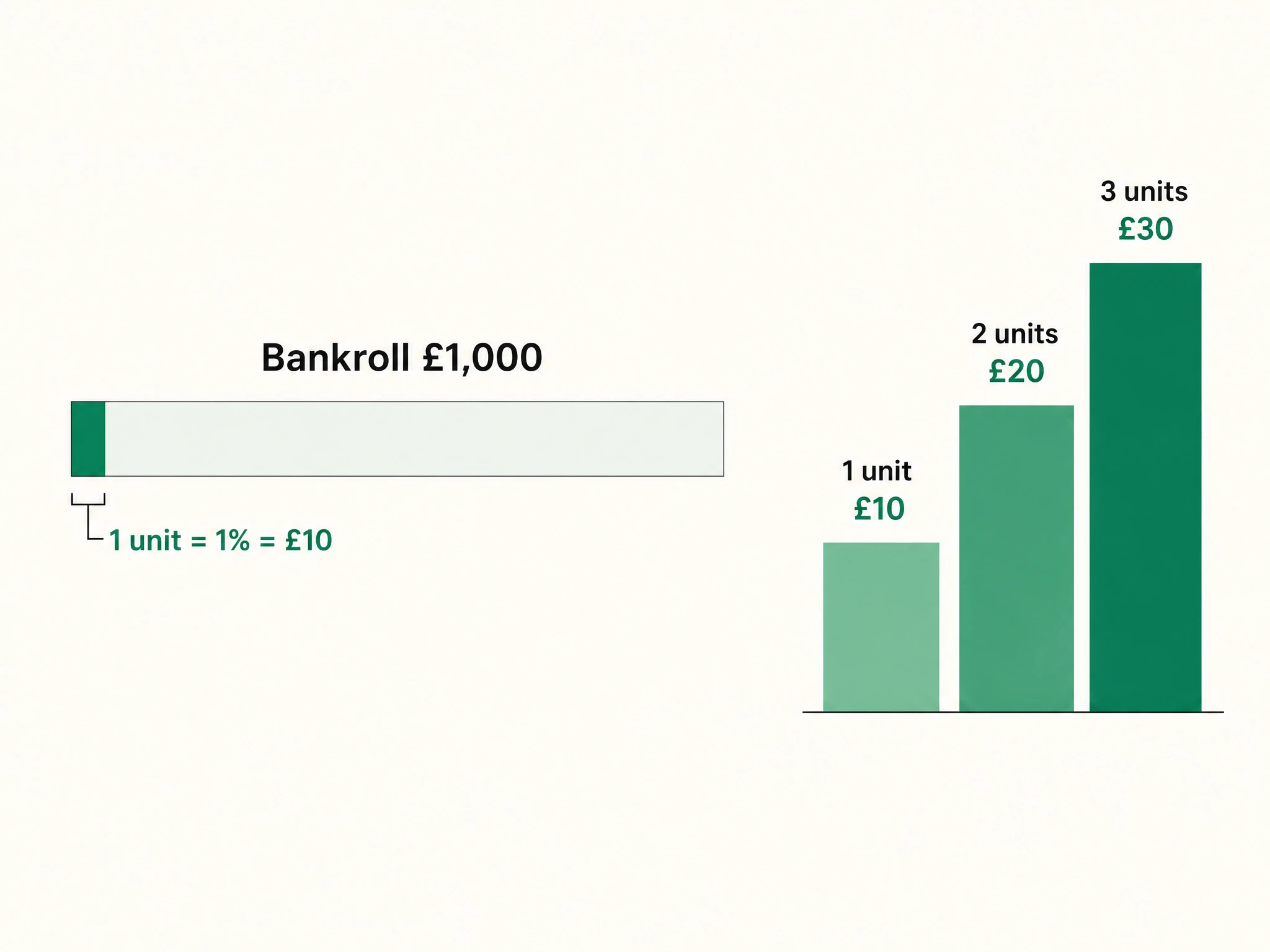
That’s the whole system for a flat-unit bettor. Every stake is £10, £20 or £30, and you never have to ask yourself “how much should I put on this” in cash terms again, only “how many units is this worth”. If a normal bet ever tempts you past three units, that’s usually a sign the confidence is running ahead of the evidence, not that the bet deserves it.
Fixed-amount units vs recalculated-percentage units
There are two ways to run a unit once you’ve set it, and they only start to differ once results come in.
A fixed-amount unit locks the cash figure in. You work out 1% of £1,000, get £10, and £10 is your unit from then on regardless of what the bankroll does. It’s the simplest version to run, because there’s nothing to recalculate before each bet, and it lines up with flat staking.
A recalculated-percentage unit keeps the percentage fixed and lets the cash figure move with the bankroll. 1% of £1,000 is £10 today; if the pot grows to £1,200, 1% is now £12, and if it drops to £800, 1% is £8. You recalculate the unit every so often, so the stake shrinks automatically during a bad run and grows during a good one. That’s percentage staking, and the self-adjustment is the whole point of it.
- The cash stake stays the same, £10 every bet.
- Nothing to recalculate before you place a bet.
- Easiest to read back over a whole season.
- The cash stake moves as the bankroll moves.
- Shrinks automatically during a losing run.
- Needs a reset point, weekly or after a set swing.
Neither is the “right” one. Fixed-amount units are easier to stay disciplined with and easier to read back over a season; recalculated units protect the bankroll on the way down without you having to remember to ease off. Most people who recalculate don’t do it after every single bet, they reset the unit at a set point, say weekly or after every 5% swing, so the number stays stable enough to actually use. How these two plans behave side by side over a run of bets is covered in more detail in staking plans compared, which sets flat, percentage and Kelly staking against each other on the same bankroll.
Confidence-based staking, and its risks
Confidence staking means varying the stake by how strongly you rate a bet, usually on a one-to-three unit scale. A standard bet is one unit, a bet you’re more sure of is two, and your strongest, rarest calls are three. It’s the most common way bettors let conviction feed into stake size while keeping a hard cap on the top end.
The idea is sound in principle: if you genuinely have a bigger edge on some bets than others, putting more on the better ones should pay off over time. That’s the same logic behind the Kelly criterion, which sizes each stake to the edge directly, covered in staking plans compared.
The risk is that “confidence” and “edge” aren’t the same thing. A bet can feel nailed on and still be a coin flip. If your three-unit calls don’t actually win more often than your one-unit calls, all the confidence scale does is put more money on the bets you happen to feel good about, which is exactly the staking-by-mood that unit sizing is meant to stop. The scale is only worth running if you track it and can show that your higher-confidence bets really do land at a higher rate. Until you can, a flat one unit on everything is the safer default, and it removes one more decision made in the heat of the moment.
Keep the top of the scale sensible, too. A one-to-three scale on a 1% unit tops out at 3% of the bankroll, which is still inside the range most people can survive. Stretch it to one-to-ten units and a single wrong ten-unit call is 10% of your pot gone on one bet, which is the kind of stake that turns a normal losing run into a real problem.
Rate the bet before you see the price
Find the bets worth more than one unit
Player trends show how often a player has hit a line across recent matches. Check the record before you size a bet up to two or three units, so the confidence has something behind it.
Where unit sizing sits
Unit sizing is one piece of a bigger picture. Bankroll management is the habit it belongs to: ring-fence a pot, bet a small share, don’t stake from your rent money. Staking plans compared takes the unit you’ve defined here and shows how flat, percentage and Kelly staking each turn it into a stake on a real run of bets. And whatever unit and plan you settle on, it’s only worth anything if you can see what it did, which is what tracking your bets is for. A log kept in units rather than pounds is the cleanest way to read your own results back.
Unit sizing FAQs
What is a unit in betting?
A unit is a fixed fraction of your bankroll that you use as your standard stake, most often 1% to 2%. On a £1,000 bankroll, a 1% unit is £10, so “three units” means £30. Sizing in units keeps the relative risk the same whatever your bankroll is.
How much is one unit?
One unit is the percentage of your bankroll you have chosen as your standard stake. If you set your unit at 1% of a £1,000 bankroll, one unit is £10; at 2% it is £20. The cash figure depends on your bankroll and your chosen percentage, not on any fixed amount.
What percentage of my bankroll should one unit be?
Staking guides commonly suggest 1% to 2% of the bankroll per unit, with the lower end being the more cautious choice. A smaller unit survives a longer losing run before it does real damage, at the cost of slower growth. There is no single correct figure, but larger than about 5% is widely treated as aggressive.
What does “3 units” mean?
Three units is three times your standard stake. If your unit is £10, three units is £30. It is used for the bets you rate most highly on a confidence scale, and it means the same relative risk to anyone regardless of their bankroll size.
Should I stake more on bets I am confident about?
Only if your confidence actually tracks your win rate. Confidence staking, betting one to three units by how strongly you rate a bet, works if your higher-confidence bets really do win more often. If they do not, it just puts more money on the bets you feel good about, which is the mood-based staking unit sizing is meant to prevent.
Is a fixed unit or a percentage unit better?
Neither wins outright. A fixed-amount unit keeps the cash stake the same and is simpler to run and audit. A recalculated-percentage unit keeps the percentage fixed and lets the cash figure move with your bankroll, which shrinks stakes automatically during a bad run. Consistency with whichever you pick matters more than the choice.