Staking plans compared: flat, percentage and Kelly
Flat staking bets the same amount every time. Percentage staking bets a fixed share of your current bankroll, so the amount moves with it. The Kelly criterion sizes the bet to your edge and the odds, and full Kelly is usually too aggressive to run at full size.
Team FootyMetrics
Updated Jul 2026 · 7 min read
- Flat staking bets a fixed amount every time, for example £20 a bet, whatever the odds or how confident you are.
- Percentage staking bets a fixed share of your current bankroll, so the stake shrinks after losses and grows after wins without you touching it.
- Kelly sizes the stake to your edge and the odds. On a £1,000 bankroll at odds of 2.20 with a 48% win chance, full Kelly stakes £46.67, half Kelly £23.33, quarter Kelly £11.67.
- Full Kelly is the growth-optimal stake only if your win probability is exactly right. Get it wrong and it overbets hard, which is why fractional Kelly or plain percentage staking is what most bettors actually run.
What does it actually mean?
Bankroll management covers ring-fencing your betting money and keeping the stake a small, consistent share of it. It doesn't go deep on how that share gets calculated bet to bet. That's what this page does: the same £1,000 bankroll, the same bet, staked three different ways, so you can see how each one actually behaves.
Flat staking
Flat staking means betting the same amount every time. Pick £20 and every bet is £20, whether it's a short-priced favourite or a rank outsider, whether you rate it your best pick of the week or your least. The stake doesn't move until you decide to change it.
The appeal is that there's nothing to calculate. You don't need to know your bankroll balance before placing a bet, you just bet the unit. That also makes it easy to audit afterwards: multiply your strike rate and average odds by a single number and you get your result for the period.
The weakness is that flat staking ignores the size of your edge. A bet where you think you have a big edge over the market gets the same £20 as a bet where the edge is tiny, or where you're not sure there's an edge at all. It also ignores your bankroll's direction of travel. If you're down to £600 after a bad month, a flat £20 stake is suddenly a much bigger share of what's left than it was when the bankroll stood at £1,000, and the plan itself won't tell you that.
Percentage staking
Percentage staking bets a fixed share of your current bankroll rather than a fixed cash amount. A 2% unit on a £1,000 bankroll is £20, the same as the flat example above. But the two plans diverge the moment results come in.
Say that bankroll drops to £900 after a run of losses. A flat plan is still staking £20, which is now 2.2% of what's left. A percentage plan recalculates: 2% of £900 is £18, so the stake has already shrunk before you've made any conscious decision to be more careful. The reverse happens on a winning run. A bankroll that grows to £1,200 lifts the 2% unit to £24, without you deciding anything new either.
That self-adjustment is the whole case for percentage staking. It builds in a brake during a downswing and lets stakes compound upward during a good spell, both automatically. The catch is that no single stake stays fixed for long, which makes the plan slightly more fiddly to run and slightly harder to eyeball at a glance than a flat number.
The Kelly criterion
The Kelly criterion sizes a bet using your estimated edge and the odds on offer, not a flat share of the bankroll. The formula, first published by John Kelly at Bell Labs in 1956, is:
f* = (b × p − q) / b
f* is the fraction of your bankroll to stake, p is your estimated probability the bet wins, q is 1 − p, and b is the net odds (decimal odds minus 1).
Take a bet at decimal odds of 2.20, where you believe the true win probability is 48%. The market's implied probability at those odds is about 45.5%, so if you're right, you've got a real edge. Plug in the numbers: b = 1.20, p = 0.48, q = 0.52. f* comes out at roughly 4.67% of the bankroll, £46.67 on a £1,000 pot.
That's more than double the £20 flat or percentage stake on the same bankroll, and that's the point of Kelly: the bigger your edge, the bigger the stake it recommends. With no edge over the market price at all, Kelly recommends betting nothing.
The same £1,000, staked three ways
Here's what each plan actually stakes on that one bet, at odds of 2.20 with a 48% estimated win probability.
| Staking plan | How the stake is set | Stake on this bet |
|---|---|---|
| Flat | Fixed unit, chosen in advance | £20.00 |
| Percentage (2%) | 2% of the current £1,000 bankroll | £20.00 |
| Full Kelly | f* = 4.67% of the bankroll | £46.67 |
| Half Kelly | Half of the full Kelly fraction | £23.33 |
| Quarter Kelly | A quarter of the full Kelly fraction | £11.67 |
Full Kelly is by far the biggest stake here, more than double the flat and percentage unit. Half Kelly happens to land close to the 2% unit on this particular edge. Quarter Kelly is the smallest of the five.
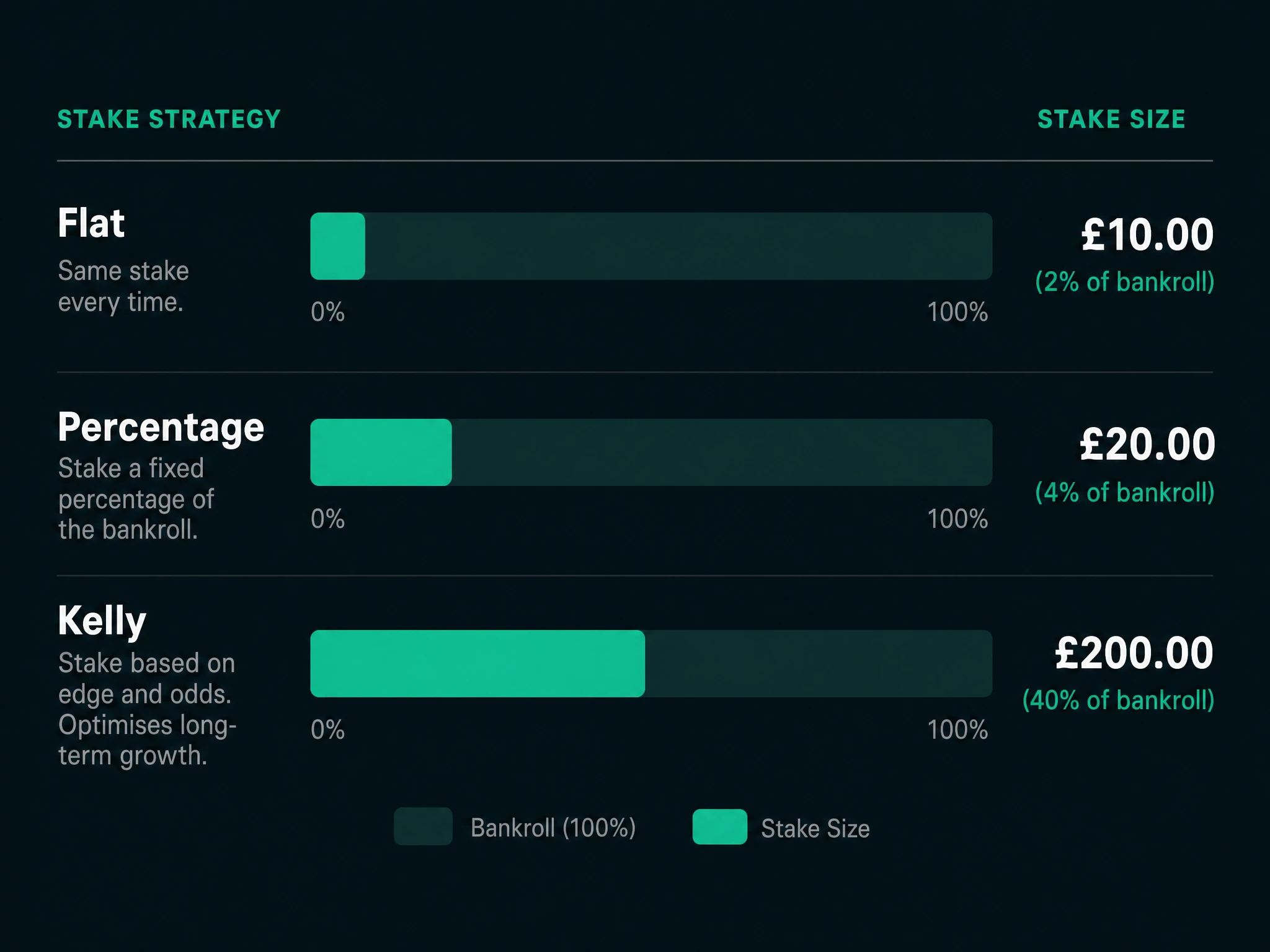
How the three plans behave over a run of results
A single bet only tells you the starting stake. What actually separates the three plans is how the stake moves as results come in. Take the same £1,000 bankroll, the same £20 flat and 2% starting units, and a quarter Kelly stake (roughly 1.17% of the bankroll, a quarter of that 4.67% full Kelly fraction), then run three losses in a row followed by a win at odds of 2.20.
| Bet | Result | Flat stake | Flat bankroll | Percentage stake | Percentage bankroll | Quarter Kelly stake | Quarter Kelly bankroll |
|---|---|---|---|---|---|---|---|
| Start | n/a | n/a | £1,000.00 | n/a | £1,000.00 | n/a | £1,000.00 |
| 1 | Loss | £20.00 | £980.00 | £20.00 | £980.00 | £11.67 | £988.33 |
| 2 | Loss | £20.00 | £960.00 | £19.60 | £960.40 | £11.53 | £976.80 |
| 3 | Loss | £20.00 | £940.00 | £19.21 | £941.19 | £11.40 | £965.40 |
| 4 | Win | £20.00 | £964.00 | £18.82 | £963.77 | £11.26 | £978.91 |
The flat stake never changes, £20 on every single bet, so the bankroll after the run is set purely by how many bets won and lost. The percentage and quarter Kelly stakes shrink on their own after each loss, £20.00 down to £18.82 for percentage, £11.67 down to £11.26 for quarter Kelly, so each loss costs a little less in cash terms than the one before it. The quarter Kelly stake is the smallest of the three throughout, which comes from that fraction being smaller than the flat and percentage unit on this particular edge, not from Kelly being inherently cautious. On a bigger edge, the Kelly stake would have started above the other two instead.
Why full Kelly is riskier than it looks
Full Kelly has a strong mathematical reputation. It's the stake that maximises the long-run growth rate of a bankroll, provided your win probability estimate is exactly right. That's the part that gets left out when Kelly gets recommended as simply "the best" staking plan.
In practice, nobody knows their true win probability to the decimal place. You're working from a model, a set of stats, or your own judgement, and that estimate carries error. Kelly's stake size grows directly with how big you think your edge is, so an overestimated edge doesn't just cost you a bit more, it compounds through every bet sized off that same wrong number. A model that says 52% when the real figure is 50% isn't a rounding error at Kelly stakes, it's the difference between a sensible bet and a bet that's too big for the edge that's actually there.
Full Kelly also produces bigger bankroll swings than most bettors can sit through, even when the edge estimate is correct. A string of losses that's entirely normal statistically can still cut a bankroll staked at full Kelly by a third or more before it turns around.
Fractional Kelly exists for a reason
Every version of Kelly above starts from one input: your estimated win probability. Get that wrong and the stake it recommends is wrong too, whatever fraction of Kelly you're running. That estimate is the same edge calculation behind expected value, so it's worth reading that alongside this page rather than treating Kelly's formula as a black box that turns any guess into a safe stake.
It's also worth remembering that a real edge doesn't mean a smooth ride. Variance and sample size covers why a genuine edge can still lose money over 50 or 100 bets, which is exactly why the staking plan matters as much as finding the edge in the first place. A stake sized too large for the edge you actually have turns normal variance into a bankroll problem.
Whichever plan you settle on, it's only worth anything if you can see what it actually did over time rather than judging it off the last few bets. A simple log of stake, odds and result against how to track your bets shows whether your chosen plan is behaving the way the maths says it should.
Staking plans FAQs
Which staking plan is best?
There's no single best plan for everyone. Flat staking is the simplest to run and easiest to audit. Percentage staking adjusts automatically for a moving bankroll without you having to remember to change anything. Kelly, run at a fraction, sizes the stake to your edge, but only helps if your probability estimates are good enough to trust. Consistency with whichever plan you pick matters more than which one you choose.
Is Kelly staking too risky for a normal bettor?
Full Kelly is too aggressive for most people, since it demands an accurate win probability and produces large swings even when that estimate is right. Fractional Kelly, half or a quarter of the full stake, is what most bettors who use Kelly at all actually run, because it cuts the swings a lot while giving up comparatively little long-run growth.
How do I work out my win probability for the Kelly formula?
It's the same edge estimate behind an expected value calculation: your own view of how likely the outcome is, checked against the odds on offer. There's no shortcut to a good estimate, it comes from research and a model or method you trust, and the Kelly stake is only as reliable as that number.
Why does percentage staking shrink automatically during a losing run?
Because the stake is calculated as a share of whatever the bankroll is at that moment, not a fixed cash figure. A 2% unit on £1,000 is £20; the same 2% unit on £900 after some losses is £18. The plan recalculates itself before you place the next bet.
Can I mix staking plans, for example flat for most bets and Kelly for a few?
Some bettors do use a smaller, flat confidence stake for most bets and reserve a Kelly-sized stake for the rare bet where they have real conviction in an edge. It's more to manage than picking one plan and sticking to it, but there's nothing wrong with it as long as the switching is planned in advance and not just how you feel on the day.