What to record for every bet
A bet log that actually teaches you something records nine things for every bet: the date, the event, the market, the selection, your stake, the odds you took, the closing odds, the result, and your running profit and loss. Most people log the first eight and skip the closing odds, which is the one field that tells you whether you are beating the market before the results catch up.
Team FootyMetrics
Updated Jul 2026 · 6 min read
- The essential fields are date, event, market, selection, stake, odds taken, closing odds, result and running P/L. Each one answers a question you will ask later.
- Closing odds is the field people skip and the one worth the most, because it lets you measure closing line value, a signal that shows up long before profit does.
- Tag each bet with the bookmaker and the bet type or market so you can slice the log later and see which markets actually make you money.
- A log only works if you fill it in every time. A log with the winners in and half the losers missing flatters you and teaches you nothing.
A bet log is only worth keeping if the fields in it let you answer a question later. “Am I any good at over 2.5 goals?” needs the market recorded. “Am I getting good prices?” needs the odds you took and the price the market closed at. “Am I actually up?” needs stake, result and a running total. Record the wrong things, or record them inconsistently, and you end up with a diary you can read but not learn from.
This page is about what to record and why each field earns its place. If you are still deciding where to keep the log, a spreadsheet or a dedicated app, that is a separate question covered on how to track your bets. The fields below matter whichever tool you land on.
The essential fields
Nine columns cover almost everything you will want to look back on. Each one is here because a review you will want to run later depends on it.
- Date. When you placed the bet. It is what lets you look at a month, a season, or the stretch after you changed your approach, rather than one undifferentiated pile of bets.
- Event. The match, so a row means something when you read it back. “Arsenal v Chelsea, 12 Jan” is a bet you can remember and check; “home win” on its own is not.
- Market. Match result, over/under, a player shots prop, and so on. This is the field that later lets you see you are quietly losing money on one market and winning on another. Skip it and every bet blurs into one number.
- Selection. What you actually backed, specific enough to know exactly what settled it. “Over 2.5 goals” not “goals”. If you cannot tell from the row what would have made it win, the row is too vague.
- Stake. How much you risked. Without it there is no profit and loss, and no way to tell whether a good month was good betting or just bigger bets.
- Odds taken. The price at the moment you placed the bet. This is what turns stake into potential return, and half of what you need to work out whether you are getting good prices.
- Closing odds. The market’s final price on the same selection, just before kick off. This is the other half, and the most valuable field in the whole log.
- Result. Won, lost, void or push, and the actual return. Record the actual return, since a void leg in an acca or a partial payout changes the number.
- Running P/L. A cumulative total down the column. One glance tells you where you stand, and it is what makes a losing run visible while it is happening rather than after.
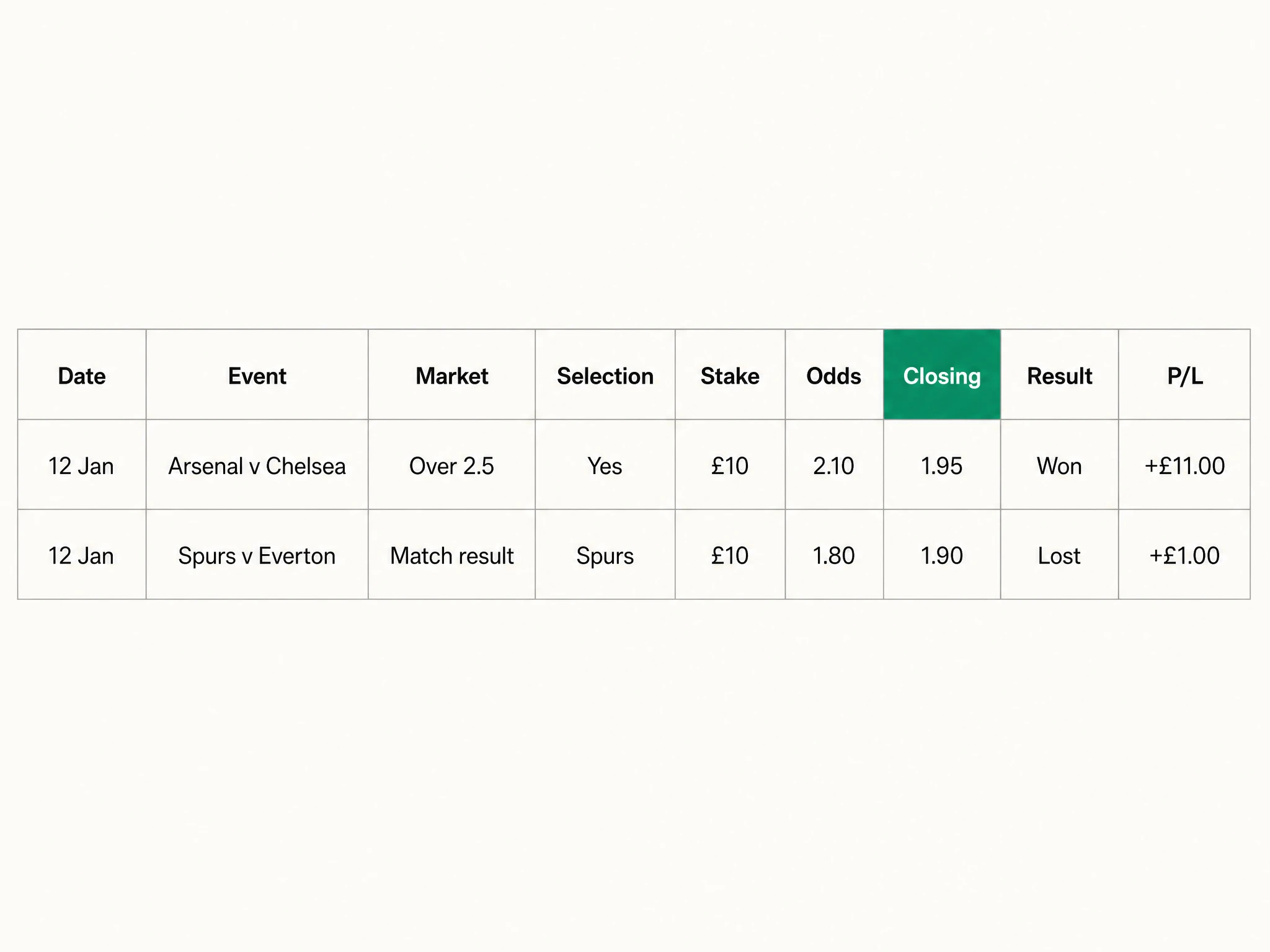
The field everyone skips: closing odds
If a log stops at the result, it is a record of what happened. The closing odds are what turn it into a tool for working out whether what happened was any good.
Closing odds are the market’s final price on your selection right before the event starts, after all the team news and betting money has moved the line. Comparing the price you got to that closing price gives you closing line value, and consistent positive CLV is one of the earliest signs that you are pricing games better than the market. It shows up in far fewer bets than profit does, because it strips out the luck of whether any single result landed.
That is the whole case for the column. Results tell you what happened; closing odds tell you whether you were on the right side of the price, which is the thing you can actually repeat. A bettor who beats the closing line for months but has run cold is very different from one who is up on luck alone, and the log is the only place that difference shows.
To record it, you note the odds and bookmaker when you place the bet, then check the same market again just before kick off and write down where it closed. It is one extra habit per bet, and it is the field people leave out precisely because it takes that bit of effort at kick off rather than at the moment of the bet.
Fields that turn a diary into an analysis tool
Beyond the essentials, a few tags cost nothing to add and change what the log can do. They are what let you slice it instead of just totalling it.
- Bookmaker. Which book took the bet. It tells you where you are getting your prices, it is what you check the closing line against, and over time it flags whether one account is where all your winning bets sit, which is worth knowing before that account gets restricted.
- Bet type. Single, double, accumulator, bet builder. Lumping a 12-fold acca in with your singles hides the fact that the accas are where the money goes.
- A market or category tag. A short label, “player props”, “corners”, “match result”, so you can filter. This is what lets you answer “how am I doing on player shots props specifically” instead of guessing.
None of these change how a bet settles. They change what you can ask the log afterwards. A plain list of bets tells you your total P/L. A tagged list tells you your P/L by market, by bookmaker, by bet type, which is where the useful lessons actually are.
Log the tag when you place the bet
How to review it
A log is only worth keeping if you read it, and the point of reading it is to find the pattern, not to relive the last result. Two numbers do most of the work.
The first is yield, your profit as a percentage of everything you staked, broken down by market. This is where the market tag pays off. A healthy overall yield can hide a market you are steadily losing on, propped up by one you are good at. Yield by market shows you where the edge actually is, and where you are donating.
The second is your average closing line value, treated as the leading indicator. Because CLV shows up in a smaller sample than results do, it is the number that tells you a cold run is bad luck rather than bad betting, or warns you that a hot run is not as solid as the P/L makes it look. Review after a meaningful batch of bets rather than after each one, since a handful of results tells you almost nothing either way. See variance and sample size for why the small samples lie.
- Yield by market, rather than only the overall total, so a losing market can't hide.
- Average closing line value across the batch, as the leading indicator.
- Running P/L over a real sample, not the last few results.
- Which bookmaker and bet type your profit is actually coming from.
See how your markets are trending
FootyMetrics tracks player and team form across 115+ leagues, so you can research the markets your log tells you to focus on.
The log only works if you fill it in
All of this depends on one unglamorous thing: logging every bet, every time, including the ones you would rather forget. This is the part that quietly breaks most logs.
Memory keeps the winners and loses the losers. A log with the good bets entered and the bad ones left for later is worse than no log, because it looks like data and reads like a story about how well you are doing. The running P/L will be wrong, the yield will be flattered, and the CLV will only reflect the bets you felt like recording. A messy, complete log beats a tidy, selective one every time.
The way to make it stick is to log the bet when you place it, not later. Fill in everything except the closing odds and result at the moment of the bet, add the closing odds at kick off, and settle the result when it comes in. Reconstructing a week of bets from memory on a Sunday is exactly when the losers go missing.
Bet log FAQs
What is the single most important field in a bet log?
Beyond the basics needed to work out profit, the closing odds. Recording the market's final price on your selection lets you measure closing line value, which signals whether you are beating the market well before your profit and loss does, because it strips out the luck of individual results.
What fields should I record for every bet?
Date, event, market, selection, stake, odds taken, closing odds, result and a running profit and loss total. Adding the bookmaker and a bet type or market tag lets you slice the log later by market or book, which is where the useful patterns show up.
Why should I record the closing odds?
Because comparing the price you took to the market's closing price gives you closing line value, and consistent positive CLV shows up in far fewer bets than profit does. It is the field that tells you whether a losing run is bad luck or bad betting.
How do I review my betting log?
Look at your yield broken down by market, so a market you are quietly losing on cannot hide behind one you are good at, and track your average closing line value as the leading indicator. Review after a batch of bets rather than after each one, since a small sample tells you very little.
Does a bet log need to be an app?
No. A spreadsheet with the same columns does the same job. The tool is a separate choice from what you record. What matters is that the fields are there and every bet gets logged.
Is it a problem if I miss logging some bets?
Yes, and it is the most common way a log becomes useless. Missing bets, usually the losers, flatter every number in the log: the running total, the yield and the CLV. A complete log with rough entries is far more useful than a neat one with gaps.