What is field tilt in football?
Field tilt is a team's share of the touches that happen in the attacking third, the final third of the pitch closest to the opposition goal. Add up every touch both teams take in that third, and field tilt is the percentage of them that belong to one side. A team on 70% field tilt is doing far more of its work in the dangerous area, even when overall possession is close to level.
Team FootyMetrics
Updated Jul 2026 · 6 min read
- Field tilt is one team's final-third touches divided by both teams' combined final-third touches, shown as a percentage. A touch means a pass, dribble, carry or shot in that zone.
- It's a better dominance signal than raw possession because possession counts every sterile pass in a team's own half, while field tilt only counts the touches that got play into the final third.
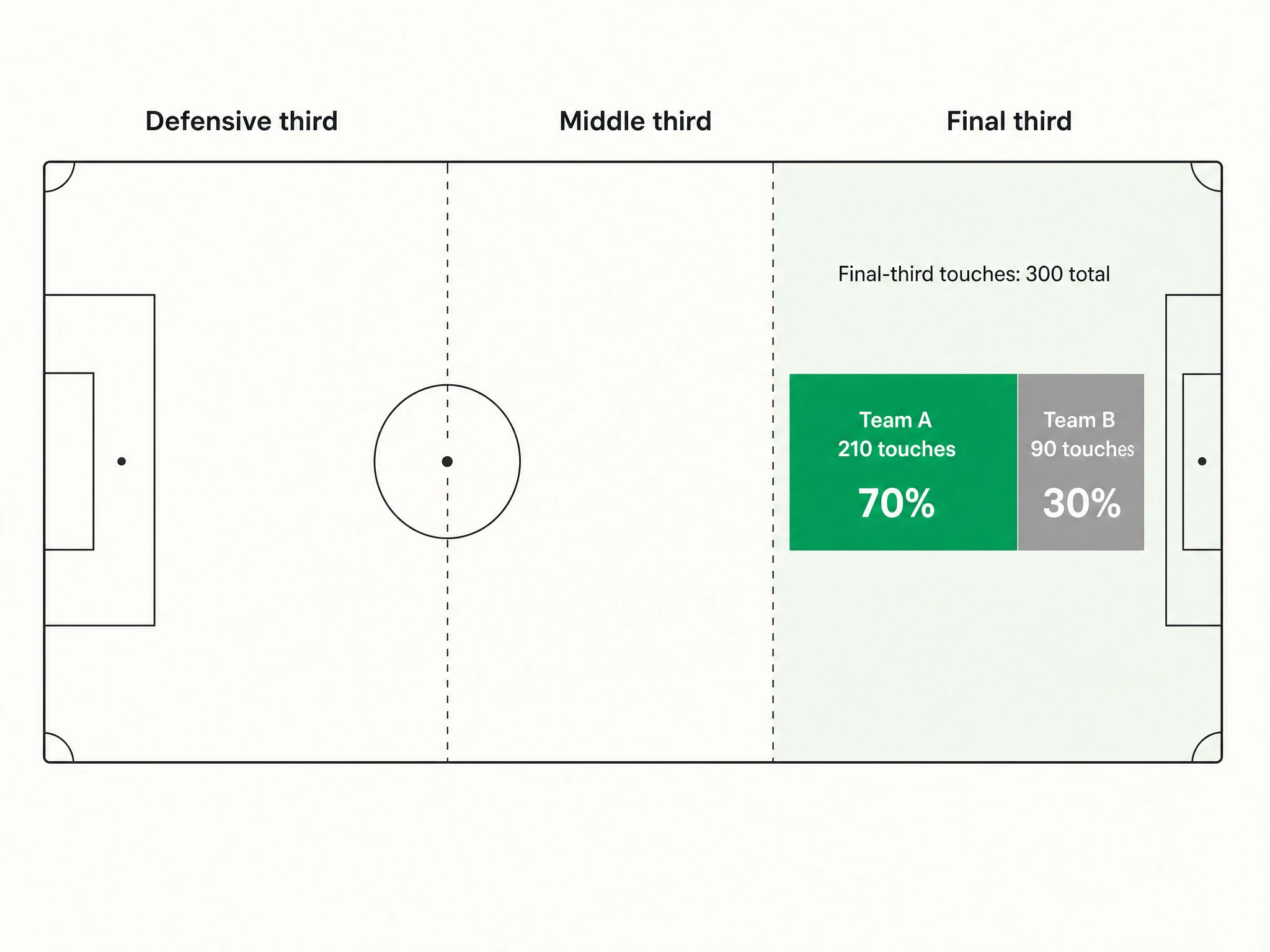
- Worked example: Team A takes 210 touches in the final third, Team B takes 90. The combined total is 300, so Team A's field tilt is 210 divided by 300, which is 70%.
- FootyMetrics does not track field tilt. We track total touches, touches in the box and possession for every side, which cover related ground.
What field tilt measures
Field tilt answers a narrow question: of all the ball activity in the final third, how much of it was yours? It ignores the rest of the pitch entirely. A pass between two centre-backs on the halfway line does not count. A pass, carry or shot inside the attacking third does.
The calculation is a share, not a raw count. Take every touch both teams record in the final third, then work out what percentage of that combined total belongs to each side. The two teams’ figures always add up to 100, the same way possession does. Driblab, a data analysis firm, describes it as looking at the last 35 metres of the pitch and working out what proportion of the touches and passes there belong to each team, so that a side might average 69.7% of the total in their worked example while the opponent takes the rest (driblab).
A touch for this purpose is any contact with the ball: a pass, a dribble, a carry or a shot. That is a wider net than passes alone, which is why some analysts quote field tilt on touches and others on passes. The two versions track each other closely because most touches in the final third are passes anyway.
Why it beats raw possession as a dominance signal
Possession has a well-known flaw. A team can hold 60% of the ball by knocking it side to side across its own half, never getting near the opposition box, and the possession number rewards that just as much as sixty minutes of pressure high up the pitch. It tells you how much of the ball a team had, not where.
Field tilt strips out that sterile passing. Because it only counts touches in the final third, a team that keeps the ball in its own half racks up possession but almost no field tilt. A team that spends the match pinning the opposition back scores high on field tilt even if its overall possession is closer to even. That is the point: field tilt is a proxy for territory, for which side spent the match camped near the goal that matters.
Two sides can finish a match on 51% and 49% possession and post a field tilt split of 70/30. The near-even possession says the ball changed hands a lot. The lopsided field tilt says one team did nearly all of its ball activity in the dangerous third while the other rarely got there. This is one reason modern analysis reaches for field tilt when the plain possession number looks level but the game clearly was not.
A worked example
Say a match produces 300 touches in the final third across both teams. Team A takes 210 of them, Team B takes 90.
Team A’s field tilt is 210 divided by 300, which is 70%. Team B’s is 90 divided by 300, or 30%. Team A did more than two-thirds of the final-third ball activity, so it controlled the attacking territory even if the two sides finished level on possession or shots.
The number on its own is a starting point, not a verdict. It tells you where the ball spent its time, not what came of it. A side on 70% field tilt still has to turn that territory into shots and goals, and plenty of teams dominate the final third without scoring.
How it relates to possession and PPDA
Field tilt sits alongside two metrics people already know.
Possession is the parent idea. Field tilt is essentially possession measured only in the final third, which is why it is sometimes called attacking-third possession share. The two are calculated the same way, as one side’s share of a combined total. Field tilt just narrows the pitch to the part that carries a threat.
PPDA comes at territorial control from the defensive end. It measures how many passes a team lets the opposition make before it tries to win the ball back high up the pitch, so a low PPDA means aggressive pressing. Field tilt and PPDA often move together: a team that presses hard tends to win the ball back in advanced areas, which pushes its field tilt up. They measure different things, one your pressing intensity and the other your share of attacking-third touches, but a high-press side usually scores well on both.
What field tilt doesn’t tell you
Field tilt has a real limit worth stating plainly. A team defending a lead can hand over field tilt on purpose. Sit deep, invite the opponent forward, soak up pressure and hit on the break, and you will finish the match with a low field tilt while being perfectly happy with how it went. The territory was ceded by design, not lost.
That is the counterattacking case, and it breaks the simple reading that more field tilt is always better. A side that bypasses the final third with one or two quick passes and scores from a fast break can win comfortably on a field tilt of 30%. So field tilt reads best next to the result and the chances: high field tilt with no shots is control without end product, low field tilt with two goals from three breaks is a plan working.
Read it next to the shots, not on its own
Does FootyMetrics track field tilt?
No. Field tilt, or attacking-third possession share, is not a stat FootyMetrics shows on the site right now.
We do track the touch data around it. FootyMetrics records total touches and touches in the box for every player and side, plus team possession percentage for every match. Those cover related ground: touches in the box tells you about final-third activity at the sharp end, and possession gives you the whole-pitch figure that field tilt refines. The final-third share itself is not something we publish.
Team trends
Possession, touches and the full range of team stats for every side, filtered by home, away and opponent.
Field tilt FAQs
What is a good field tilt percentage?
Anything clearly above 50% means a team did more of the final-third ball activity than its opponent. Dominant possession sides often sit in the 60% to 70% range across a match, while a team set up to counter can win comfortably on 30%. There is no single good number because it depends on how a team is set up to play.
Is field tilt the same as possession?
No. Possession counts a team's share of the ball across the whole pitch, including sterile passing in its own half. Field tilt only counts touches in the final third, so it measures territory near the opposition goal rather than overall ball control. A team can have high possession and low field tilt at the same time.
How is field tilt calculated?
Take one team's touches in the final third and divide by the combined final-third touches of both teams, then multiply by 100. If Team A has 210 final-third touches and Team B has 90, the combined total is 300, so Team A's field tilt is 210 divided by 300, which is 70%.
Does a low field tilt mean a team played badly?
Not necessarily. A team defending a lead or set up to counterattack often cedes field tilt on purpose, sitting deep and hitting on the break. A low field tilt with a win and a couple of goals is a plan working, not a poor performance.
Does field tilt count passes or touches?
It depends on who is measuring it. Some analysts count only passes in the final third, others count all touches, which includes passes, dribbles, carries and shots. The two versions track each other closely because most final-third touches are passes.
Does FootyMetrics show field tilt?
No, not currently. FootyMetrics tracks total touches, touches in the box and team possession percentage, but final-third touch share, which is field tilt, is not a stat shown on the site right now.