Acca boosts and enhanced multiples explained
An acca boost adds an extra percentage to your accumulator's winnings, and that percentage climbs with the number of legs: a small nudge on a four-fold, a much bigger one once you get into double figures. It is a bonus on a bet you were placing anyway, so it is genuinely free money when the acca lands. The catch is the small print and the maths behind why bookmakers can afford to give it away.
Team FootyMetrics
Updated Jul 2026 · 6 min read
- An acca boost pays an extra percentage of your winnings on a winning accumulator, and the percentage rises with the number of selections.
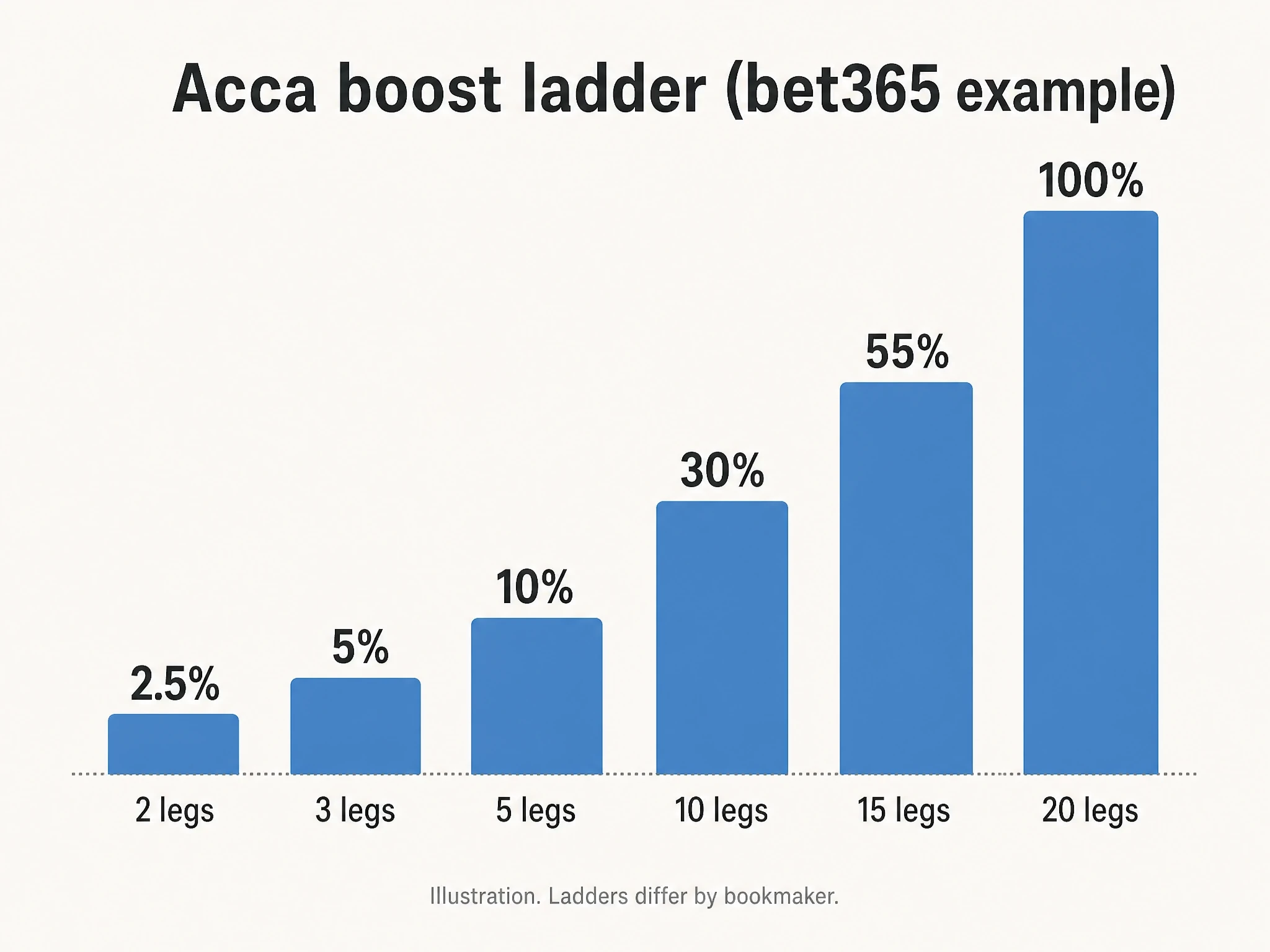
- bet365's Acca Boost runs from 2.5% on a double up to 100% on a 20-fold, with steps in between: a five-fold gets 10%.
- The boost applies to winnings, not your total return, and only when every leg wins. One losing leg and the boost is worth nothing.
- The extra margin baked into a long acca usually costs more than a modest boost hands back, so a boost rarely turns a long acca into good value.
What an acca boost actually is
An acca boost is a bonus a bookmaker adds to the winnings on a winning accumulator, with the size of the bonus tied to how many legs the acca has. It goes by a few names: acca boost, acca bonus, accumulator bonus, enhanced multiples. The mechanism is the same. Place a qualifying multiple, win every leg, and the bookmaker tops up your winnings by a set percentage.
The defining feature is the ladder. A two or three-leg acca gets a small boost. A ten-leg acca gets a much larger one, and the biggest accas get the headline percentages the offer is marketed on. bet365’s Acca Boost is the clearest published example. Its ladder runs from 2.5% on a double, 5% on a treble, up through the folds to 100% on a twenty-selection acca, and bet365’s own terms say the boost applies to the winnings on the accumulator, not the stake.
Here is the bet365 ladder as a reference point. Every bookmaker sets its own, so treat this as one real example rather than a universal standard.
| Selections | Boost |
|---|---|
| 2 (double) | 2.5% |
| 3 (treble) | 5% |
| 4 | 7.5% |
| 5 | 10% |
| 6 | 12.5% |
| 8 | 20% |
| 10 | 30% |
| 12 | 40% |
| 15 | 55% |
| 20 | 100% |
Paddy Power runs a flatter version: a 20% boost on winning accas of five folds or bigger, rather than a rising ladder. So even the shape of the offer differs by bookmaker. Some ramp the percentage up leg by leg, some apply one flat rate above a minimum number of selections.
A worked example
Take a £10 acca with five legs, each priced at 1.50. On bet365’s ladder a five-fold earns a 10% boost.
The five prices multiply together: 1.50 to the power of five is 7.59, so the combined odds are 7.59. A £10 stake at 7.59 returns £75.94 if all five land, which is £65.94 of winnings on top of your tenner coming back.
The boost is 10% of the winnings, not the total return. Ten per cent of £65.94 is £6.59. So the boost pushes your winnings from £65.94 to £72.53, and your total return from £75.94 to £82.53.
| Without boost | With 10% boost | |
|---|---|---|
| Stake | £10 | £10 |
| Combined odds | 7.59 | 7.59 |
| Winnings | £65.94 | £72.53 |
| Total return | £75.94 | £82.53 |
That £6.59 is real. When the acca wins, it is money you would not otherwise have had. The problem is everything you had to get past to collect it.
The small print that eats the value
Read the terms before you count the boost as value. The clauses that matter most:
- The boost is on winnings, not returns. A "10% boost" tops up the profit slice, not the whole payout. On the example above the profit slice is £65.94, so 10% of it is £6.59, not 10% of the £75.94 total. This is the same trap as a profit boost token, covered in profit boost and bet boost tokens explained.
- Minimum odds per leg. bet365’s boost does not apply if any selection is priced under 1/10, and other bookmakers set the floor higher, often around 1/5 or 1/4 per leg, to stop bettors padding an acca with near-certainties purely to unlock the boost.
- It pays only on a full win. Every leg has to land. One loser and the whole acca goes down and the boost with it. A boost does nothing to soften a loss, which is a different product from acca insurance, where you get a refund when a single leg lets you down.
- Maximum boost caps. There is a ceiling on the extra winnings the boost can add. bet365 caps it at £100,000, which almost nobody troubles, but smaller bookmakers cap far lower.
- Free bet stakes and cash out usually void it. Accas funded with a free bet often will not qualify, and cashing out early commonly cancels the boost, the same pattern seen across UK price and acca boosts generally.
None of these are hidden, but stacked together they narrow the offer to exactly what it is: a bonus on a specific kind of winning bet, on the bookmaker’s terms.
Why a small boost rarely covers the extra margin
Here is the part the marketing skips. Every leg of an accumulator carries the bookmaker’s overround, the built-in margin that makes a market’s prices add up to more than 100%. On a single bet that margin costs you a little. On an accumulator it compounds, because the legs multiply.
Go back to the five legs at 1.50. Suppose the fair, no-vig price on each of those selections was actually 1.60, so the bookmaker is shading each leg by about 6.7%. Small enough per leg. But those shaded prices multiply. Five legs at the fair 1.60 would combine to odds of 10.49, returning £104.86 on your tenner. The bookmaker’s offered price of 7.59 returns £75.94. The margin has quietly taken £28.92 of expected return off the bet before any boost is applied.
Now add the boost back. It lifts the return from £75.94 to £82.53. The 10% boost hands back £6.59. The compounded margin took £28.92. The boost recovers roughly a fifth of what the overround removed on this bet. The longer the acca, the worse this gets, because the boost climbs slowly while the margin compounds across every extra leg.
A boost is a rebate, not a route around the edge
When a boost genuinely helps
A boost is worth having in the cases where you were placing the acca anyway and the individual legs are priced close to fair. If you have found genuine value on each of four or five selections, checked each price against its fair, no-vig odds, and would back them regardless, then the boost is a clean extra on a bet that already stood up. Free money on top of a sound bet is always welcome.
Where it goes wrong is using the boost as the reason to build the acca in the first place. Adding a sixth or seventh leg to climb one rung up the ladder means adding another shaded price, and the extra margin on that leg almost always outweighs the couple of percentage points the ladder gives back. The boost should follow a bet you already wanted, never justify one you did not.
Pick acca legs on merit, not to climb the ladder
Fixture Scout surfaces the angles on a match so you are choosing each leg on its own merits, rather than padding an acca just to reach the next rung of the boost.
Acca boost FAQs
What is an acca boost?
An acca boost is a bonus a bookmaker adds to the winnings on a winning accumulator, with the size of the bonus rising as you add more legs. A small acca gets a small boost; a long acca can get a much bigger one. The boost only pays out if every leg wins.
Does an acca boost apply to my stake or just my winnings?
Just your winnings. bet365's Acca Boost, for example, applies to the winnings on the accumulator, not the stake. A 10% boost tops up the profit slice by 10%, not the whole return, so the cash figure is smaller than it first sounds.
How much is a bet365 acca boost?
bet365's Acca Boost runs on a ladder tied to the number of selections: 2.5% on a double, 5% on a treble, 10% on a five-fold, 30% on a ten-fold, up to 100% on a twenty-selection acca. The boost applies to the winnings and does not apply to any selection priced under 1/10.
Is an acca boost the same as acca insurance?
No. An acca boost pays extra on a fully winning acca. Acca insurance refunds your stake, usually as a free bet, when a single leg lets an otherwise winning acca down. A boost rewards a win; insurance softens a near-miss.
Does an acca boost make a long accumulator good value?
Rarely. Every leg carries the bookmaker's margin, and across a long acca that margin compounds. A modest boost usually hands back only a fraction of what the compounded overround has already removed from the bet's expected return, so a boost makes a poor-value acca slightly less poor, not good.
Do acca boosts work with free bets or cash out?
Usually not. Accas funded with a free bet often will not qualify for the boost, and cashing out a bet early commonly cancels it. Bookmakers also set a minimum price per leg, so you cannot pad an acca with near-certainties just to climb the ladder. Check the specific offer's terms.