What is the overround in betting?
The overround is what you get when you convert every price in a betting market to an implied probability and add them up: the total comes to more than 100%, and that excess is the bookmaker's built-in margin. A market that sums to 106% has a 6% overround, an edge the book is guaranteed if it takes stakes in the right proportion.
Team FootyMetrics
Updated Jul 2026 · 6 min read
- The overround is the amount a market's implied probabilities exceed 100% once every outcome is added up. It is also called the bookmaker's margin, the vig, or the juice.
- It exists because a bookmaker builds a profit margin into a market rather than pricing outcomes at their true probability.
- The size of the overround varies a lot by market type. A two-way or three-way market like match odds usually runs a tight overround. A market with dozens of outcomes, like first goalscorer, usually runs a much bigger one.
- Comparing the overround across bookmakers on the same market is one of the clearest ways to tell a competitively priced book from a soft one.
What the overround actually is
Every betting price converts to an implied probability. Divide 1 by the decimal odds and that is the chance the price is telling you the outcome has. Odds of 2.00 imply a 50% chance. Odds of 4.00 imply a 25% chance. Add up the implied probabilities of every possible outcome in a market and, with no bookmaker margin at all, they would total exactly 100%, because one of those outcomes has to happen and only one.
In practice they never total 100%. They come to somewhere above it, and that excess is the overround. A market priced at 106% has a 6% overround. That is not a rounding error, it is the bookmaker’s edge, built into the price on purpose so the book turns a profit regardless of which outcome wins.
The overround goes by several names depending on who is using it. Bookmakers and traders often call it the margin or the book percentage. American sportsbooks call it the vig, short for vigorish, or the juice. All three describe the same number: the amount the market’s implied probabilities exceed 100%.
Stripping that margin back out of a price to see the market’s true, no-vig probability is a separate step, covered in what are fair odds and, for the method itself, how to devig odds.
A worked example
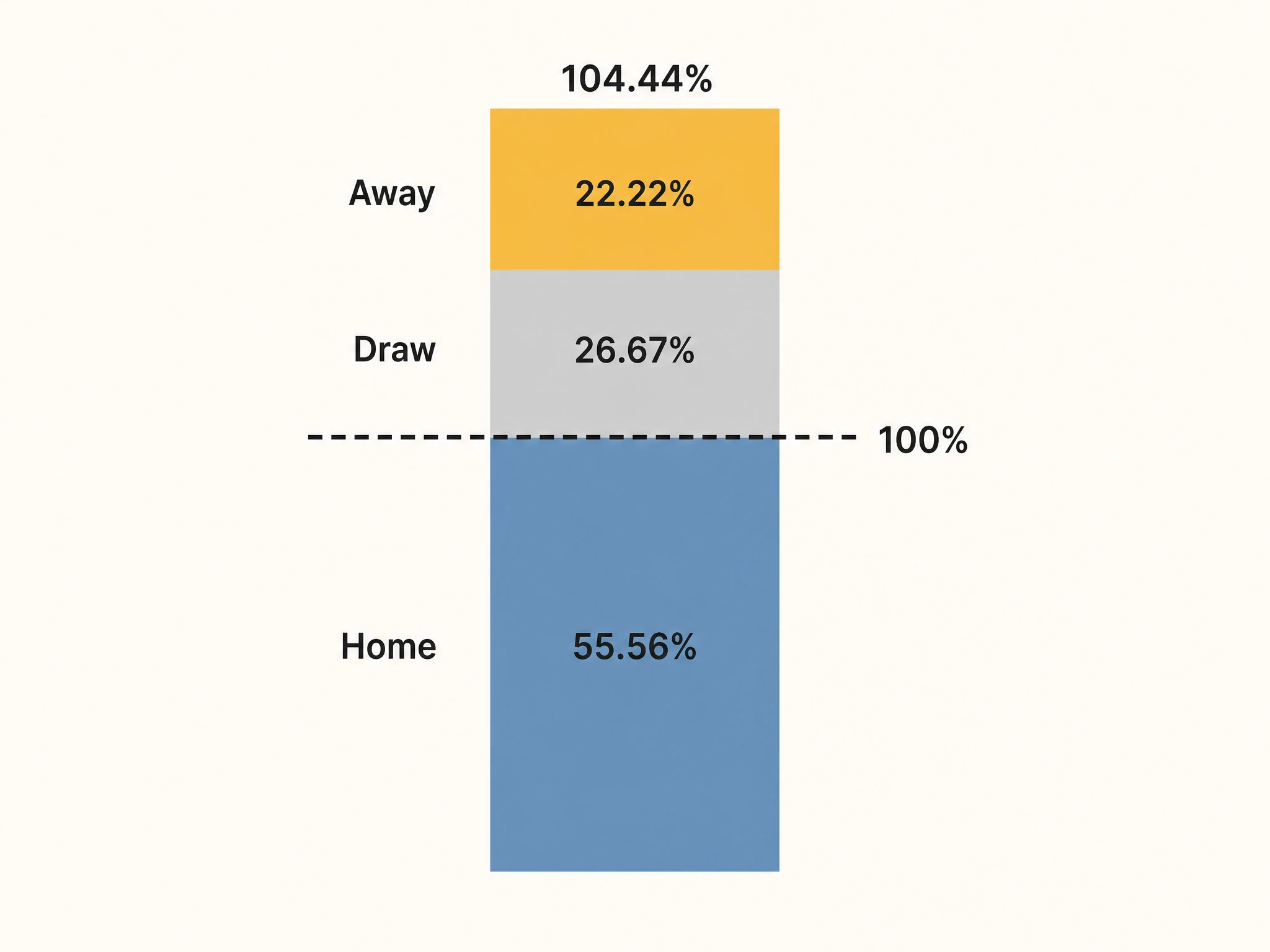
Take an illustrative three-way match odds market: Home 1.80, Draw 3.75, Away 4.50. These are not live prices from any bookmaker, just a clean example to show the maths.
| Outcome | Odds | Implied probability |
|---|---|---|
| Home | 1.80 | 55.56% |
| Draw | 3.75 | 26.67% |
| Away | 4.50 | 22.22% |
| Total | 104.44% |
Converting each price to an implied probability, 1 divided by the decimal odds: Home is 1 / 1.80, which is 55.56%. Draw is 1 / 3.75, which is 26.67%. Away is 1 / 4.50, which is 22.22%. Add those three together and the total is 104.44%, so 4.44 percentage points over 100%. The overround on this market is 4.44%.
What the gap means in cash
Say the book takes £100 in total stakes on that match, split across the three outcomes in proportion to their implied probability: £55.56 on Home, £26.67 on the Draw, £22.22 on Away. That adds up to £104.44 taken in total. Whichever result comes in, the payout is the same: £55.56 x 1.80 = £100, £26.67 x 3.75 = £100, £22.22 x 4.50 = £100. The book pays out exactly £100 no matter which outcome wins, against £104.44 taken in. That £4.44 difference is the bookmaker’s margin banked with certainty, regardless of the result.
Real books rarely see stakes land in exactly that proportion, which is part of why bookmakers shift prices during the run-up to a match, to balance their liability and keep that edge intact even when the betting public leans heavily one way. The overround is the bookmaker pricing itself a profit before a ball is kicked.
The overround formula
Why the overround varies so much by market type
Not every market carries the same margin, and the gap between markets is large. A two-way or three-way market like full-time match odds is usually the tightest, because it is the most heavily bet and most closely watched market on the board. Bookmakers know these prices get compared across several books in seconds, so they cannot afford to price them loosely without losing that business to a competitor.
Pinnacle Odds Dropper’s overround explainer gives a rough sense of the range: major football leagues typically run at 102 to 104%, tennis matches at 103 to 105%, and niche sports or lower-league football climb to 107 to 110%, with accumulators going higher still. The pattern is consistent: markets with less betting volume and less competitive pressure carry a bigger margin.
A first goalscorer market is the clearest example of why. Instead of three outcomes, it might have twenty or more, one for every player with a realistic chance of scoring, plus “no goalscorer.” Every extra outcome is another place for the bookmaker to shade the price a little in its own favour, and with dozens of outcomes those small shades stack up fast. A market like that can carry a total overround many times the size of a match odds book on the same fixture, because there are far more prices to pad and far fewer bettors checking each individual runner’s price against a rival book.
The same logic applies to correct score and half-time/full-time markets, both of which spread a large number of outcomes across a single football match. If you are betting a market with a long list of runners, expect the built-in margin to be a lot wider than the headline 1X2 price on the same game.
Comparing the overround to spot a sharp book
Because the overround is just arithmetic, anyone can calculate it for any market at any bookmaker, and doing that across a few books on the same match is one of the simplest ways to judge how competitively a bookmaker prices its lines. A book that consistently runs a tighter overround than its rivals on the same market is pricing closer to the true probability and taking a smaller cut to do it.
That is one of the practical signals bettors use to tell a sharp bookmaker from a soft one. See sharp vs soft bookmakers for the fuller picture, including how the two also differ in how they treat winning accounts, but margin is the part you can check yourself on any market in a couple of minutes: convert every price to implied probability, add them up, and see how far over 100% the total sits.
Fair odds with no overround baked in
FootyMetrics' player matchups tool builds a fair price for a stat market straight from a player's own record, not from a bookmaker's odds, so there is no margin sitting inside the number in the first place.
Overround FAQs
What is the overround in betting?
The overround is the amount by which a market's implied probabilities exceed 100% once every outcome's odds are converted and added together. It is the bookmaker's built-in profit margin, also called the vig or the juice.
Why do bookmaker odds always add up to more than 100%?
Because the bookmaker prices in a margin so the book turns a profit regardless of which outcome wins. If the odds summed to exactly 100%, the bookmaker would be offering the market at the true probability with no edge for itself.
Is the overround the same as the vig or the juice?
Yes. Overround, margin, book percentage, vig and juice all describe the same thing: the amount a market's prices exceed 100% once converted to implied probability. Vig and juice are more common in American sportsbook terminology, overround and margin in UK and European betting.
Why is the overround bigger on a first goalscorer market than a match odds market?
A first goalscorer market has far more outcomes than a two-way or three-way match odds market, often twenty or more. Every extra outcome is another price the bookmaker can shade in its own favour, and there is less competitive pressure on niche markets with fewer bettors comparing prices across books, so the margins stack up higher.
How do I calculate the overround myself?
Convert every outcome's decimal odds to an implied probability by dividing 1 by the odds, then add all of the implied probabilities together. Subtract 100% from that total and the result is the overround.
Does a lower overround mean better value for a bettor?
Generally yes. A tighter overround means the bookmaker is taking a smaller cut on that market, so prices sit closer to the true probability. It does not guarantee an individual bet wins, but comparing overround across books is a fair way to judge which one is pricing more competitively.