Turning odds into implied probability
Implied probability is the chance of an outcome that a set of odds suggests, before anything is stripped out. From decimal odds it's 1 divided by the odds, from fractional it's the denominator divided by the numerator plus the denominator, and American splits by sign. All three land on the same number for the same price.
Team FootyMetrics
Updated Jul 2026 · 6 min read
- Decimal to probability: 1 divided by the decimal odds. 2.50 gives 1 / 2.50 = 0.40, or 40%.
- Fractional to probability: denominator divided by (numerator plus denominator). 3/2 gives 2 / (3 + 2) = 0.40, or 40%.
- American to probability: positive odds use 100 / (odds + 100), negative odds use odds / (odds + 100) using the absolute value.
- The number you get still has the bookmaker's margin baked in. Every outcome in a market adds up to more than 100%, never exactly 100%.
What implied probability actually means
Every price a bookmaker posts is a statement about probability dressed up as a payout. Implied probability undresses it: it's the chance of that outcome that the price alone suggests, calculated directly from the number on the coupon.
It isn't the bookmaker's private view of the true chance. It's what you'd get if you assumed the price was a fair, honest reflection of probability with nothing added on top. In reality every price has the bookmaker's margin built into it, so the raw implied probability always comes out a bit higher than what the bookmaker actually thinks will happen.
If you haven't already, read how to read betting odds first. That page covers what decimal, fractional and American odds actually mean and how to convert between them. This page assumes you can already read a price in all three formats, and takes the next step: turning any of them into a probability.
Decimal odds to implied probability
The formula: implied probability = 1 / decimal odds.
Decimal odds are already a return multiplier, so inverting them hands you a probability directly. There's no other formula in this article that's simpler.
Worked example: decimal odds of 2.50. 1 / 2.50 = 0.40. As a percentage, that's 40%.
A second one: decimal odds of 1.50. 1 / 1.50 = 0.6667, which rounds to 66.7%. Shorter odds mean a higher implied probability, which is exactly what you'd expect: a price of 1.50 is saying that outcome is a lot more likely than a price of 2.50 does.
Fractional odds to implied probability
The formula: implied probability = denominator / (numerator + denominator).
A fractional price of 3/2 has a numerator of 3 and a denominator of 2. Add them together to get the total number of shares the bet represents, then the denominator tells you how many of those shares are the stake.
Worked example: 3/2. Denominator is 2, numerator plus denominator is 3 + 2 = 5. So 2 / 5 = 0.40, or 40%. That's the same 40% as decimal 2.50, because 3/2 and 2.50 are the same price written two different ways.
Worked example for a shorter price: 1/2. Denominator is 2, numerator plus denominator is 1 + 2 = 3. So 2 / 3 = 0.6667, or 66.7%, matching decimal 1.50 above.
American odds to implied probability
American odds need two different formulas depending on the sign, because positive and negative American odds describe the price in different units.
Positive American odds: implied probability = 100 / (American odds + 100).
Negative American odds: implied probability = American odds (as a positive number) / (American odds (as a positive number) + 100).
Worked example, positive: +150. 100 / (150 + 100) = 100 / 250 = 0.40, or 40%. Again, that's the same price and the same 40% as 2.50 decimal and 3/2 fractional.
Worked example, negative: -200. Take the 200 as a positive number: 200 / (200 + 100) = 200 / 300 = 0.6667, or 66.7%. Same price as 1.50 decimal and 1/2 fractional, same answer.
All three formats, side by side
Every row below is one price. Read across and the formula in the middle column produces the same result in the last column no matter which format you started from.
| Format | Price | Formula | Result |
|---|---|---|---|
| Decimal | 2.50 | 1 / 2.50 | 40.0% |
| Fractional | 3/2 | 2 / (3 + 2) | 40.0% |
| American | +150 | 100 / (150 + 100) | 40.0% |
| Decimal | 1.50 | 1 / 1.50 | 66.7% |
| Fractional | 1/2 | 2 / (1 + 2) | 66.7% |
| American | -200 | 200 / (200 + 100) | 66.7% |
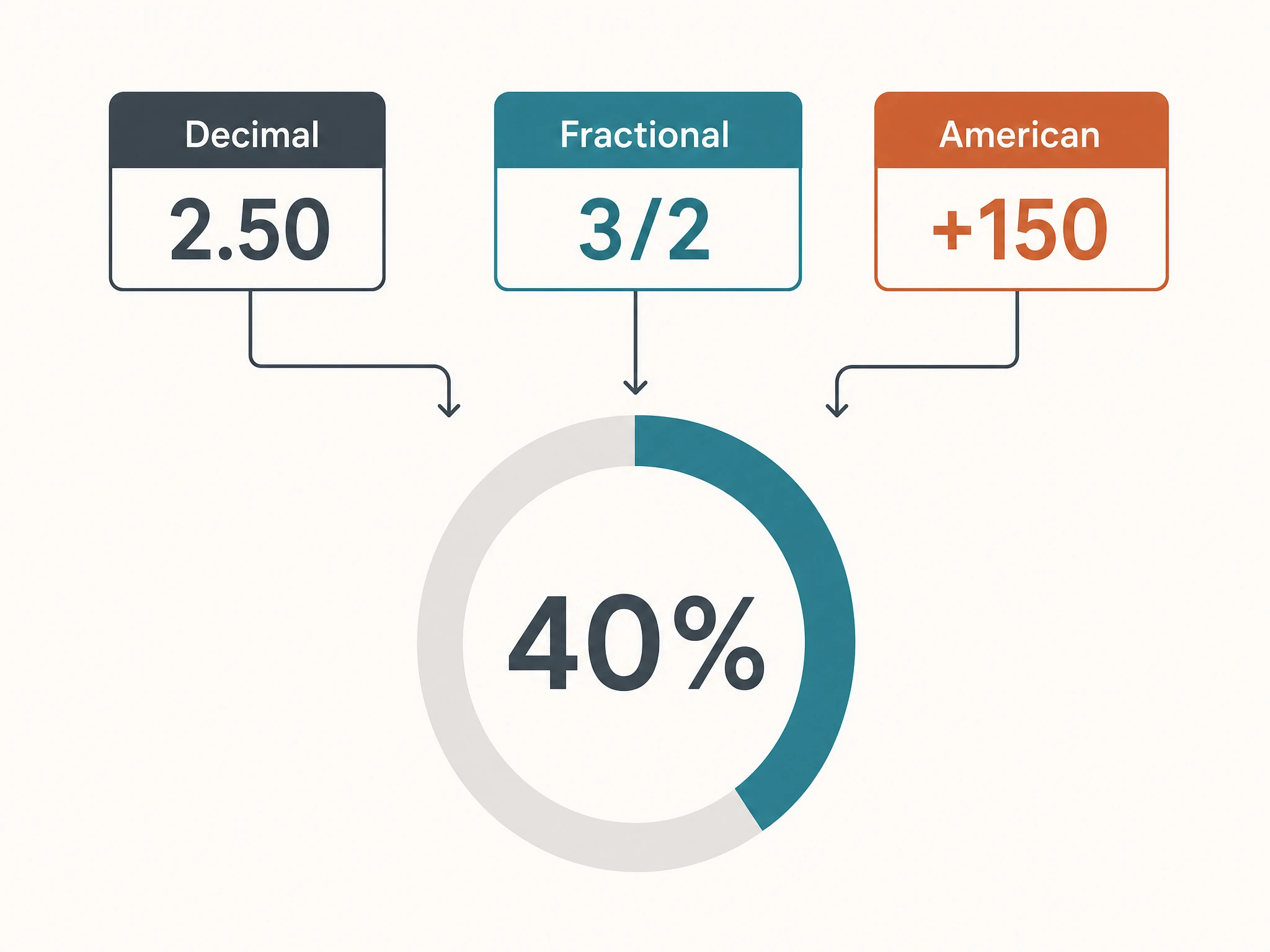
Whichever format a bookmaker happens to display, the underlying probability is identical, because the three formats are just different notations for the same price. If your maths gives you a different answer for the same price in two formats, you've either misread the price or made an arithmetic slip, not found a genuine discrepancy.
Why this number alone isn't the finished answer
Work out the implied probability for every outcome in a market and add them up. They come to more than 100%, every time, on every market, at every bookmaker.
Take a simple two-way market priced at 1.90 on each side. 1 / 1.90 = 0.5263, or 52.6%, for each outcome. Add the two together: 52.6% + 52.6% = 105.3%. There is no third outcome here, no draw, nothing missing. The market still doesn't sum to 100%, because the bookmaker has built their margin into the price on both sides.
This raw figure still has the margin in it
Getting from this raw number to the market's true, no-vig probability, the number with the margin properly stripped back out, is its own topic with its own maths. What is the overround? covers where that extra percentage comes from and how bookmakers size it. How to devig odds covers the actual working, stripping the margin back out so the probabilities of every outcome sum to exactly 100%. Read both once you're comfortable converting a price to its raw implied probability, since devigging starts from the number this page teaches you to calculate.
Fair odds, already devigged
FootyMetrics' fair odds tool applies the devigging step for you across every price on a match. Worth knowing the raw conversion by hand first, so you can see exactly what it's adjusting.
Implied probability FAQs
What is implied probability in betting?
Implied probability is the chance of an outcome that a set of odds suggests when read at face value. It's calculated directly from the price, 1 divided by the decimal odds, for example. It still includes the bookmaker's margin, so it isn't the same as the market's true probability.
How do you convert odds to a percentage?
Work out the implied probability first using the formula for that odds format, then multiply by 100. Decimal 4.00 gives 1 divided by 4.00, which is 0.25, or 25%.
Why don't implied probabilities add up to 100%?
Because bookmakers price in a margin, known as the overround, on every outcome in a market. A two-way market priced at 1.90 each way adds up to 105.3%, not 100%, because both prices have been shaded slightly against the bettor.
Is implied probability the same as true probability?
No. Implied probability is read straight off the price and includes the bookmaker's margin. True probability, sometimes called fair or no-vig probability, has that margin stripped back out so the whole market's probabilities sum to exactly 100%.
Which odds format is easiest to convert to probability?
Decimal. The formula is a single division, 1 divided by the odds, with no separate case for the sign and no fraction to reduce first. Fractional and American both need an extra step.
Do all three odds formats give the same implied probability for the same price?
Yes. Decimal 2.50, fractional 3/2 and American +150 are the same price written three different ways, and every one of them converts to 40%. If you get a different answer for what should be the same price, check the conversion, not the format.