How to devig odds
Devigging odds means converting each price to an implied probability, dividing every one of those probabilities by their combined total, then converting the result back into decimal odds. That last step strips the bookmaker's margin out and leaves you with the market's fair, no-vig price.
Team FootyMetrics
Updated Jul 2026 · 6 min read
- Devigging removes the overround from a set of odds so the probabilities sum to exactly 100% instead of something over it.
- The standard approach is the proportional method: divide each outcome's implied probability by the total of all implied probabilities in the market.
- Convert the result back to decimal odds with 1 divided by the fair probability, and you have a no-vig price for every outcome.
- The proportional method assumes the margin is spread evenly across outcomes. That is not always true, which is why other methods such as Shin's exist.
Take a real market. The overround is the gap that makes this necessary in the first place; devigging is how you close it back down to 100%.
The method in four steps
A bookmaker prices both teams to score (BTTS) at Yes 1.83, No 2.05.
Step 1: convert each price to an implied probability
Divide 1 by the decimal odds.
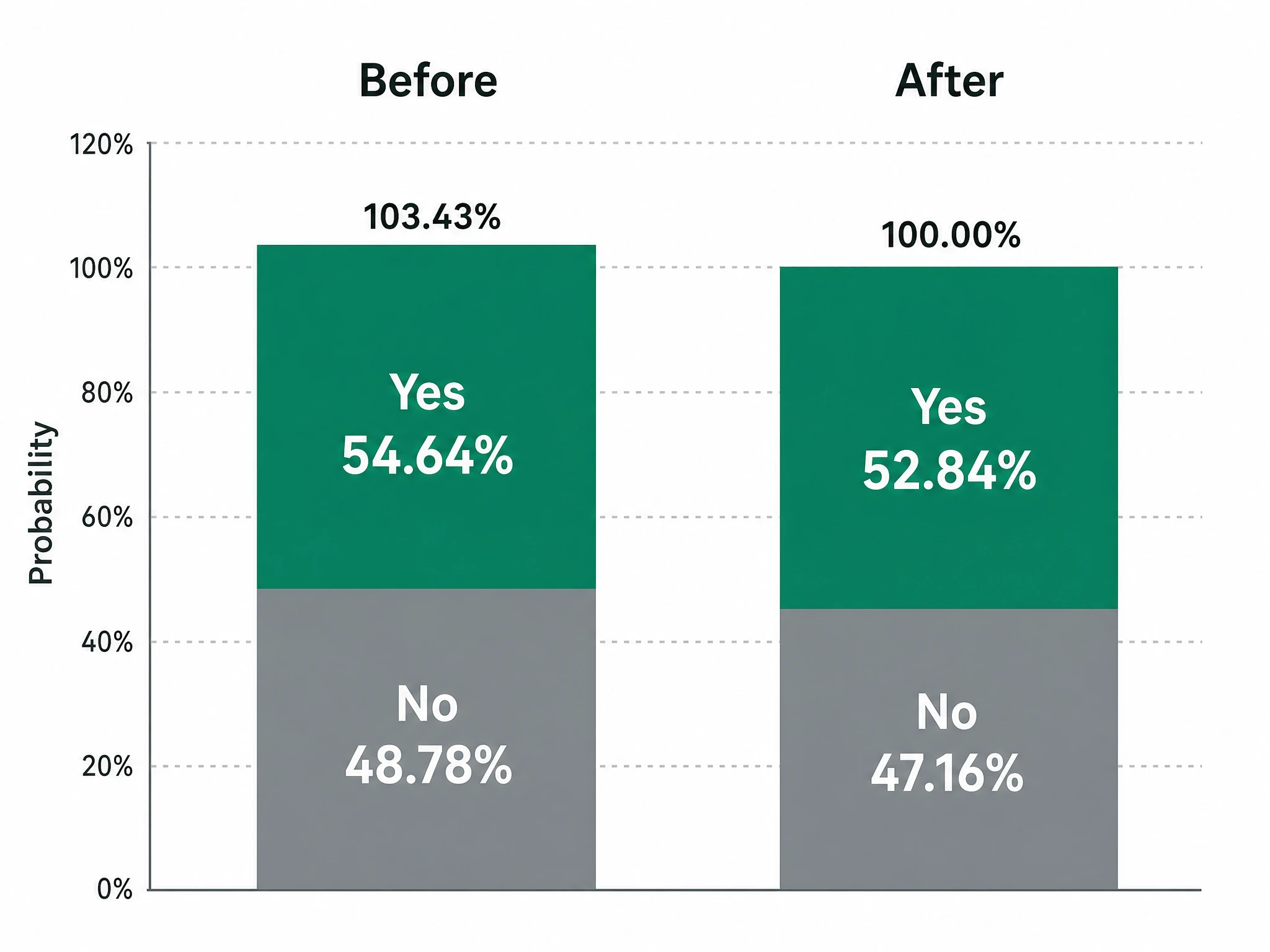
- Yes: 1 ÷ 1.83 = 0.5464, or 54.64%
- No: 1 ÷ 2.05 = 0.4878, or 48.78%
Step 2: add the implied probabilities together
54.64% + 48.78% = 103.43%
Since exactly one of "both teams score" or "not both teams score" has to happen, a margin-free market would sum to precisely 100%. This one sums to 103.43%, so the overround here is 3.43%, the bookmaker's built-in edge, spread across both prices.
Step 3: divide each implied probability by the total
This is the actual devig. It rescales both numbers down so they sum to exactly 100% again, in the same proportion to each other that they started with.
- Fair probability, Yes: 54.64 ÷ 103.43 = 0.5284, or 52.84%
- Fair probability, No: 48.78 ÷ 103.43 = 0.4716, or 47.16%
Check it: 52.84% + 47.16% = 100.00%. That is the proof the devig has worked.
Step 4: convert the fair probabilities back to decimal odds
Run the implied-probability formula in reverse: fair odds = 1 divided by the fair probability.
- Fair odds, Yes: 1 ÷ 0.5284 = 1.89
- Fair odds, No: 1 ÷ 0.4716 = 2.12
Both fair prices are longer than the bookmaker's actual prices, 1.89 against 1.83, 2.12 against 2.05, which is exactly what stripping a margin out should do. The book was always going to pay a little less than the true probability justified, on both sides at once.
That is the whole technique. A three-way market takes the same four steps with one more outcome in the sum.
A three-way market works the same way
The steps do not change with three outcomes instead of two, you are just summing and dividing across three implied probabilities rather than two. Say a match is priced Home 2.30, Draw 3.30, Away 3.10.
| Outcome | Bookmaker odds | Implied probability | Fair probability | Fair odds |
|---|---|---|---|---|
| Home | 2.30 | 43.48% | 41.00% | 2.44 |
| Draw | 3.30 | 30.30% | 28.58% | 3.50 |
| Away | 3.10 | 32.26% | 30.42% | 3.29 |
| Total | 106.04% | 100.00% |
Same arithmetic, one more row in the table. This is what most bettors mean when they say they have devigged a line: running these four steps and getting a no-vig probability and price for every outcome in the market.
Where the proportional method breaks down
The proportional method assumes the bookmaker has built its margin evenly across every outcome, in proportion to how likely each one is. In practice, a bookmaker does not have to price that way. It can load more margin onto the outcome the public backs hardest, typically the favourite or the draw, and less onto the side it expects less action on. When that happens, spreading the margin back out proportionally does not fully undo what the bookmaker actually did, and the resulting "fair" price is an approximation rather than an exact figure.
Shin's method and the alternatives
None of that changes what most people mean when they say "devig the odds": the proportional method above, run by hand or by a spreadsheet. It is the standard because it is simple and close enough for almost all practical use. Once you have a fair, devigged price, the next step is turning the gap between it and a live bookmaker price into expected value, and reading it against what fair odds actually mean. FootyMetrics runs the same idea from the other direction on player matchups, turning a player's own record into a fair price rather than starting from a bookmaker's line.
Devigging odds FAQs
What does devigging odds mean?
Devigging means removing the bookmaker's margin, the vig, from a set of odds so what is left reflects the market's true, no-vig implied probability rather than a probability with a built-in house edge.
What is the simplest way to devig odds?
The proportional method. Convert each outcome's odds to an implied probability, add all the implied probabilities in the market together, then divide each individual one by that total. The results sum to exactly 100% and convert back to fair decimal odds with 1 divided by each fair probability.
Do you devig odds before or after checking for value?
Before. A devigged, fair price is the benchmark you compare a live bookmaker price against. You devig one market, often a sharp, high-liquidity book, to estimate the true probability, then check whether a different, softer price on offer elsewhere is longer than that fair price.
Does devigging work on any number of outcomes?
Yes. The same four steps apply whether there are two outcomes, such as both teams to score, or three, such as a football match result with a draw, or more, such as a correct score market. You are always dividing each implied probability by the sum of all of them.
Is the proportional method exactly accurate?
No. It assumes the bookmaker's margin is spread evenly across outcomes in proportion to their probability, which is not always how a book actually prices a market. It is an approximation, a good one for most everyday purposes, but methods such as Shin's exist because that assumption does not always hold, particularly in three-way markets where the draw can carry a different share of the margin.
Can you devig odds from just one bookmaker's price?
Yes, that is the whole point of the method: it only needs the odds from a single market. The catch is that the fair price you get out is only as good as the odds you put in. Devigging a soft bookmaker's price inherits whatever pricing error sits in it, so a sharper, high-volume market tends to produce a more reliable fair price to start from.