Acca insurance: money back if one leg lets you down
Acca insurance refunds your accumulator stake if exactly one of your legs loses, on qualifying bets that meet the minimum number of selections and minimum odds. The catch most bettors miss is that the money almost always comes back as a free bet, not cash, so the refund is worth less than the stake it replaces.
Team FootyMetrics
Updated Jul 2026 · 6 min read
- Acca insurance pays you back if exactly one leg of a qualifying accumulator loses. Two or more losing legs and you get nothing.
- Bookmakers gate it: a minimum number of selections (commonly five or more), a minimum price on each leg, and a minimum combined price on the whole acca.
- The refund almost always arrives as a free bet, not cash, and a stake-not-returned free bet is worth well under its face value.
- Work out the real value before you rely on it: a £10 free bet used at even money is worth about £5 in cash terms.
What acca insurance actually is
Acca insurance is a bookmaker promotion that refunds your stake when one, and only one, leg of your accumulator loses. Land four out of five and the fifth lets you down, and you get your money back. It runs automatically on qualifying bets at the bookmakers that offer it, so there is usually nothing to opt into.
The line that trips people up is “one leg”. If two or more of your selections lose, the insurance does not pay. It is not a safety net that softens any losing acca; it only covers the specific case where a single result stops an otherwise winning bet. That is a much narrower promise than “money back on losing accas” makes it sound.
Coral and Betfred have both run acca insurance in this form, and Betfred’s current version, marketed as Acca Flex, refunds in cash instead of a free bet. Coral has since replaced its football acca insurance with other promotions. The version this page works through, and the one still running as a straight one-leg refund, is Ladbrokes’ acca insurance, whose own terms we quote below.
The qualifying rules
Every acca insurance offer sits behind a set of conditions. Miss any one of them and the bet is not covered, even if it loses by a single leg. Ladbrokes’ own promotion terms set them out plainly:
- Minimum selections. The acca must have “5 or more selections” on the eligible markets. A four-fold does not qualify.
- Minimum odds per leg. Each selection “must have minimum odds of 1/10 (before any odds boosts have been applied)”. That rules out heavy odds-on shots added purely to pad the bet.
- Minimum combined odds. “The entire accumulator must have combined odds of minimum 3/1.” A stack of short-priced favourites can fail this even with five legs.
- Eligible markets only. The offer applies to a defined list of markets (match result, both teams to score, correct score, over/under goals and similar), not every bet on the coupon.
These specific numbers are Ladbrokes’ rules. Other bookmakers set their own: a nine or ten-fold might be allowed two losing legs, an eleven-plus fold three, and the minimum prices and caps differ. Always read the promotion’s own terms, because the exact minimum legs, minimum odds and refund cap change from one bookmaker to the next.
Free bet, not cash, and why that matters
Here is the part that decides whether acca insurance is worth much at all. When your one-leg-down acca settles, Ladbrokes pays “Money Back as a Free Bet up to £/€10”, and the “Free Bet must be used within 7 days of it being credited to your account, otherwise, it will expire”. You do not get cash back into your balance. You get a token you have to stake again.
A free bet is worth less than the same amount in cash because most free bets are stake not returned. When a normal cash bet wins, you get your stake back plus the profit. A stake-not-returned free bet only pays the profit; the stake portion is never handed over, because it was the bookmaker’s token, not your money. The true value of a free bet is therefore below its printed face value, and the gap is widest at short odds.
That turns the headline into something smaller. “Money back if one leg lets you down” reads like you are made whole. In practice a £10 stake comes back as a £10 free bet, and a £10 free bet is not worth £10.
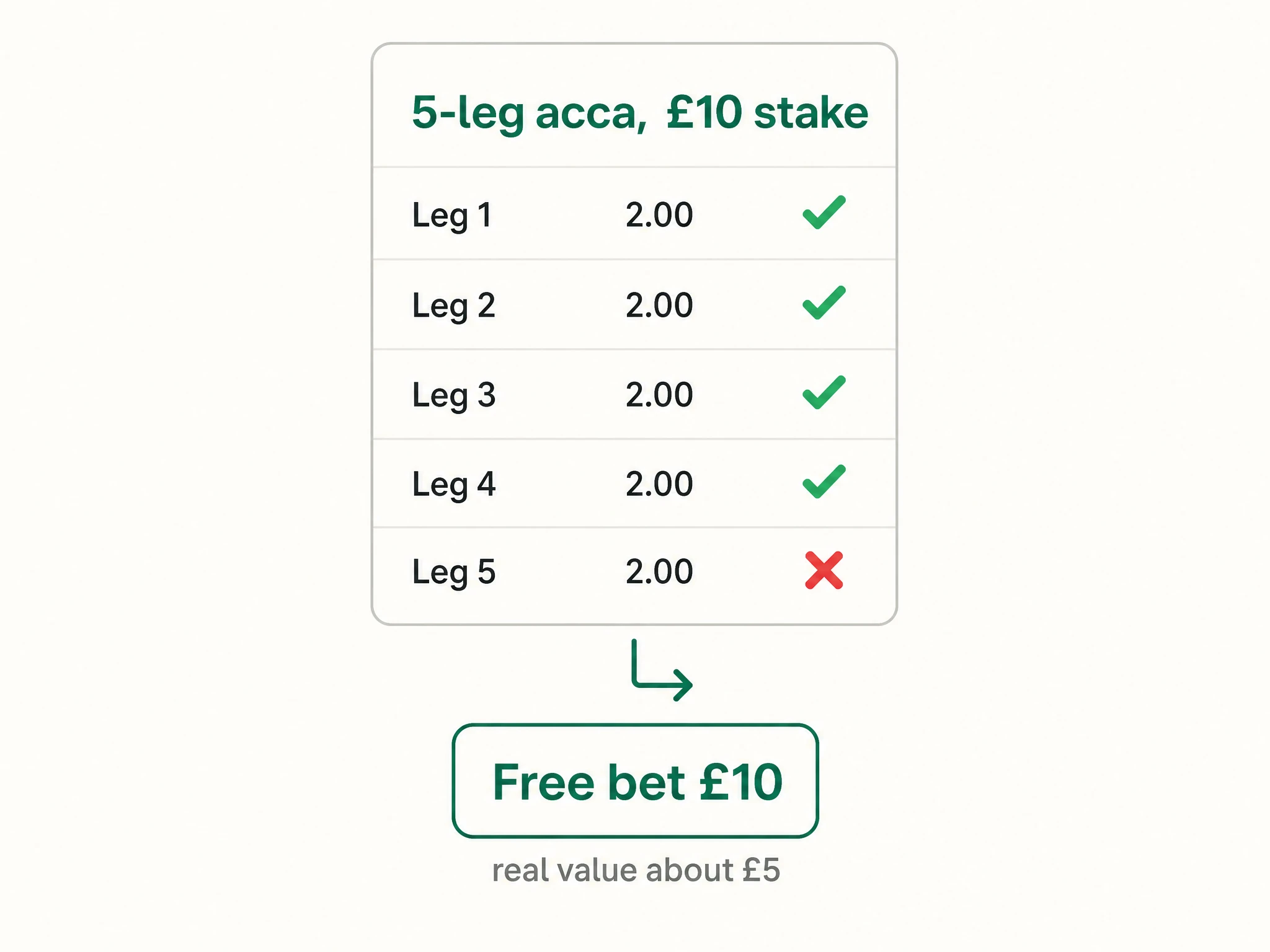
Worked example: what the refund is really worth
Take a five-leg acca, £10 stake, each leg priced at 2.00 (even money). Every leg clears the 1/10 minimum, and the combined price is 2.00 to the power of five, which is 32.00, comfortably above the 3/1 minimum. So the bet qualifies.
Four legs win, one loses. Your acca is dead, and acca insurance kicks in: your £10 stake comes back as a £10 free bet.
Now value that free bet. Say you use it on another even-money selection at 2.00. A stake-not-returned free bet’s real cash worth is face value multiplied by (odds - 1) divided by odds. At 2.00 that is £10 x (2.00 - 1) / 2.00, which is £10 x 0.50, or £5.
So the £10 stake you lost comes back as a token really worth about £5 if you use it at even money. The insurance covered roughly half your stake in cash terms, not all of it. Use the free bet at longer odds and it keeps more of its face value; use it on a short-priced favourite and it keeps even less. Either way, “money back” is not the same as your money back.
The other outcome the insurance ignores
How a void leg changes things
A void leg is not a losing leg. If one of your selections is voided (a game postponed, a market settled as void), that leg is removed and the acca reforms around the remaining selections at their combined odds. A five-fold with one void becomes a four-fold.
That matters for acca insurance because it can quietly drop you below the qualifying threshold. If the offer needs five or more selections and a void turns your five-fold into a four-fold, the bet may no longer qualify for the insurance at all, even though nothing you picked actually lost. A void can also pull the combined odds below the 3/1 minimum. The rules on how a void selection is treated sit in the promotion’s terms, so check whether a voided leg still counts toward the minimum before you lean on the cover. Our guide to void and dead heat rules explains how void selections are handled in an accumulator generally.
Build the acca before you trust the insurance
Check fixtures, form and prices across the coupon so your five legs are picks you'd back anyway, not padding to hit a promo threshold.
Working out if it’s worth it
Acca insurance is a real refund on a specific outcome, but its value is smaller than the face amount suggests, and it only applies to bets you were going to place on qualifying terms anyway. A few things to weigh:
- It pays only on exactly one losing leg. On most losing accas, more than one leg is wrong, so the insurance never triggers.
- The refund is a free bet, worth roughly half its face value at short odds and more at long odds. Value it with the free bet formula, do not treat it as cash.
- The qualifying rules can push you toward bigger accas or specific markets you would not otherwise pick. A promotion that changes your bet is a cost, not a freebie.
If you are comparing offers, acca insurance sits alongside acca boost, which adds a percentage to the winnings of a fully winning acca, and money-back specials, which refund single markets on defined events like a nil-nil draw. Insurance covers the near-miss; a boost rewards the full hit; a special refunds a named scenario. They solve different problems and often cannot be combined.
Acca insurance FAQs
Does acca insurance pay out if two of my legs lose?
No. Acca insurance only refunds when exactly one leg of a qualifying accumulator loses. If two or more selections lose, the bet is not covered and you get nothing back. Some bookmakers extend the cover to two losing legs on larger accas, for example a nine or ten-fold, but the standard offer is one leg only.
Is the acca insurance refund cash or a free bet?
It is almost always a free bet, not cash. Ladbrokes, for instance, pays money back as a free bet up to a set amount, and the free bet expires if it is not used within seven days. Betfred's current Acca Flex version refunds in cash instead, so it varies by bookmaker. Check the specific promotion's terms.
How many selections do I need for acca insurance?
Usually five or more. Ladbrokes' acca insurance requires an accumulator of five or more selections on eligible markets, with each leg at minimum odds of 1/10 and combined odds of at least 3/1. Other bookmakers set their own minimums, so read the offer's terms before placing the bet.
What is a £10 acca insurance free bet actually worth?
Less than £10 in cash. Most free bets are stake not returned, meaning a win pays the profit only and not the stake. A £10 free bet used at even money (2.00) is worth about £5 in real cash terms. Used at longer odds it keeps a bigger share of its face value.
Does a voided leg count toward acca insurance?
It depends on the bookmaker's terms. A void leg is removed and the acca reforms with fewer selections, which can drop you below the minimum number needed to qualify, or below the minimum combined odds. Check whether a voided selection still counts toward the qualifying threshold before relying on the cover.
Do I need to opt in to acca insurance?
Usually not. At bookmakers that run it, acca insurance applies automatically to qualifying bets, so there is no code to enter or box to tick. The refund is credited after all your selections have settled, typically within 24 hours.
Keep learning
Free bet true value
Why a stake-not-returned free bet is worth less than cash
Acca boost explained
The percentage ladder added to a winning acca's returns
Money-back specials explained
Single-market refunds on named events like a bore draw
Void and dead heat rules
How a void selection reforms an accumulator