Money-back specials: bore draw, first scorer and own goals
A money-back special refunds your stake when a named event happens, whether or not your bet wins. The classic football ones are the 0-0 bore draw refund on correct score and scorecast bets, money back if your first goalscorer pick scores but not first, and own-goal refunds. The trigger is usually rare, which is what makes the refund cheap for a bookmaker to run and easy to overvalue.
Team FootyMetrics
Updated Jul 2026 · 6 min read
- A money-back special pays your stake back if a specific event occurs, on top of whatever the bet itself does. The trigger is a single named thing, not a leg of an acca.
- The three common football versions are the 0-0 bore draw refund, first goalscorer money back if your player scores second, and own-goal refunds.
- The refund can come as cash or as a free bet, and that matters: cash is worth its full face value, a free bet is worth less.
- A refund only improves a price if you were close to taking it anyway. It lowers your break-even, it does not turn a bad price into a good one.
What a money-back special is
A money-back special is a bookmaker promotion that returns your stake when a specific, named event happens during the match. The refund sits on top of the bet. Your selection still wins or loses on its own terms, and separately, if the trigger fires, you get your stake back.
The trigger is one defined thing: the match finishing 0-0, your goalscorer pick scoring but not first, an own goal deciding a market. That is what separates these from acca insurance, where the refund is tied to one losing leg of a multiple. Acca insurance is covered on acca insurance explained. This page is about single-bet, event-triggered refunds.
The bore draw refund
The bore draw refund is the best known of the three. If the match finishes 0-0, you get your stake back on certain bets that a 0-0 would otherwise beat. It typically runs on correct score, half-time/full-time and scorecast markets, the markets where a goalless game kills almost every selection except the 0-0 itself.
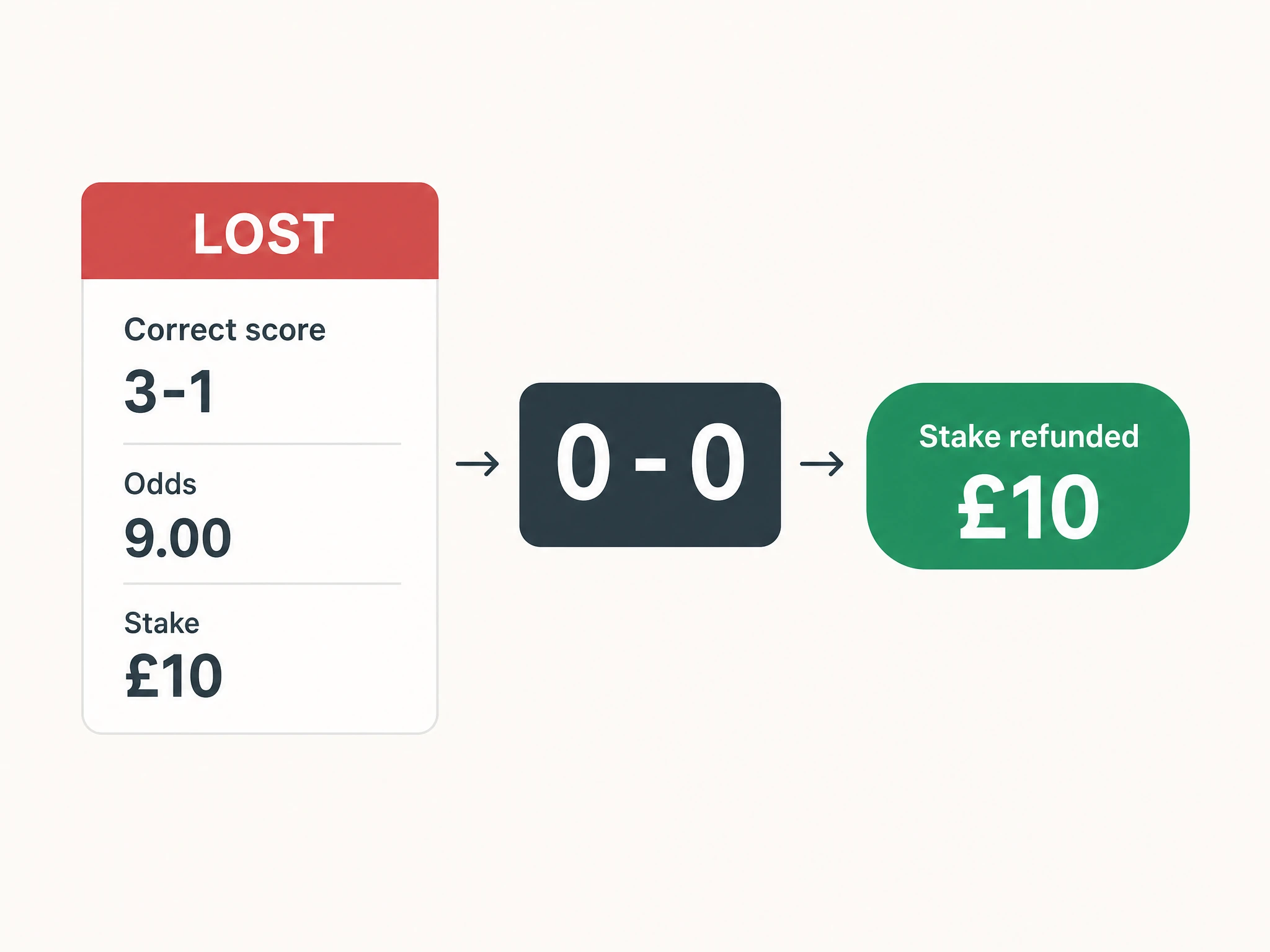
bet365 has run a Bore Draw Money Back offer of this shape, refunding losing correct score, half-time/full-time and scorecast bets as cash when the game ends 0-0, with no minimum odds and no maximum stake under the terms documented by advantage-play trackers. Because the refund is cash rather than a free bet, it is worth its full face value, which is unusual and generous for this kind of promo. Terms and the list of qualifying matches change, so the bookmaker’s own offer page is the only place to confirm the current rules before you rely on them.
The logic from the bookmaker’s side is simple. A 0-0 is uncommon, so the refund rarely triggers, and when it does the game was low scoring anyway, meaning most of the affected bets were correct score or scorecast lines that were never likely to land. The offer costs little and reads well.
First goalscorer money back
The first goalscorer refund covers the most annoying near miss in the sport: you back a striker to score the opening goal, they score, but a team-mate got there first. Under a first-scorer money-back offer, that outcome refunds your stake instead of settling as a loss.
The refund usually applies to the first goalscorer market only, not anytime scorer, and only when your player scores at any point after someone else has opened the scoring. If your player never scores at all, there is nothing to refund and the bet simply loses. Own goals normally do not count as the first goal for the purposes of the market, which is where own-goal rules and first-scorer rules meet. How the opening goal itself is credited is covered on goalscorer markets settlement.
First-scorer refunds are often paid as a free bet rather than cash. That is the single most important detail to check, because a £10 free bet is not worth £10.
Own-goal refunds
Own-goal specials come in two shapes. One refunds a first goalscorer or anytime scorer bet if the first goal of the match is an own goal, on the basis that an own goal is nobody’s goal and your player never got a fair shot at opening the scoring. The other, less common, refunds a market that an own goal decided, for example a bet that would have won but for an own goal at the other end.
These are the rarest triggers of the three, which is exactly why bookmakers can afford to offer them. Own goals are a small fraction of goals scored. The refund almost never fires, so it costs the bookmaker very little while adding a line of reassurance to the bet slip.
Cash refund or free bet
Every money-back special pays out in one of two forms, and the gap between them is large.
A cash refund is worth its full face value. Get £10 back as cash and you have £10 to do anything with, including withdraw it.
A free bet is worth less than its face value, because most free bets are stake not returned: if the free bet wins, you keep the profit but not the free-bet stake. A £10 stake-not-returned free bet used at odds of 2.00 is worth about £5 in real cash terms, and at longer odds it keeps a bigger share. The full breakdown, with the true-value formula, is on free bet true value. When you compare two money-back offers, a cash refund beats a free-bet refund of the same face value every time.
Check the payout form first
How a refund changes the price you are getting
A refund does not change the printed price. What it changes is your break-even, because some of the outcomes that used to cost you your stake now cost you nothing.
Take a first goalscorer bet at odds of 9.00 with a £10 stake, on a player covered by a money-back-if-they-score-second offer.
- Your player scores first: the bet wins, returning £90 for £80 profit.
- Your player scores, but not first: the bet loses, but the special refunds your £10.
- Your player does not score at all: the bet loses and there is no refund. You lose £10.
Without the offer, the middle outcome loses you £10. With it, that outcome costs you nothing. You now only lose money when your player fails to score at all, which is a smaller slice of the possible results. Your break-even win rate drops, so a price you would have passed on can become one worth taking.
The size of that improvement depends on how often the refund triggers. Here is the bore draw version costed over 100 identical £10 bets on a correct score line at odds of 9.00, using illustrative outcome counts to show the mechanic, not real 0-0 frequencies.
| Outcome | Bets | Without refund | With 0-0 cash refund |
|---|---|---|---|
| Selection wins | 12 | +£960 | +£960 |
| Loses, match 0-0 | 8 | -£80 | £0 (refunded) |
| Loses, not 0-0 | 80 | -£800 | -£800 |
| Net over £1,000 staked | 100 | +£80 | +£160 |
The wins are identical either way. The refund only touches the losing 0-0 bets, turning eight £10 losses into eight break-evens. That is £80 of downside removed across the hundred bets, which is what lifts the net result. The rarer the trigger, the smaller that number, which is why an own-goal refund moves your effective price far less than a bore draw one, and a bore draw one far less than something that fires often.
Factoring a special into whether a price is worth taking
Treat the refund as a small discount on your losing outcomes, not as free money. A few honest rules:
- Value the refund by its real worth, not its face value. Cash at face value, a stake-not-returned free bet at the reduced figure from free bet true value.
- Weight it by how often it triggers. A refund on a 0-0 is worth more than a refund on an own goal, because 0-0 happens more often than a deciding own goal.
- Never let the refund be the reason for the bet. If the underlying price is poor, a refund that fires once in twenty bets will not rescue it.
- Check the payout form and the qualifying market on the bookmaker’s own terms. Rules differ by bookmaker and change between promotions, so the offer page is the only reliable source for the current version.
Price boosts work on the same principle from the other direction: they change the number rather than the downside. Whether those are worth taking is covered on are price boosts good value.
Line up the fixture before you take the price
Use Fixture Scout to check form, likely goals and the shape of a game before deciding whether a refund is doing any real work on your bet.
Money-back specials FAQs
What is a money-back special in football betting?
A money-back special is a bookmaker offer that refunds your stake if a specific named event happens in the match, such as the game finishing 0-0, your first goalscorer pick scoring after someone else, or an own goal. The refund is separate from whether the bet itself wins.
How does the bore draw money back offer work?
If the match finishes 0-0, the bookmaker refunds your losing bet on qualifying markets, usually correct score, half-time/full-time and scorecast. It only applies when the bet loses, not when you back the 0-0 itself, and the exact markets and refund form are set by each bookmaker's own terms.
Is a money-back refund paid as cash or a free bet?
It depends on the offer. Some pay cash, which is worth its full value, and some pay a free bet, which is worth less because most free bets are stake not returned. Always check the offer's terms for which form applies before valuing it.
Does a first goalscorer refund apply if my player scores second?
Under a first-scorer money-back offer, yes: if your player scores at any point after another player has opened the scoring, the stake is refunded rather than lost. If your player does not score at all, there is no refund and the bet loses.
Do money-back specials make a bet good value?
Not on their own. A refund lowers your break-even by removing the downside on the triggering outcome, but it only helps if the underlying price was close to worth taking. A refund that rarely fires cannot rescue a poor price.
How is a money-back special different from acca insurance?
A money-back special refunds a single bet when a named event happens in the match. Acca insurance refunds a multiple when exactly one leg lets you down. One is triggered by an event, the other by a losing leg.
Keep learning
Acca insurance explained
Refunds tied to a losing leg of a multiple, not a single event
Are price boosts good value?
The other promo that changes your effective price
Free bet true value
Why a free-bet refund is worth less than its face value
Goalscorer markets settlement
How the first goal and scorer are credited