First, anytime and last goalscorer: how they settle
First goalscorer asks who scores the opening goal, anytime goalscorer asks whether a named player scores at all, and last goalscorer asks who scores the final goal. All three ignore own goals when deciding who counts as the scorer, and all three settle on 90 minutes plus stoppage time unless a match's own rules say otherwise.
Team FootyMetrics
Updated Jul 2026 · 6 min read
- First goalscorer only cares about the opening goal. Anytime goalscorer only cares whether a named player scores at all, at any point, and one goal is enough. Last goalscorer only cares about the final goal, which can't be confirmed until the match ends.
- Own goals don't count as anyone's goal for any of the three markets. For first goalscorer, if the opener is an own goal, the bet rolls on to the next goal rather than voiding.
- A goal that's given, celebrated and then overturned by VAR is treated as if it never happened, for all three markets. A bet placed live during the review itself is a separate, murkier case.
- Anytime goalscorer is the most forgiving of the three. First and last goalscorer are timing-sensitive in a way anytime isn't.
- If your player is substituted off before scoring, the bet normally just loses, unless the bookmaker offers a super sub-style protection that moves it onto the replacement.
These three markets draw from the same team sheet but ask for a different moment in the match. The detail worth getting right is what happens when the goal in question is an own goal, and what a VAR-overturned goal does to a bet already placed.
First, anytime and last goalscorer defined
All three markets rely on the same underlying goal-attribution rule that Opta’s data feeds settle on, covered in full on how goals are attributed. What changes between the three markets below is only which moment in the match is being asked about.
First goalscorer is a bet on which player scores the opening goal of the match, and nothing after that. Once that first goal goes in, the market is decided, whatever happens for the rest of the 90 minutes. A player who scores twice more later doesn't change anything if someone else got the opener.
Anytime goalscorer is a bet on whether a named player scores at all, at any point in the match. It doesn't need to be the first goal, the last goal, or a goal that changes the result. One goal settles it as a winner. A player who scores a second or third adds nothing extra to a straight anytime bet, since the market only asks a yes or no question.
Last goalscorer is a bet on which player scores the final goal of the match. Because the "final" goal can only be confirmed once the match has actually finished, this market can't settle early the way first goalscorer sometimes can. If the scoreline moves again after a leading goal, the market moves with it, right up to the final whistle.
- First goalscorer, the moment a genuine opening goal goes in.
- Anytime goalscorer, the moment the named player scores.
- Last goalscorer, since the final goal can't be confirmed until the match ends.
Own goals: the rule that trips people up
All three markets treat an own goal as no one's goal, for betting purposes. An own goal is not credited to any player as a scorer on any of the three markets, since it's the ball going into a team's own net rather than a player finishing a chance for their own side.
For anytime goalscorer, this is simple: an own goal just doesn't advance a bet on any named player, attacker or defender. It has no bearing on the market at all.
For first goalscorer, it's more consequential, because the market needs an opening goal to have a winner. If the first goal of the match is an own goal, the bet doesn't settle as void and it doesn't settle as a loser. It rolls on to the next goal that isn't an own goal, and settles on whoever scores that one. Sky Bet’s football goalscorer rules state this directly: if the first goal is an own goal, bets roll on to the next goal. Paddy Power’s own goals rules describe the same mechanic: an own goal does not count as a goal for settlement purposes, so a first goalscorer bet is settled on the next goal scored instead.
An own-goal opener rolls the bet on, it doesn't void it
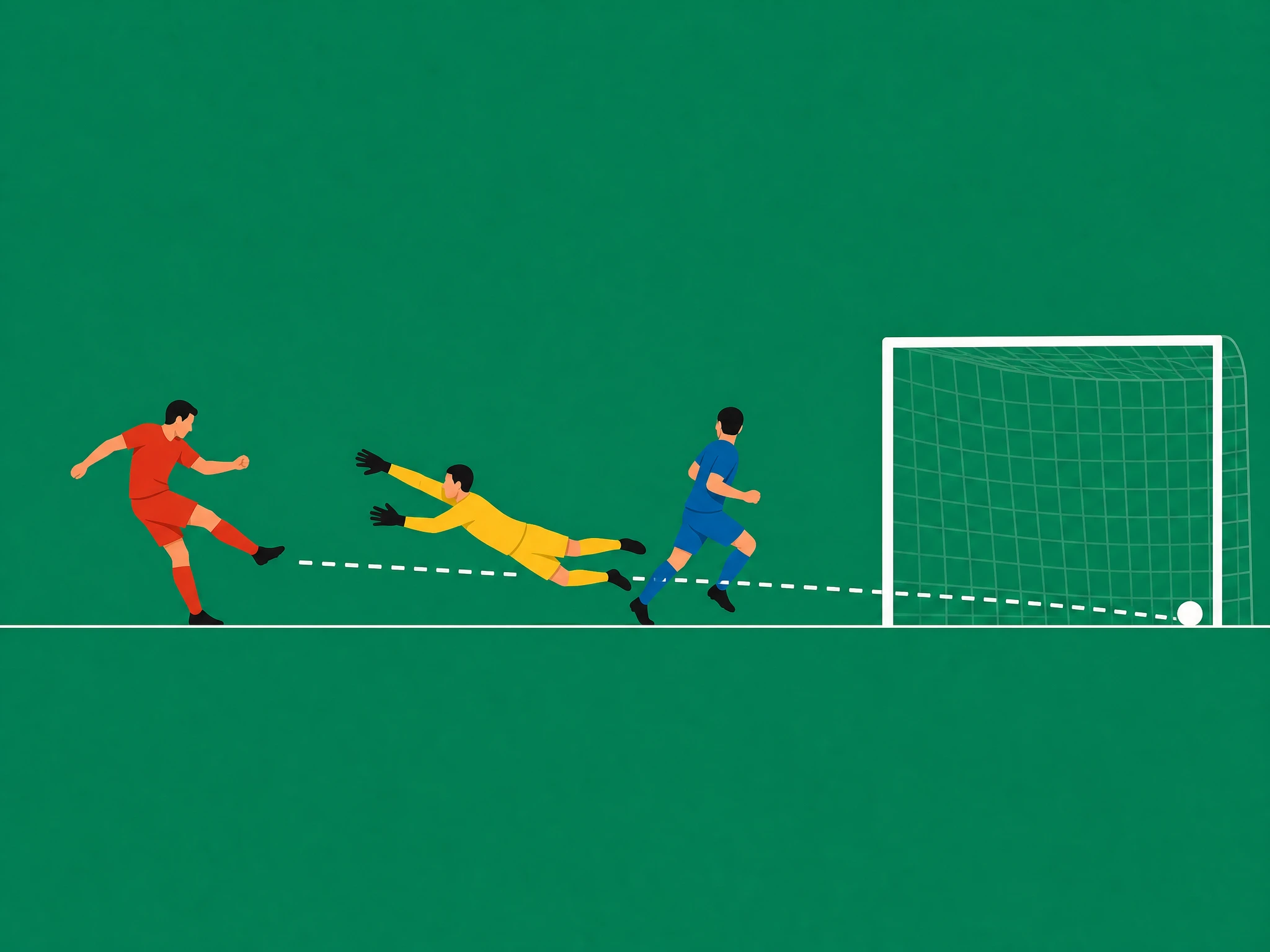
For last goalscorer, the same logic runs in reverse. An own goal doesn't count as the deciding last goal either, so if the final goal of the match is an own goal, settlement rolls back to whichever goal before it was scored by a player for their own side.
Both Sky Bet and Paddy Power also note that an own goal is judged on how it's recorded on the day of the match. A later reclassification by a dubious goals panel, sometimes changing a goal from a player's effort to a defender's own goal or the other way round well after the final whistle, doesn't reopen or resettle the bet. That mirrors how a clean sheet works too: it's whose net the ball ends up in on the day that counts, not a later ruling.
The VAR-overturned goal
A goal that's given, celebrated and then disallowed by VAR before the restart is treated the same way as a goal that was never given in the first place. It doesn't count for any goalscorer market, first, anytime or last, no matter how long the celebration lasted or how confident the scoreboard looked in the meantime. Only a goal that stands once play resumes counts for settlement. See how VAR works for what VAR can and can't review in the first place.
Where it gets genuinely murkier is a bet placed live, in the window between the goal being awarded and VAR reversing it. Betfair’s exchange rules state that where a material event such as a goal is cancelled following a video review, bets matched between the goal being awarded and the reversal being confirmed are voided.
This varies by bookmaker and bet type
Why anytime is the forgiving one
Of the three, anytime goalscorer asks the least of the timing. It doesn't matter if the goal comes in the first minute or the last, doesn't matter if the team is already winning or losing when it goes in, and scoring a second or third goal doesn't add anything beyond the first, but it also doesn't cost anything. First and last goalscorer are the opposite: they hinge on one specific goal in the match, decided either right at the start or only once the match has finished, and an own goal in the wrong place can change who wins either market without a single extra kick of the ball for the player concerned.
Check who's actually getting the goals
FootyMetrics tracks goals and shots for every player across 115+ leagues, whether it's a first goalscorer punt or a straight anytime bet.
If your player is subbed off before scoring
A subbed-off goalscorer bet is the other big way people lose these without realising it. Normally, if your player is withdrawn before they score, the bet just loses, same as if they'd played the full 90 minutes and stayed goalless. Several bookmakers offer a specific protection against this: bet365 (Sub On, Play On), William Hill (Impact Sub), Paddy Power and Sky Bet (Super Sub), and SBK (Fresh Legs) all cover first, anytime and last goalscorer among their listed markets, and will move the bet onto the substitute at the same stake and odds if your original player comes off. It isn't universal (check for the icon on the bet slip) and a straight red card doesn't trigger it the same way a substitution does. The full mechanics, every bookmaker's current name for it, and the exclusions are covered in the super sub offer explained.
90 minutes plus stoppage time, unless stated otherwise
All three markets settle on the result after 90 minutes of play, including any stoppage time added by the referee, unless the specific match's market rules state otherwise. Extra time and penalty shootouts in a cup tie don't usually count towards a standard goalscorer market by default. A goal scored in extra time doesn't retroactively become the last goalscorer of a match settled on normal time rules, and a shootout has no goalscorer market bearing at all under the standard rule. As with any market, it's worth checking the specific competition and bookmaker wording before assuming, particularly for cup fixtures that could go to extra time.
First, anytime and last goalscorer FAQs
Does an own goal void a first goalscorer bet?
No. If the first goal of the match is an own goal, the bet doesn't void. Sky Bet's goalscorer rules state that bets simply roll on to the next goal that isn't an own goal, and Paddy Power's own goals rules describe the same mechanic, settling on the next goal scored.
What happens if every goal in the match is an own goal?
First goalscorer settles as 'no goalscorer' if the only goals in the match are own goals, or if the game finishes 0-0. The same applies if a match somehow has only own goals scored in it, there's no player left for the bet to roll on to.
Does an anytime goalscorer bet need the goal to be decisive?
No. Anytime goalscorer is a straight yes/no on whether a named player scores at all, at any point in the match. It doesn't matter if the goal is the winner, an equaliser, or a goal in a match that's already decided, and scoring twice doesn't add anything beyond the first goal.
Does a goal disallowed by VAR count for a goalscorer bet?
No. A goal that's given, celebrated and then overturned by VAR before the restart is treated as if it never happened, for first, anytime and last goalscorer alike. It gets more complicated for a bet placed live during the review itself, since some bookmakers and exchanges void bets matched in that window specifically, so check the in-play rules for wherever the bet was placed.
Do goalscorer bets include extra time?
Not by default. All three markets settle on 90 minutes plus stoppage time unless the specific match's rules say otherwise, so extra time and penalty shootouts in a cup tie don't usually count towards a standard goalscorer bet.
What happens to a goalscorer bet if the player is subbed off?
Normally it just loses, the same as if they'd stayed on and not scored. Several bookmakers offer a specific exception to this: bet365's Sub On, Play On, William Hill's Impact Sub, Paddy Power and Sky Bet's Super Sub, and SBK's Fresh Legs all list first, anytime and last goalscorer among the markets they cover, moving the bet onto the substitute at the same stake and odds instead.
Can a first or anytime goalscorer bet settle before full time?
Yes, for those two markets specifically. First goalscorer settles the moment a genuine opening goal goes in, and anytime goalscorer settles the moment the named player scores, whatever the clock says at that point. Last goalscorer is the exception: it can't settle until the final whistle, since the final goal isn't confirmed until the match actually ends.
Keep learning
How goals are attributed
The rule behind deflections and own goals
How does VAR work?
What VAR can and can't review
The super sub offer explained
What happens if your goalscorer is subbed off
Player goals trends
Who's actually finding the net, across 115+ leagues
Extra time and penalty shootouts
Why these markets settle on 90 minutes only