Extra time and penalty shootouts explained
In a knockout match still level after 90 minutes, extra time adds two more 15-minute periods. If the teams are still level after that, a penalty shootout decides who goes through, but it does not change the result of the markets that had already settled at 90 minutes.
Team FootyMetrics
Updated Jul 2026 · 6 min read
- Extra time is two periods of 15 minutes each, 30 minutes total, played when a knockout match is level after 90 minutes and the competition needs a winner.
- A penalty shootout follows if the score is still level after extra time. Each team takes turns, normally five kicks each, and it can end early once one side has an unassailable lead.
- Only players on the pitch, or temporarily off it for treatment, at the end of extra time can take part. A player already substituted off cannot come back on to take a kick.
- Most standard match markets, including match result and correct score, settle on 90 minutes. A shootout breaks the tie for the competition, it does not overturn those markets.
The two things people get wrong most are assuming every level cup tie goes to extra time, and assuming a shootout changes the 90-minute result. Neither is true. Extra time only happens where the competition’s own rules say so, and a shootout decides who goes through, not how the match markets settle.
How long extra time actually is
Extra time is two periods of 15 minutes each, 30 minutes in total, played when a knockout match finishes level after 90 minutes and the competition rules require a winner on the day. IFAB's Law 7 sets this out directly. Both periods are always played in full, including any added stoppage time, even if one side goes ahead early.
That is different to how it used to work. Football had a golden goal rule that ended the match the instant a goal went in during extra time, but IFAB abolished that in 2004 after it was found to make teams play more cautiously rather than less. There is a short break before extra time starts and another when ends are switched at the 15-minute mark, plus a brief drinks break allowed at that same interval.
Not every level knockout match goes to extra time. Some cup formats settle a level match straight from penalties with no extra time played at all, so it depends on the specific competition's rules, not one universal format.
The shootout procedure
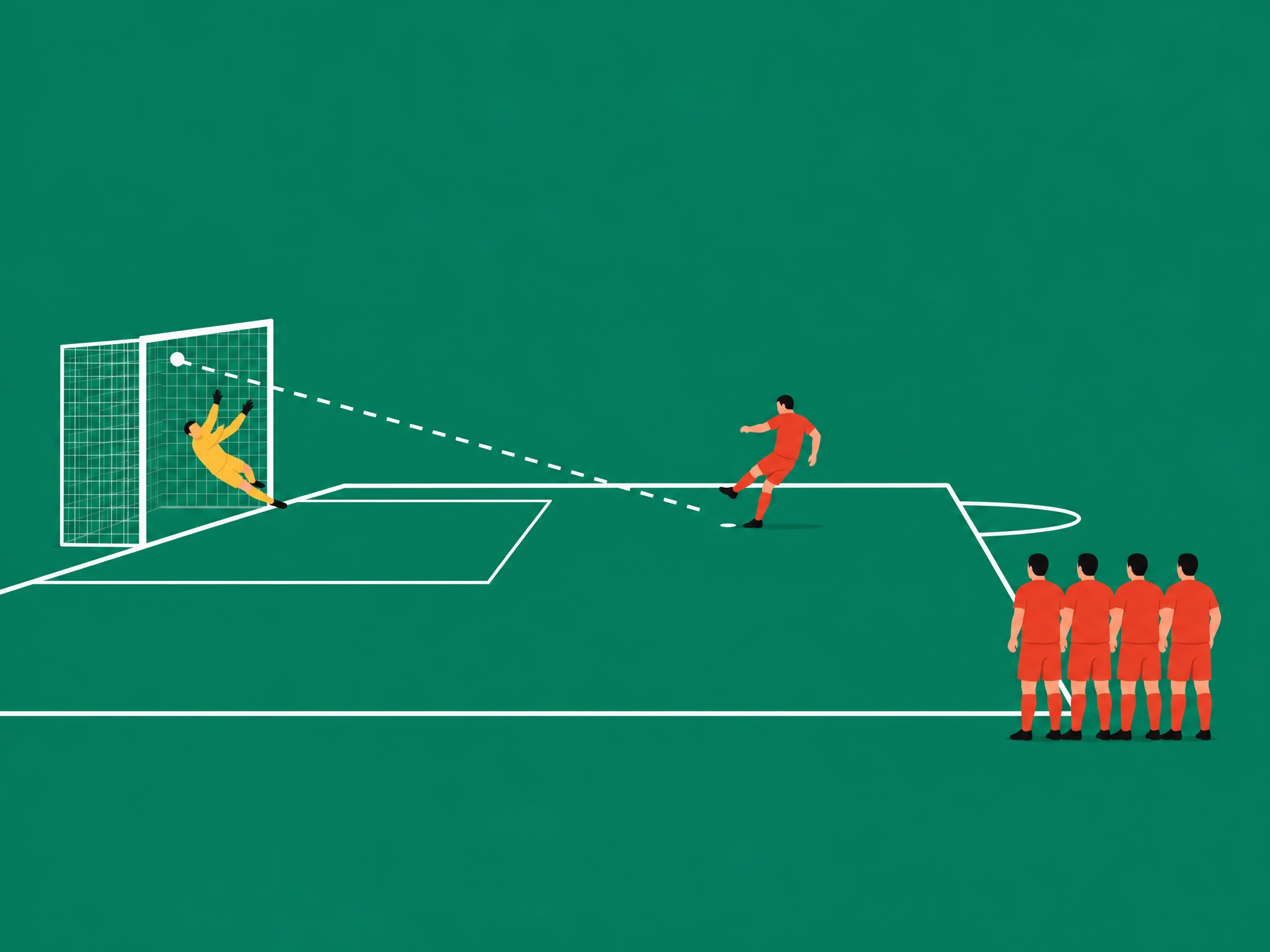
If the score is still level after extra time, the match is settled by kicks from the penalty mark. Each team takes turns, alternating kicks, normally five each, taken by different players. The team that scores more of its five kicks wins.
It does not always take the full five each. Under IFAB's Law 10, once one team has scored more goals than the other could reach even by completing all five kicks, the shootout stops there. A team leading 4-0 after four kicks each, for example, has already won regardless of what the fifth kick would do, so it is not taken.
If the teams are still level after five kicks each, the shootout moves into sudden death, one kick each per round, continuing until one team has scored and the other has not from the same number of kicks taken.
Is the ABBA penalty order still used?
The standard order alternates kicks between the two teams: team A takes the first kick, team B the second, and so on. IFAB trialled an alternative order called ABBA in 2017, modelled on the serving sequence in a tennis tiebreak, where team A takes the first kick, team B takes the second and third, team A the fourth and fifth, and so on. The idea was to remove the psychological edge of always kicking first.
Some competitions used the ABBA trial during that period, but IFAB dropped it as an option in November 2018 after finding limited support, mainly because of how complicated it was to apply in practice. The standard alternating order is what is used now.
Don't assume ABBA is the current rule
Who can take a penalty
Only players who are on the pitch, or temporarily off it for an allowed reason (receiving treatment for an injury, sorting out equipment) at the end of the match, are eligible to take part in the shootout. A player who has already been substituted off during normal time or extra time cannot be brought back on to take a kick.
There is one specific exception. If a goalkeeper is unable to continue before or during the shootout, they can be replaced, either by an outfield player already on the pitch to even up the sides, or, if the team has not used all its permitted substitutions, by a named substitute from the bench. The goalkeeper who was replaced takes no further part and cannot take a kick themselves. For the wider rules on who can come on and when, see the substitution rules page.
A player sent off at any point in the match takes no part in the shootout, and if one team finishes with fewer eligible players, the other side must reduce to the same number before kicks start. What a red card means for the matches that follow is covered on red card suspensions.
Do betting markets include extra time and shootouts?
Most standard match markets, including match result and correct score, settle on the score after 90 minutes plus stoppage time. This is the same "90 minutes means 90 minutes" convention covered on win to nil explained and what is a clean sheet, so it is not repeated in full here. Extra time and any penalty shootout that follows do not change how those markets settle. A shootout exists to decide which team goes through to the next round of the competition, not to alter a full-time scoreline that has already been fixed for betting purposes.
This means a correct score bet on the standard 90-minute market is already settled at full time, win, lose or void depending on the actual scoreline, regardless of what happens afterwards. A separate market, often labelled something like "correct score after extra time" or built into a "to qualify" market, exists for punters who specifically want a bet that accounts for extra time or the shootout outcome. These are distinct markets from the standard 90-minute correct score, and it is worth checking which one is actually being offered before backing a scoreline in a cup tie that could go the distance.
Whether extra-time goals count towards a scoreline market depends entirely on which specific market is being bought. A standard correct score market excludes them. A market explicitly billed as covering extra time, or a 120-minute market, includes them. Always check the specific market name and rules rather than assuming.
Player props in extra time are a separate question
Cup and knockout fixtures
See upcoming knockout matches, lineups and form across 115+ leagues before a tie that could go to extra time.
Extra time and shootouts FAQs
How long is extra time in football?
Two periods of 15 minutes each, 30 minutes in total, played when a knockout match is level after 90 minutes and the competition needs a winner. Both periods are always played in full, even if a team scores early.
Does a penalty shootout change the 90-minute result for betting purposes?
No. Standard match result and correct score markets settle on the 90-minute scoreline. A shootout decides which team goes through in the competition, it does not overturn those markets.
Can a substituted player take a penalty in a shootout?
No. Only players who are on the pitch, or temporarily off it for an allowed reason such as treatment, at the end of the match are eligible. A player already substituted off during normal time or extra time cannot return to take a kick.
Is the ABBA penalty order used in every competition?
No. ABBA was trialled by IFAB from 2017 as an alternative to the standard alternating order, then dropped as an option in November 2018 due to limited support. The standard alternating order is what's used now, so ABBA should not be assumed as a current or universal rule.
Do correct score bets include extra time goals?
Not in the standard market. A standard correct score bet settles on the 90-minute scoreline. Extra-time goals only count in a market specifically labelled to include extra time, such as an after-extra-time or 120-minute correct score market.
Can a penalty shootout end before five kicks each?
Yes. Once one team has scored more goals than the other could reach even by completing all five kicks, the shootout stops. A team 4-0 up after four kicks each has already won, so the remaining kicks are not taken.
Can an injured goalkeeper be replaced during a shootout?
Yes, this is the one exception to the no-new-players rule. A goalkeeper unable to continue can be replaced by an outfield player already on the pitch, or by a named substitute if the team still has a substitution available. The replaced goalkeeper takes no further part.