Straight red vs two yellows, and the ban that follows
A straight red card is one offence serious enough to send a player off on its own, such as serious foul play or violent conduct. A red card from two yellows is two separate cautions in the same match that add up to a dismissal. Both end a player's afternoon, but how long the ban that follows lasts depends on the offence and the competition's own disciplinary code, not one fixed rule.
Team FootyMetrics
Updated Jul 2026 · 6 min read
- A straight red is one offence judged serious enough on its own, such as serious foul play, violent conduct or denying a goal-scoring opportunity. A second yellow is two separate cautions in the same match converting to a red.
- In English domestic football, the FA's own automatic suspension table sets different bans for different offences: 3 matches for serious foul play or violent conduct, 6 for spitting, 1 for denying a goal-scoring opportunity, and 1 for a second yellow card.
- UEFA club competitions use a flat one-match automatic ban for any red card, which UEFA's disciplinary bodies can extend for a serious offence, including into other competitions.
- Ban length depends on the offence and the competition's own rulebook. Always check the specific competition before assuming a number applies.
That's the short version. The detail that actually matters is which offence was committed and which competition's rules apply, since neither one fixes the length of the ban on its own.
Straight red vs two yellows
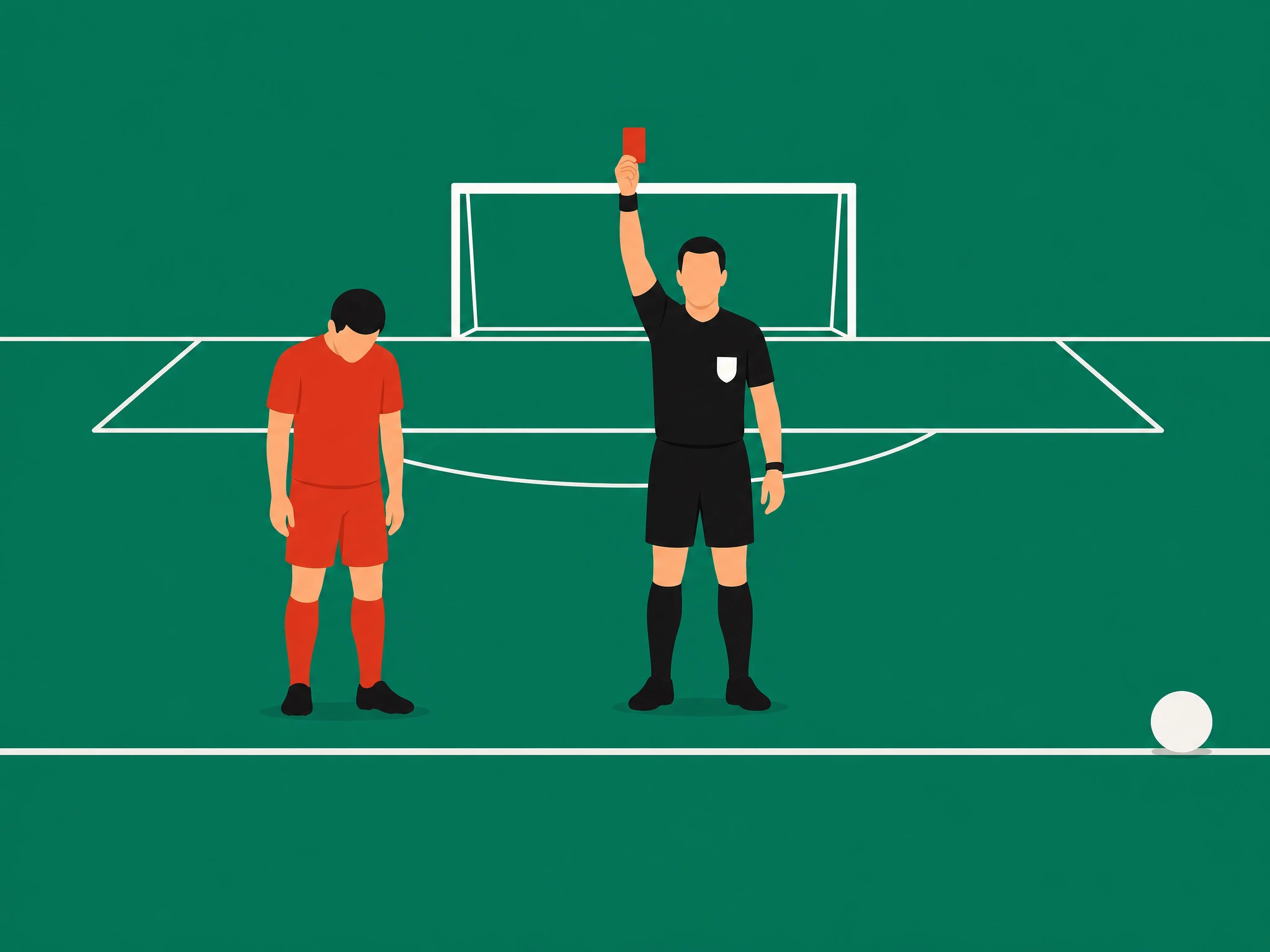
A straight red card is shown for a single act the referee, or VAR, judges serious enough to be a sending-off offence on its own. Under IFAB's Law 12, that includes serious foul play, violent conduct, spitting at anyone, denying an obvious goal-scoring opportunity, and serious offensive or insulting language or gestures. One incident, one card, straight off.
A second yellow works differently. The player has already picked up one caution earlier in the match for a separate, lesser offence. A second cautionable offence, however minor compared with the first, produces a second yellow card, which is automatically followed by a red. The referee shows two cards in sequence, yellow then red, for two separate incidents rather than one serious one.
That distinction matters beyond the match itself, because English football's own disciplinary table treats them very differently once it comes to punishment.
Why the ban isn't one fixed number
There is no single number that applies everywhere. Two things decide how long a suspension lasts:
- The offence itself. Governing bodies grade sending-off offences by seriousness and attach different automatic suspensions to each one.
- The competition's own disciplinary code. English domestic football, UEFA's club competitions and international football each run separate regulations, and none of them defers automatically to the others.
Ban length varies by competition and offence, there is no single universal number
English domestic football: the FA's automatic suspension table
The FA publishes an offence-by-offence table of automatic suspensions for cautions and dismissals. For sending-off offences, the current bans are:
- Serious foul play: 3 matches.
- Violent conduct, including elbowing, kicking, stamping, striking, biting and head-to-head contact: 3 matches.
- Spitting at an opponent or any other person: 6 matches.
- Denying a goal or an obvious goal-scoring opportunity by deliberately handling the ball: 1 match.
- Denying an obvious goal-scoring opportunity to an opponent moving towards goal by an offence punishable by a free kick or penalty: 1 match.
- Use of offensive, insulting or abusive language: 2 matches.
- A second yellow card in the same match: 1 match.
So a straight red and a second yellow are not punished the same. A straight red for serious foul play or violent conduct carries a 3-match automatic ban. A red from two yellow cards carries a 1-match ban, the same length as a straight red for denying a goal-scoring opportunity, and well short of the 3 matches for serious foul play or violent conduct. A second yellow doesn't carry an extra ban on top of normal yellow-card accumulation either, which is a separate count that only triggers a ban once a player passes a threshold of cautions across a season.
These suspensions are served in the match-based football category the offence occurred in, plus FA Cup (and FA Vase, at non-league level) fixtures where applicable. A player who picks up a further red card later in the same season gets an additional one-match ban stacked on top of the automatic one for that new offence, increasing again for every subsequent dismissal.
A European example: UEFA club competitions
UEFA's club competitions, the Champions League, Europa League and Conference League, run a different system. Article 63 of the Champions League regulations sets a flat one-match automatic suspension for a player or team official sent off, whatever the offence, rather than an offence-graded table like the FA's. For a serious offence, UEFA's disciplinary bodies can increase that suspension, and the regulations explicitly allow extending an increased punishment to other competitions, at UEFA's discretion, rather than that being the default outcome of every red card.
Yellow cards in these competitions accumulate separately: a player is suspended for the next match after their third caution in the competition that did not produce a red, and after every subsequent odd-numbered caution, the fifth, seventh, and so on. That yellow-card count resets at set points in the competition, for example on completion of the quarter-finals before the semi-finals, and again at the end of the season, rather than running all year like a domestic accumulation count.
A UEFA ban doesn't automatically follow a player home
Can a suspension be appealed or increased on review?
Yes, in both directions, though the routes differ by competition and level. Domestically, a club can challenge a straight red through the FA's wrongful dismissal process, which can have the sending off, and the automatic ban that follows it, set aside if the panel agrees the dismissal was incorrect. At international level, disciplinary bodies can review a serious incident and lengthen a suspension beyond the standard punishment, and a national federation can separately submit its own appeal against a dismissal or the suspension attached to it. An appeal generally needs a clear case that the sending off was wrong, or that the punishment should be different, rather than being a routine option after every red card.
Why this matters for lineup and prop research
A suspended player cannot play the next match by definition, which is the most direct way a red card connects to prop and lineup research: once a ban is confirmed, that player is off the team sheet entirely for however many matches the suspension covers, and any market involving them for that fixture is void from the start. A confirmed one-match ban for a second yellow means that player cannot appear in any player prop market, anytime scorer through to cards, for the very next fixture in that competition, so check suspension status before backing a returning player at a price that assumes they start. It sits alongside booking points, which is the bookmaker scoring system for cards within a single match, rather than the suspension that follows one.
Player card trends
Check a player's card history before a match to spot who's carrying a caution or building a disciplinary record that could turn into a suspension.
Red card suspensions FAQs
Is a red card from two yellow cards the same punishment as a straight red?
No. In English domestic football, a second yellow card carries a 1-match automatic ban, while a straight red for serious foul play or violent conduct carries 3 matches, per the FA's own offence table.
How many matches is a red card ban in the Premier League?
It depends on the offence, since the Premier League follows the FA's disciplinary table: 3 matches for serious foul play or violent conduct, 1 match for a second yellow card or for denying a goal-scoring opportunity, and 6 matches for spitting.
Does a Champions League suspension carry into the Premier League?
No, not by default. UEFA suspensions apply within UEFA club competitions, and domestic suspensions apply within domestic competitions, unless a specific disciplinary ruling extends a punishment further.
Can a red card suspension be appealed?
Yes. Domestically, a club can contest a dismissal through the FA's wrongful dismissal process. At international level, a federation can appeal a sending off or its suspension, and disciplinary bodies can also lengthen a punishment for a serious incident on review.
Does a suspended player count for a booking points or cards market?
No. A suspended player is not selected for the match, so they cannot appear in any cards or booking points market for that fixture. Suspension removes them from the team sheet entirely.