Booking points explained
Booking points is a bookmaker scoring system, not a football rule. Most UK bookmakers score a yellow card as 10 points and a red card as 25 points, and a second yellow that produces a red is scored as both added together, 35 points, not capped at 25.
Team FootyMetrics
Updated Jul 2026 · 6 min read
- Booking points is a bookmaker market convention for scoring cards, not an IFAB law. It turns every card in a game into a number so a total can be bet over or under a line.
- The common scoring across bet365, William Hill and Paddy Power is 10 points for a yellow card and 25 for a red. It's a bookmaker convention, not a universal standard, so check the specific bookmaker's rules before betting.
- A second yellow that produces a red is scored as both cards added together, 10 plus 25, for 35 points. It isn't capped at 25 and the second yellow isn't ignored.
- Cards in stoppage time count. Cards shown after the final whistle generally don't, across every bookmaker checked.
The bit that catches people out is the second-yellow scoring, and exactly which cards count once the final whistle is in sight.
What booking points actually are
Booking points is a market invented by bookmakers to turn cards into a single number worth betting on. It has nothing to do with IFAB's Laws of the Game, which only recognise a caution (yellow card) and a sending off (red card), no points attached. The points system exists so a bookmaker can offer a line like “over 45.5 total booking points” and settle it with one number instead of a count of cards.
That makes it a different bet from a plain cards market. A cards market just counts cards: a yellow is worth 1, a red is worth 1, and a second yellow that leads to a red is worth 2. A booking points market weights the cards instead. Three separate yellows (30 points) still outscore one straight red (25), but a red carries more weight than any single yellow, and a match with a sending off tends to push a booking points total up fast.
How many points is each card worth?
Checking bet365, William Hill and Paddy Power’s own football rules pages, all three describe the same numbers for a standard booking points market: a yellow card scores 10 points and a straight red card scores 25 points. It's a widely used convention across UK bookmakers, but it's still a house rule set by each operator, not a fixed industry standard, so it's worth opening the specific market rules before betting, especially with a newer or smaller bookmaker.
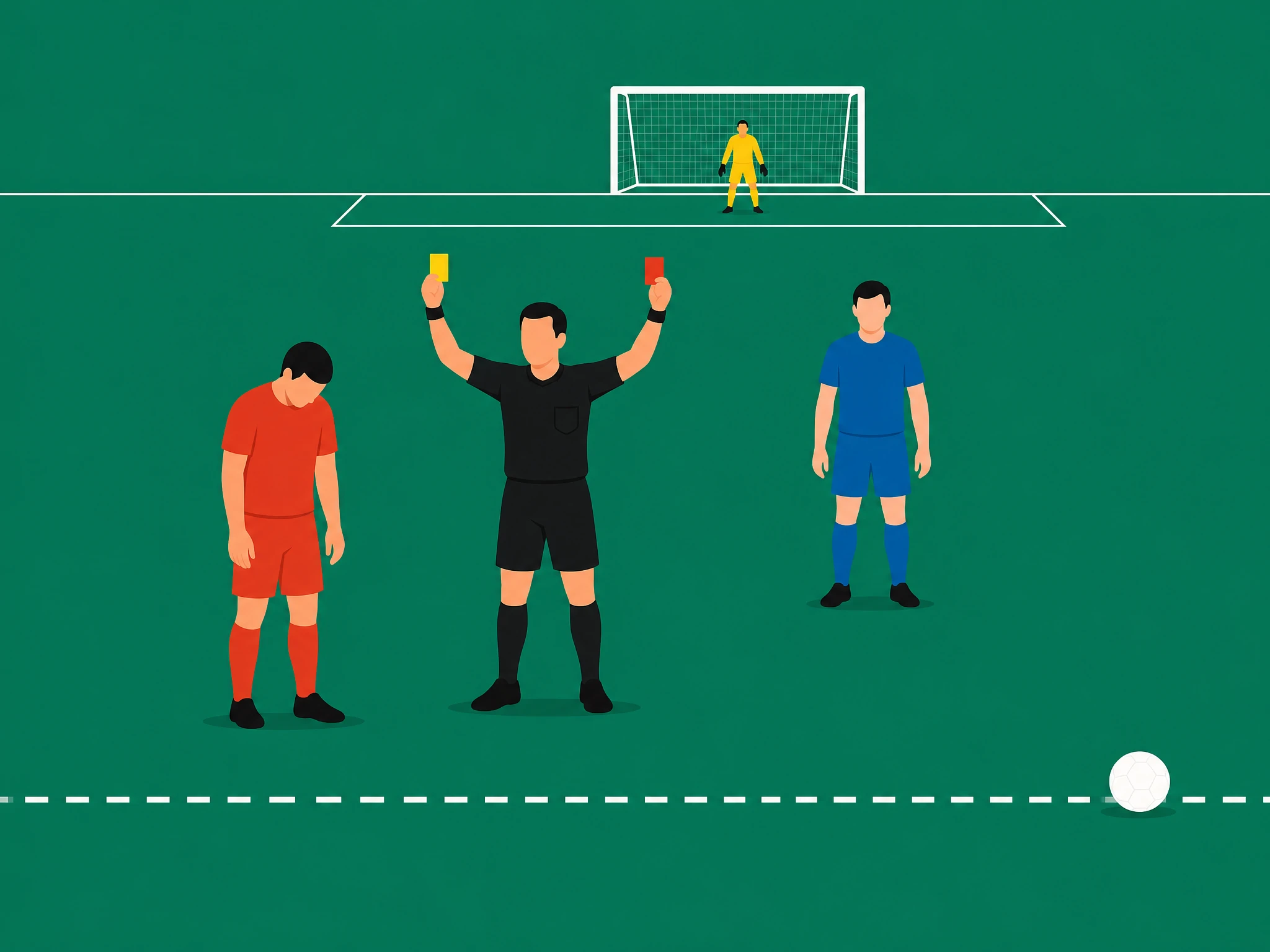
A second yellow is scored as 10 + 25 = 35, not capped
For a plain cards market, as opposed to a points market, the counting convention is different again and worth not confusing with the above: a straight red typically counts as 1 card, and a second yellow plus the resulting red typically counts as 2 cards, not 3. Sky Bet’s general football rules describe this exact card-counting approach, separate from any points system. Check whether you're looking at a cards market or a points market before assuming which convention applies, since the two count a second yellow differently.
Which cards count towards booking points?
Every bookmaker rules page checked (bet365, William Hill, Paddy Power) agrees on the same shape of rule, even where the exact wording differs slightly between operators.
- Cards shown during the 90 minutes of normal play, including stoppage time added by the referee.
- Cards shown at half time.
- A card shown to a substitute, once that player actually appears in the match.
- A card issued retrospectively by VAR at half time, on most bookmakers' rules.
- Cards shown to a manager, coach, or a substitute who never comes on.
- Cards shown after the final whistle, including full-time confrontations.
- Cards added after the final whistle following a VAR review, on most bookmakers' rules.
That last point matters for the kind of thing that actually happens on a pitch: a flare-up between players after the final whistle, common enough after a heated derby, will usually not add to a booking points total, even though everyone watching saw the referee reach for a card. The settlement clock for these markets runs out with the final whistle, not the moment officials leave the pitch.
Where this feeds into real markets
Booking points is one member of a small family of cards-related markets, and it helps to know how they relate to each other rather than treat booking points as the only one.
- Total booking points (over/under). The core market this page is about: bookmaker points added up across the whole match, or for one team, bet against a line.
- Player to be booked / carded. A single-player market settled simply on whether that player is shown a yellow or a red card at any point in normal time. It doesn't use the points weighting at all, a yellow and a red both just win the bet.
- First card / next card. Settled on which player or team is shown the first card in the match, or the next card after a certain point. If two players are booked from the same incident, bookmakers generally settle on whichever player the referee shows the card to first.
- Team cards / team booking points. The same total and points ideas, split out by team rather than combined, useful for backing one side to be the more heavily booked.
Card counts also swing hard from match to match, more than most stats, since one flashpoint can produce three bookings in a minute. Treat any single-match card total the way you would treat any low-sample stat, covered in variance and sample size, and size stakes accordingly.
FootyMetrics tracks cards for every player and team across 115+ leagues, the same underlying data any of these markets get settled from, whether a bookmaker is counting cards, weighting them into points, or just asking who gets the first one.
Player card trends
Check a player's card history and cards-per-game rate before backing a booking points or player-to-be-booked line.
Team totals work the same way on team card trends, useful for sizing up a match total before backing an over or under on booking points.
Does the reason for the card matter?
No, and it's worth stating plainly because it feels like it should. A yellow card shown for a crunching foul reads differently to a match-going fan than a yellow shown for dissent, time-wasting, or simulation. On the pitch, one looks like a proper caution and the other can feel soft. For booking points, and for every cards market checked, the reason makes no difference at all. IFAB’s Law 12 lists several separate cautionable offences, including unsporting behaviour, dissent, persistent fouling, delaying a restart, not retreating the required distance at a free kick, and simulation, and every one of them produces the same card. A booking points market only reads the colour of the card shown, not which of those offences triggered it, so a soft yellow for kicking the ball away in frustration is worth exactly the same 10 points as a crunching foul yellow.
Booking points FAQs
How many booking points is a yellow card worth?
Most UK bookmakers, including bet365, William Hill and Paddy Power, score a yellow card at 10 points. It's a bookmaker convention rather than a universal rule, so check the specific market's rules before betting.
How many booking points is a red card worth?
A straight red card is typically scored at 25 points by the same bookmakers. A red card that follows a second yellow is scored differently, see the next question.
How are booking points scored for a second yellow card?
As the yellow plus the red added together, 10 plus 25, for 35 points, not capped at 25. Several bookmaker rules pages state this explicitly using that exact example.
Do cards in stoppage time count towards booking points?
Yes. Bookmaker rules generally settle on the full 90 minutes of play including any stoppage time added by the referee.
Do cards shown after the final whistle count?
Generally no, across every bookmaker's rules checked, including cards from full-time confrontations, though a card added retrospectively by VAR at half time typically does count.
Do cards shown to managers or unused substitutes count towards booking points?
No. Cards shown to a manager, a coach, or a substitute who never comes on do not count. A card shown to a substitute does count once that player actually appears in the match.
Is a booking points market the same as a total cards market?
No. A cards market counts cards: a yellow is 1, a straight red is 1, and a second yellow plus the resulting red is typically 2. A booking points market weights them instead: 10 for a yellow, 25 for a red, 35 for a second-yellow dismissal. The two settle the same match differently.
Does a yellow card for dissent count the same as a yellow card for a foul?
Yes. Booking points only look at the colour of the card shown. IFAB's Law 12 lists dissent, simulation and persistent fouling alongside a mistimed tackle as separate cautionable offences, but they all produce the same card and the same points.