How does VAR work?
VAR (video assistant referee) is a match official who checks major incidents on video and can only step in for a clear and obvious error or a serious missed incident, in four categories of decision. The on-field referee always makes the final call, whether from what the VAR tells them or after watching the replay at the pitchside monitor.
Team FootyMetrics
Updated Jul 2026 · 6 min read
- VAR supports the referee, it does not replace them. The referee always makes the final call.
- VAR can only get involved for four types of decision: goals, penalties, direct red cards, and mistaken identity. A missed second yellow card is not one of them.
- A check is silent and happens on every relevant incident, with no stoppage. A review only happens for a possible clear and obvious error, and can mean the referee goes to the pitchside monitor.
- VAR is why a goal can still be disallowed minutes after the players have celebrated.
Most of the confusion isn't about what VAR is, it's about what it is actually allowed to touch, and the gap between a routine check, which happens constantly and invisibly, and a full review, which is rare, visible, and sometimes ends at the pitchside monitor.
What is VAR?
VAR stands for video assistant referee. Under IFAB’s VAR protocol, a VAR is “a match official, with independent access to match footage, who may assist the referee only in the event of a ‘clear and obvious error’ or ‘serious missed incident’.” The VAR sits away from the pitch, watching every camera angle, with an assistant VAR and a replay operator alongside them. In the Premier League, that is a VAR Hub at Stockley Park.
The important phrase is “may assist the referee.” VAR does not overrule the referee and has no authority of its own to change a decision. It is a second pair of eyes with slow-motion replay, feeding information to the person still in charge of the match: the on-field referee, whose overall authority comes from Law 5.
What can VAR review? The four categories
This is the part people get slightly wrong, because commentary often talks as if VAR can step in on anything close. It cannot. IFAB’s protocol names four categories of decision, and nothing outside them:
- Goal or no goal. Was there an offence in the build-up, did the ball go out of play first, did the ball actually cross the line, was there an offside, a handball, or encroachment on a penalty.
- Penalty or no penalty. Was there an offence, did it happen inside or outside the box, was the wrong decision given either way.
- Direct red card incidents. Denial of an obvious goal-scoring opportunity, serious foul play, violent conduct, biting or spitting, or serious offensive language or gestures, where a straight red card is the punishment.
- Mistaken identity. The referee cautions or sends off the wrong player for an offence. This is the category that decides which name a card is recorded against, which is exactly what player to be carded settlement hangs on.
- A goal, including offside, handball or encroachment in the build-up.
- A penalty decision, either awarded or not awarded.
- A direct red card incident.
- Mistaken identity, when a card goes to the wrong player.
- A missed second yellow card offence, even an obvious one.
- Most fouls that only produce a yellow card, or no card at all.
- A throw-in or free-kick direction on its own.
- Any subjective decision outside the four categories above.
A missed second yellow card is the clearest example of what falls outside the list. IFAB is explicit: “VAR can only intervene when the referee shows a clearly incorrect yellow card which results in a red card, not when a potential second yellow card offence has been missed.” So if a player should have picked up a second booking and been sent off but the referee does not book them at all, VAR has no power to fix that. VAR can only step in on the other side of that coin, when a referee shows a second yellow, and therefore a red, that was clearly the wrong call, because that is a direct red card outcome being corrected, not a missed caution being invented after the fact.
A narrower fifth check exists in some competitions
Check vs review: the difference that matters
Two different things get called “VAR,” and mixing them up is where most confusion comes from.
A check happens on every one of the four categories, every time, automatically, with no stoppage and usually no one outside the VAR hub even noticing. If nothing looks wrong, IFAB calls this a “silent check”: the VAR briefly confirms there was no clear and obvious error, and the game carries on without the referee needing to know it happened.
A review only happens when the check turns something up. The VAR has to believe there is a probable clear and obvious error or a serious missed incident before recommending anything, and even then the referee decides whether to act on it. A review goes one of two ways. For a factual decision, like whether the ball went out of play or a clear offside, the VAR simply tells the referee what happened and the referee applies it, no monitor needed. For a judgement call, like whether a foul deserved a red card or whether contact in the box was a penalty, the referee is asked to look for themselves at the pitchside monitor, what the protocol calls the referee review area, before deciding. This is the on-field review, or OFR.
- Step one, the check. Silent and automatic on every goal, penalty incident, direct red card and possible mistaken identity. No stoppage, no signal, and in most cases nobody outside the VAR hub knows it happened.
- Step two, the review. Only if the check finds a probable clear and obvious error. Factual calls are corrected on the VAR’s word alone; judgement calls send the referee to the pitchside monitor before a final decision.
Factual decisions like offside or whether the ball crossed the line are not judged against the same “clear and obvious” bar as subjective ones. If the VAR spots an error there, however marginal, it gets corrected. Subjective calls, fouls, handballs, the severity of a challenge, keep the higher bar: the referee’s original call stands unless it was clearly and obviously wrong.
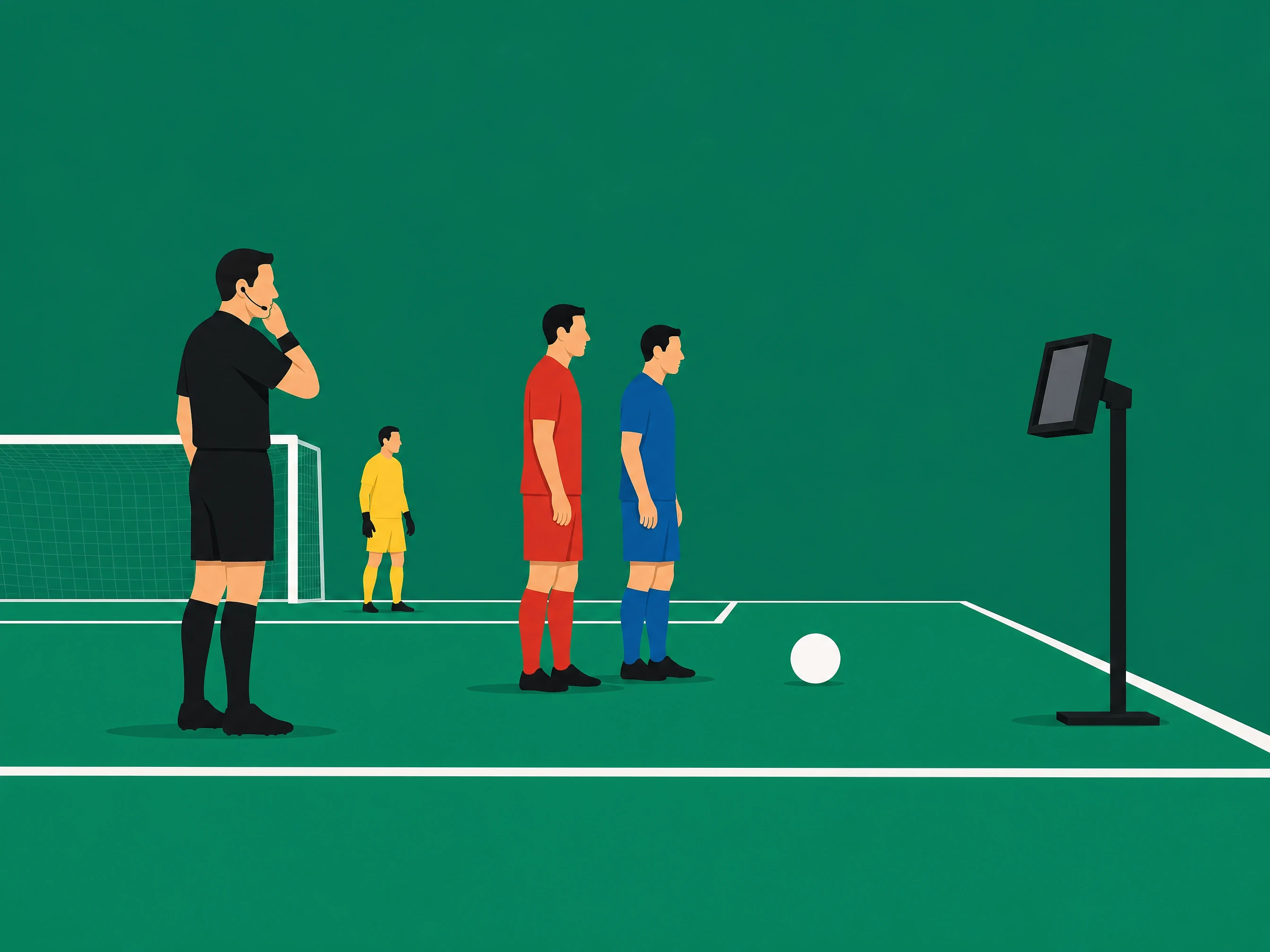
Who makes the final decision
Always the referee. IFAB’s protocol is direct about it: “The final decision is always taken by the referee, either based on information from the VAR or after the referee has undertaken an ‘on-field review’.” VAR can recommend, and can be wrong to recommend a review in the first place, but it cannot overturn a decision on its own. Every VAR intervention ends with the same person who started the game in charge, making the call.
VAR and semi-automated offside technology
Offside checks used to mean a VAR operator manually drawing crosshair lines across a single broadcast angle. Semi-automated offside technology, used in competitions including the Premier League, replaces that manual step with a tracking-camera system that finds the exact moment the ball is played and calculates the offside line automatically from tracked body points. It speeds up the position side of an offside check considerably, but a human VAR still confirms the kick point and the players involved, and still has to judge whether the offside player actually interfered with play, since that judgement call is not something cameras can make. The full rule, including the exemptions people get wrong, like a corner or throw-in received directly, is covered in what is offside in football.
Why this matters watching or betting on a match
VAR is the reason a goal can be ruled out minutes after the players have finished celebrating, sometimes after a throw-in and a goal kick have already happened at the other end. A check does not stop the clock or the game in any obvious way, so a goal can show as scored on a scoreboard or a live app for a short period before a review confirms or overturns it. That gap is longer for an on-field review, where the referee has to walk to the pitchside monitor, watch the replay, and then signal a decision.
Treat a goal, a red card or a penalty as provisional for a short period after it happens, particularly if the broadcast shows officials checking pitchside or the referee holding a hand to their earpiece. In-play markets and cash-out prices can lag behind what is on screen while a check or review is in progress, since the underlying decision has not been finalised yet. bet365’s football rules, for instance, settle in-play bets on the decision the referee finally gives after VAR, not on the provisional scoreboard, and cash-out is routinely suspended while a check is running, so an offer you saw before the check can reprice or vanish once the review ends. Rules on exactly how VAR-affected bets are settled still vary by operator and by market, so check your own bookmaker’s sport rules rather than assuming a single standard.
VAR FAQs
What does VAR stand for?
Video assistant referee, a match official who checks certain incidents on video and can recommend the referee take another look. VAR cannot change a decision on its own.
What can VAR actually review?
Only four things: goals, penalties, direct red card incidents, and mistaken identity when a card goes to the wrong player. Nothing outside that list.
Can VAR give a second yellow card that was missed?
No. VAR can only correct a second yellow card that was wrongly shown and led to a red card. It has no power to add a missed second yellow that the referee never gave in the first place.
What is the difference between a VAR check and a VAR review?
A check happens on every incident, silently, with no stoppage, and most of the time nobody notices. A review only happens if the check finds a probable clear and obvious error, and can mean the referee goes to the pitchside monitor to look themselves.
Who makes the final decision after VAR gets involved?
The referee, always, either from what the VAR tells them or after watching the replay themselves at the pitchside monitor.
Can VAR overturn a goal that has already been credited to a bet as a winner?
Bookmakers settle on the final, VAR-confirmed outcome, not a provisional scoreboard state. If a goal is scored, cashed through to a live app and then ruled out on review, the bet settles as if the goal never stood. In-play and cash-out prices can also be suspended or repriced while a check is in progress.
Can VAR review a wrongly awarded corner?
Only in competitions that adopt an optional extra check under IFAB's protocol, and only if the review can be completed immediately without delaying the restart. It is not part of the core four categories and is rarely used.
Does VAR use the same technology as semi-automated offside?
Semi-automated offside technology is a separate camera and tracking system that speeds up the position side of an offside check specifically. VAR is the wider process; the offside technology is one tool used inside a VAR check.