Are price boosts good value?
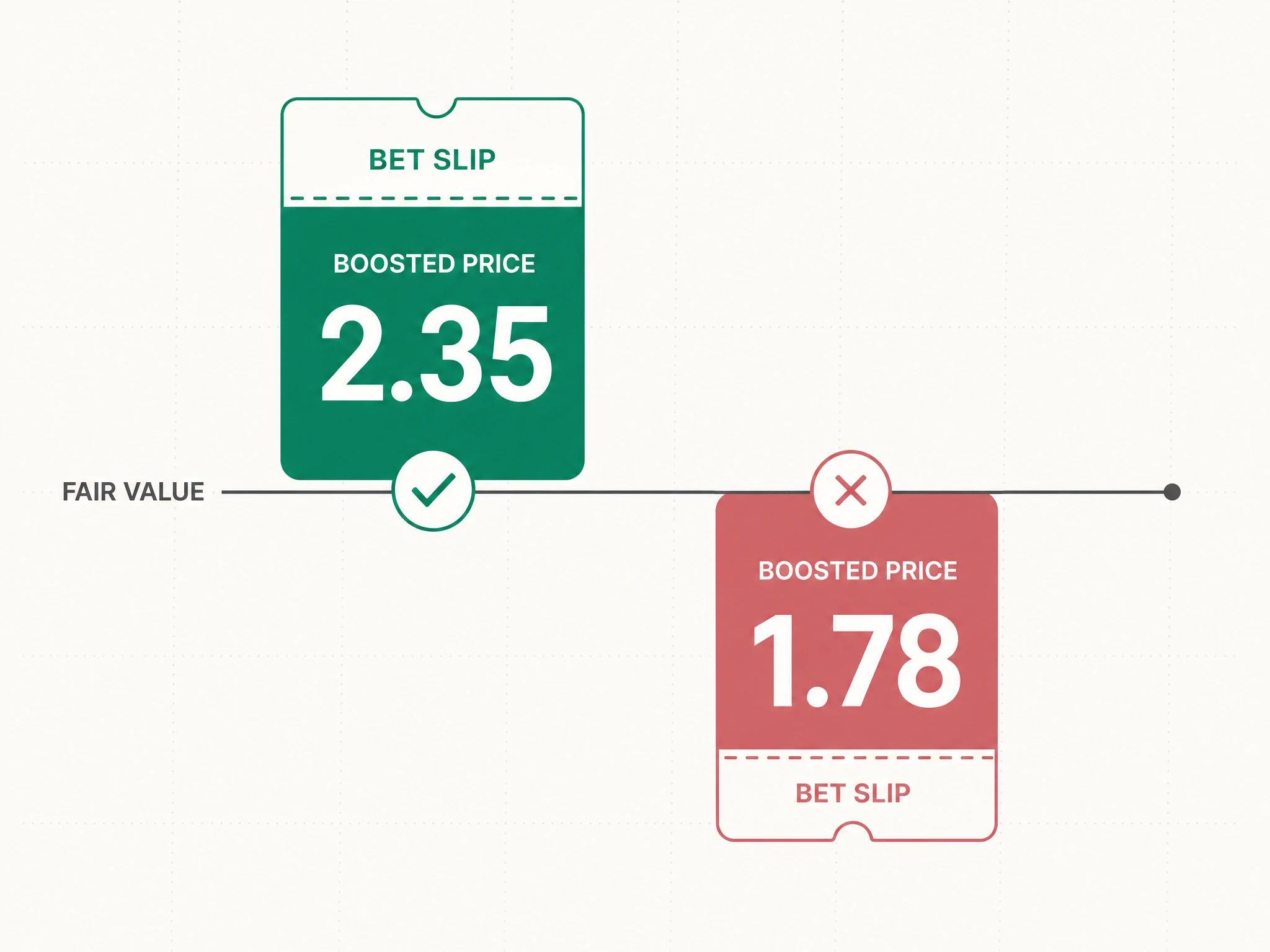
A price boost is only good value if the boosted price still beats the market's fair, no-vig price for that same outcome. A boost that pushes odds from poor to slightly less poor is still a bad bet. Check the boosted price against fair odds, not against where the price started.
Team FootyMetrics
Updated Jul 2026 · 6 min read
- A boost only means something relative to where the price started. Compare the boosted price against the fair, no-vig price for that outcome, not against the pre-boost price.
- A boosted price still below fair odds is a smaller bad bet, not a good one. A boosted price above fair odds is genuine value, whatever the percentage on the marketing banner says.
- Max stakes on boosts are usually capped low and vary customer by customer, so the cash upside is smaller than the headline percentage suggests.
- A big boost on a heavily bet market, like a major match's 1X2, is more often a loss leader than a mispriced line. A boost on a thinner market is more likely to reflect the bookmaker actually being wrong.
Most people judge a boost by how big the jump looks: 20% up, 33% up, "was 2.50, now 3.00". None of that tells you whether the bet is worth having. The only number that tells you that is the market’s fair, no-vig price for the same outcome, and whether the boosted price has actually crossed it.
What good value means for a boost
A price boost, also called an odds boost, moves a specific selection’s price up before you place the bet. The mechanics of how that differs from a profit boost, which only touches your net winnings after the bet settles, are covered in bet boost and profit boost tokens explained. This page assumes you already know the difference and asks a narrower question: once you’re looking at a boosted price, how do you tell if it’s actually worth backing?
The benchmark is the same one used for any bet: the market’s fair, no-vig price, set out in full in what are fair odds. Strip the bookmaker’s margin out of a market and you get an estimate of the true probability of each outcome. That fair price is the line a boost has to clear. Not the original, unboosted price. The fair one.
Say a bookmaker prices a team to win at 1.80, and the market’s fair, no-vig price for that same result works out at 2.05, a common gap, since bookmaker prices sit inside the fair line by design, that’s the margin. A "20% boost" on the 1.80 takes it to about 2.16. That looks big on the promo banner. It’s also now above the fair price of 2.05, so it’s genuine value, the bookmaker is paying out more than the market’s own estimate says the result is worth.
Now take the same 20% boost on a different, shorter price. A bookmaker offers 1.50 on a strong favourite, boosted 20% to 1.80. If the fair, no-vig price for that same favourite is 1.65, the boosted 1.80 has also cleared it and is worth having. But if the fair price for that favourite is actually 1.90, because the market rates the win chance higher than the boosted price still reflects, then 1.80 is still below fair. It’s a better bet than the unboosted 1.50 was. It is still not a good bet, just a smaller loss on average than the one you’d have made without the boost.
That’s the whole method. A boosted price is worth having if it clears the fair, no-vig price for that outcome. It’s still poor value, just less poor, if it doesn’t.
Three checks before you take a boost
Run these in order before a boost goes on the slip.
1. Find the fair price for the same outcome
Pull the odds for the same market and outcome from two or three other bookmakers, or an exchange if the market is liquid enough to have one. Convert each price to an implied probability (1 divided by the decimal odds), average them, then devig using the proportional method described in what are fair odds. That gives a fair, no-vig price to compare the boost against. A single bookmaker’s own price, even before the boost, already has a margin baked in, so it’s not a fair benchmark on its own.
2. Compare the boosted price in decimal terms, not the percentage
The percentage on the boost tells you how far the price moved, not where it landed. A 25% boost sounds identical whether the starting price was already close to fair or miles under it. Convert the boosted price to decimal, put it next to the fair price you calculated in step one, and ask a single question: is the boosted decimal price bigger than the fair decimal price? If yes, it’s worth having. If no, it isn’t, whatever the percentage said.
3. Check the max stake before the odds
A boost that clears fair value is only worth as much as you can actually put on it. Sky Bet’s own Price Boost terms state plainly that max stake rules apply and can vary on a customer by customer basis, and its Soccer Saturday Price Boost specifically caps every customer at a £10 stake once a choice element is added to the market. bet365 shows the maximum directly on the boosted line, and that figure also varies by user and by market rather than being fixed site-wide. A 20% boost on a bet capped at £10 is worth up to £2 more profit if it wins. The percentage on the banner and the cash difference in your account are two very different numbers, and the second one is the one that matters.
Check the betslip, not the promo email
Real value or marketing hook
Not every boost sits at the same point on this spectrum, and there’s a genuine pattern to which ones tend toward which end.
- The market is thin: a player prop, a lower-league match, a niche stat line with limited betting volume.
- The boosted price, once converted to decimal, sits above your calculated fair price from two or three other books.
- The max stake is close to what you'd normally stake on that bet anyway, so the cash upside is real, not symbolic.
- The boost applies to a specific, unusual selection rather than a whole popular market's short-priced favourite.
- The market is a big match's headline 1X2 or over/under, where volume is high and the book is priced tightly and defensively.
- The boosted price still sits below the fair, no-vig price once you devig two or three other bookmakers.
- The max stake is capped well under your normal stake size, so the extra payout in cash terms is small.
- The boost is advertised heavily with a large headline percentage on a short-priced, popular favourite.
The pattern behind this isn’t a coincidence. A heavily bet market like a big derby’s match result gets sharp, tightly priced fast, because plenty of money and plenty of other bookmakers are watching it. Boosting that market costs the bookmaker relatively little in expected terms, since the price rarely has much slack to give away, and it’s good for acquisition and retention: everyone can see the boosted number and the match is one people were going to watch anyway. A thinner market, a shots-on-target prop on a lower-league game, or an obscure card market, gets priced by fewer eyes and less capital. A bookmaker’s model can genuinely be off there, and a boost on that kind of line has a better chance of reflecting a real gap rather than just a good marketing spot.
None of that is an absolute rule. A big match boost can still clear fair value if the starting price had enough room in it, and a niche market boost can still be worse than fair if the starting price was bad enough that even a large percentage jump doesn’t close the gap. Run the actual numbers each time. The pattern is a starting expectation, not a substitute for checking.
A worked example
Take a hypothetical Premier League match. Three other bookmakers price the home win at 2.05, 2.00 and 2.10. Averaging the implied probabilities and devigging gives a fair, no-vig price of roughly 2.08 for the home win.
Bookmaker A offers 1.85 on the same home win, boosted by 20% to 2.22 (max stake £15). Convert 2.22 against the fair price of 2.08: 2.22 is bigger, so this boost has cleared fair value. On a £15 stake it pays out £32.60 total versus the fair price’s theoretical £31.20, a real if modest edge, capped by the stake limit.
Bookmaker B offers 1.70 on the same outcome, also boosted by 20%, landing at 2.04. That’s still under the fair price of 2.08. The boost narrowed the gap between Bookmaker B’s price and fair value, but it didn’t close it. Taking it is a smaller mistake than taking the unboosted 1.70 would have been. It’s still not a bet with positive expected value against this fair-price estimate.
Same percentage, same match, same outcome, two different verdicts, because the starting price was different.
Price boost value FAQs
Is a bigger boost percentage always better value?
No. A 30% boost on a price that started well under fair odds can still land below fair odds. A 10% boost on a price that started close to fair can clear it easily. The percentage describes the size of the jump, not where the price lands, so it's the wrong number to judge a boost by on its own.
Do price boosts stack with other bookmaker offers?
Usually not. Boost tokens are built to apply on their own, and terms across UK bookmakers commonly exclude combining a price boost with a profit boost, and void the enhanced price if you cash out early. Check the specific token's own terms, since exclusions vary by bookmaker and by promotion.
Why do bookmakers boost the price on popular matches if it isn't good value?
Because the boost does marketing work as much as pricing work. A boosted price on a big, well watched match gets seen by more customers and drives more sign-ups and repeat bets than the same boost on a quiet fixture, even if the underlying price barely moves relative to fair value. Boosting a tightly priced market usually costs the bookmaker very little.
How do I find the fair, no-vig price to compare a boost against?
Take the same market and outcome from two or three other bookmakers, convert each price to an implied probability, average them, then devig using the proportional method (each probability divided by the total of all of them). The full method with a worked table is in fair odds.
Is a boosted price ever worse than the unboosted price for the same bet?
No, not in decimal terms; a genuine price boost only increases the odds on the same selection, it never shortens them. What can happen is that the boost is restricted to a lower max stake than you'd normally place, so the total cash return is smaller than betting the unboosted price at your usual stake, even though the price itself is longer.
Does a profit boost need the same fair-odds check as a price boost?
Yes. A profit boost adds a percentage to your net winnings rather than moving the price, but the bet underneath it is still priced by the bookmaker at the normal, unboosted odds. If that underlying price is well below fair value, boosting the profit on top of it doesn't fix that, it just makes a losing-expectation bet pay a bit more when it happens to win.