Corner kick vs goal kick: who gets the restart
When the whole ball crosses the goal line without a goal, who gets the restart comes down to who touched it last. Off a defender last, it is a corner to the attacking team. Off an attacker last, it is a goal kick to the defending team. That single last-touch decision is the whole rule.
Team FootyMetrics
Updated Jul 2026 · 5 min read
- Ball wholly over the goal line, no goal, last touch by a defender: corner to the attackers (Law 17).
- Ball wholly over the goal line, no goal, last touch by an attacker: goal kick to the defenders (Law 16).
- The whole ball has to cross the whole line. A ball resting on the line, or partly over it, is still in play.
- A deflection is a touch. An attacker's shot that deflects off a defender and goes out is still a corner.
- Since the 2019/20 Laws change, a goal kick is in play the moment it is kicked and clearly moves, and a team-mate can receive it inside the penalty area.
Both restarts start from the same event: the whole ball has gone over a goal line and nobody has scored. The referee then has one thing to decide, and it is not a judgement about fairness or fault. It is simply which team touched the ball last.
The last-touch rule
The restart after the ball goes out over a goal line is decided by one thing: which team touched it last. Everything else follows from that.
If a defender was the last to touch the ball before it went out, the attacking team gets a corner. This is set out in Law 17, the corner kick, which awards a corner when the whole of the ball passes over the goal line, on the ground or in the air, having last touched a player of the defending team, and no goal is scored.
If an attacker was the last to touch it, the defending team gets a goal kick. Law 16, the goal kick, is the mirror image: a goal kick is awarded when the whole of the ball passes over the goal line, on the ground or in the air, having last touched a player of the attacking team, and no goal is scored.
The two laws are written the same way on purpose. The only variable that changes the outcome is whose player put the last touch on it. A clearance that a defender slices behind their own byline is a corner. A cross that an attacker overhits straight out is a goal kick.
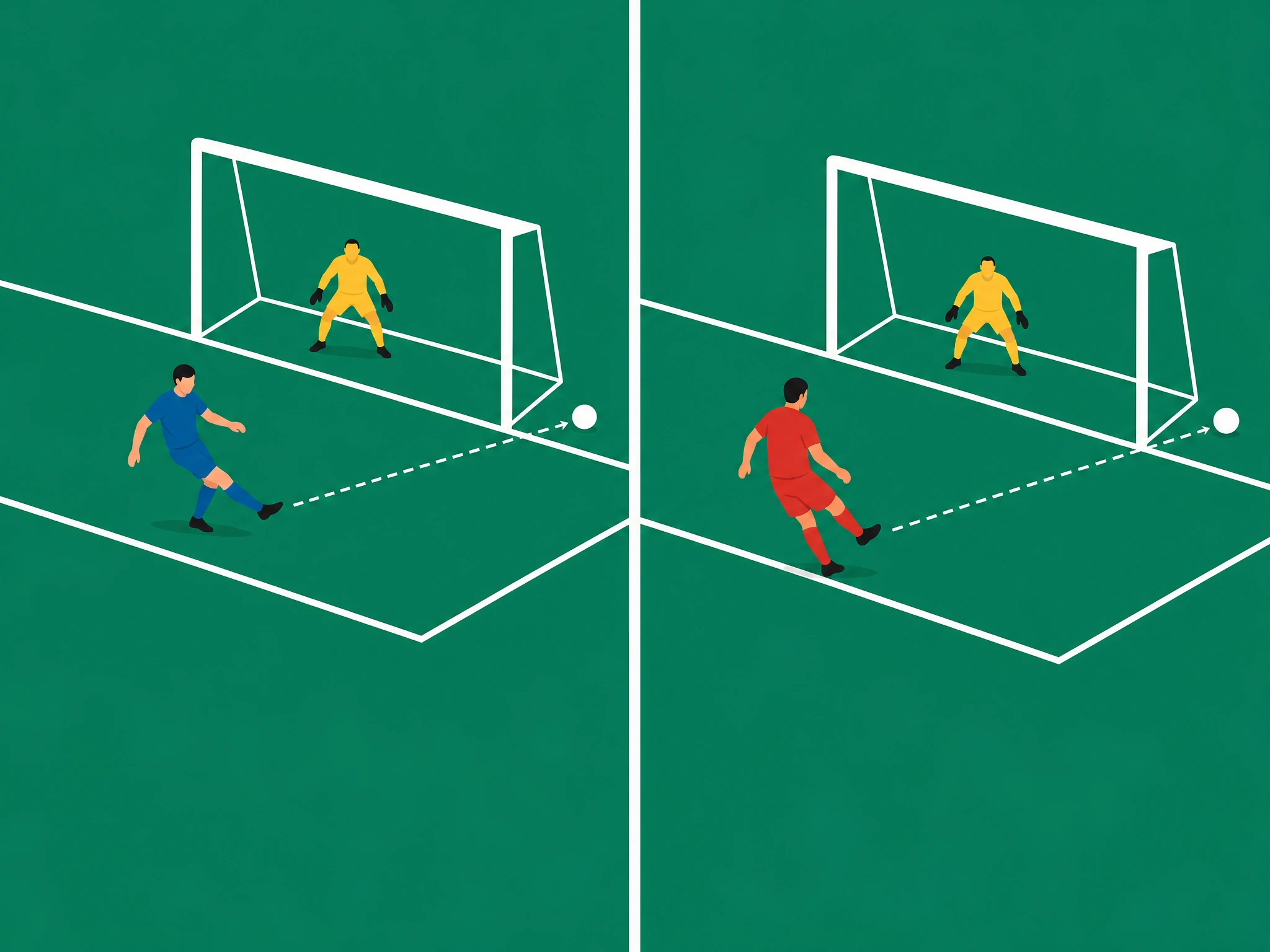
Last touch off a defender: corner to the attackers.
Last touch off an attacker: goal kick to the defenders.
The whole ball over the whole line
Both restarts need the same thing first: the ball has to be fully out. The whole of the ball must pass over the whole of the goal line. A ball sitting on the line, or hanging half over it, is still in play, and referees will wave play on in exactly those moments.
This matters because a ball can look out from the stands or from a wide camera and still be in play. The rule is judged at the point where the ball meets the line: if any part of the ball is still touching any part of the line, it has not crossed. That is the same "wholly over the line" test used to judge whether a ball has crossed the goal line between the posts for a goal, which is why goal-line technology measures the whole ball against the whole line too.
Until the ball is fully over, there is no restart to award. Once it is fully over, the last touch decides which restart it is.
Deflections still count
The last touch is the last touch, whoever it came off and whether or not they meant it. A deflection is a touch.
The situation that catches people out is an attacker’s shot that deflects off a defender and goes behind. The shot was the attacker’s, but the last player to touch the ball was the defender it deflected off, so it is a corner. It does not matter that the defender did not mean to touch it or that the attacker created the whole move. Last touch, defender, ball out: corner.
It works the other way too. A defender’s clearance that cannons off an attacker and rolls behind the byline is a goal kick, because the attacker put the last touch on it. Referees do not judge intent here. They judge who touched it last.
- Last touch off a defender before the ball goes wholly over the line.
- A defender's clearance or block that goes behind their own byline.
- An attacker's shot that deflects off a defender and goes out.
- Last touch off an attacker before the ball goes wholly over the line.
- An overhit cross or a shot that misses and goes straight out.
- A defender's clearance that deflects off an attacker and goes behind.
The modern goal kick rule
Goal kicks changed in a way worth knowing, because the old picture is still in a lot of people’s heads.
Under the current Law 16, the ball is in play as soon as it is kicked and clearly moves. A team-mate can receive it anywhere, including inside the penalty area. Opponents have to stay outside the penalty area until the ball is in play, but the moment it is kicked and moves, the ball is live and can be pressed.
Before the 2019/20 Laws change, the ball was not in play until it had left the penalty area, and a team-mate could not touch it inside the area first. The change let goalkeepers and defenders take short goal kicks to a team-mate standing in the box, which is why you now see so many sides build possession from a stationary ball inside their own area rather than launching it long every time.
The corner kick did not change here
Why the restart decision settles corner markets
This same last-touch decision is what settles corner-count betting. A corner has to be awarded before it can be counted, and it is only awarded off a defender’s last touch.
Every corner in a total corners market starts life as this decision: ball wholly over the goal line, no goal, last touch off a defender. Nothing is counted until that happens and the corner is then taken, which is the settlement detail covered on how corners are settled. A goal kick, by contrast, counts for nothing in a corners market, because the last touch was an attacker’s and no corner was awarded.
So the same judgement a referee makes in a fraction of a second, defender or attacker, is what decides whether a corner ever enters the count. If you back a total corners line, you are betting on how often that defender-last sequence happens across the match. The nearest rule-set parallel, a ball going out over a touchline instead, is set out on throw-in rules, where the same last-touch logic hands the throw to the other team.
Team corner trends
A total corners line is a bet on how often each side forces the defender-last sequence. Check corners for and against, home and away, before you back one.
Corner vs goal kick FAQs
Corner or goal kick, how is it decided?
By who touched the ball last before it went wholly over the goal line without a goal. Last touch by a defender is a corner to the attackers. Last touch by an attacker is a goal kick to the defenders.
Is a deflection off a defender a corner or a goal kick?
A corner. The last player to touch the ball is what counts, so an attacker's shot that deflects off a defender and goes behind is a corner, even though the defender did not mean to touch it.
Does the whole ball have to cross the line for a corner or goal kick?
Yes. The whole of the ball must pass over the whole of the goal line. A ball resting on the line or only partly over it is still in play, and no restart is awarded until it is fully out.
Can you receive a goal kick inside the penalty area?
Yes, since the 2019/20 Laws change. A goal kick is in play as soon as it is kicked and clearly moves, so a team-mate can receive it inside the penalty area. Before that change, the ball had to leave the penalty area first.
Which laws cover corners and goal kicks?
Law 17 covers the corner kick and Law 16 covers the goal kick. Both award the restart when the whole ball passes over the goal line without a goal, decided by which team touched it last.
Does a goal kick count for anything in a corners betting market?
No. A corners market only counts corners that are awarded and taken. A goal kick is the opposite outcome, an attacker's last touch, so it never enters a corner count.