The short answer
- A corner is awarded when the whole ball crosses the goal line, on the ground or in the air, off a defending player last, with no goal scored.
- A goal can be scored directly from a corner. There is also no offside offence for the kicker or a team-mate who receives the ball straight from it, the same exemption covered on the offside page.
- For betting, a corner only counts once it is actually taken. If the referee blows for half time or full time before an awarded corner is kicked, it does not count.
- A short corner passed along the byline still counts as one corner event, the same as a corner swung straight into the box, once it is taken.
Under the Laws of the Game, a corner exists the moment the referee points to the arc. For a betting market, it only exists once it is actually kicked. That gap between the law and the settlement rule is where most corners disputes come from.
When is a corner awarded?
Corner kicks are covered by Law 17 of the Laws of the Game. A corner is awarded when the whole of the ball passes over the goal line, on the ground or in the air, having last touched a player of the defending team, and a goal is not scored. All three parts matter: the ball has to be fully over the line, not just touching it, it has to have come off the defending side last, whether that is a deliberate clearance, a blocked shot or a deflection, and the goal has to remain unscored, otherwise the restart is a kick-off instead. The ball is then placed inside the corner arc nearest to where it crossed the line, and a player from the attacking side takes the kick.
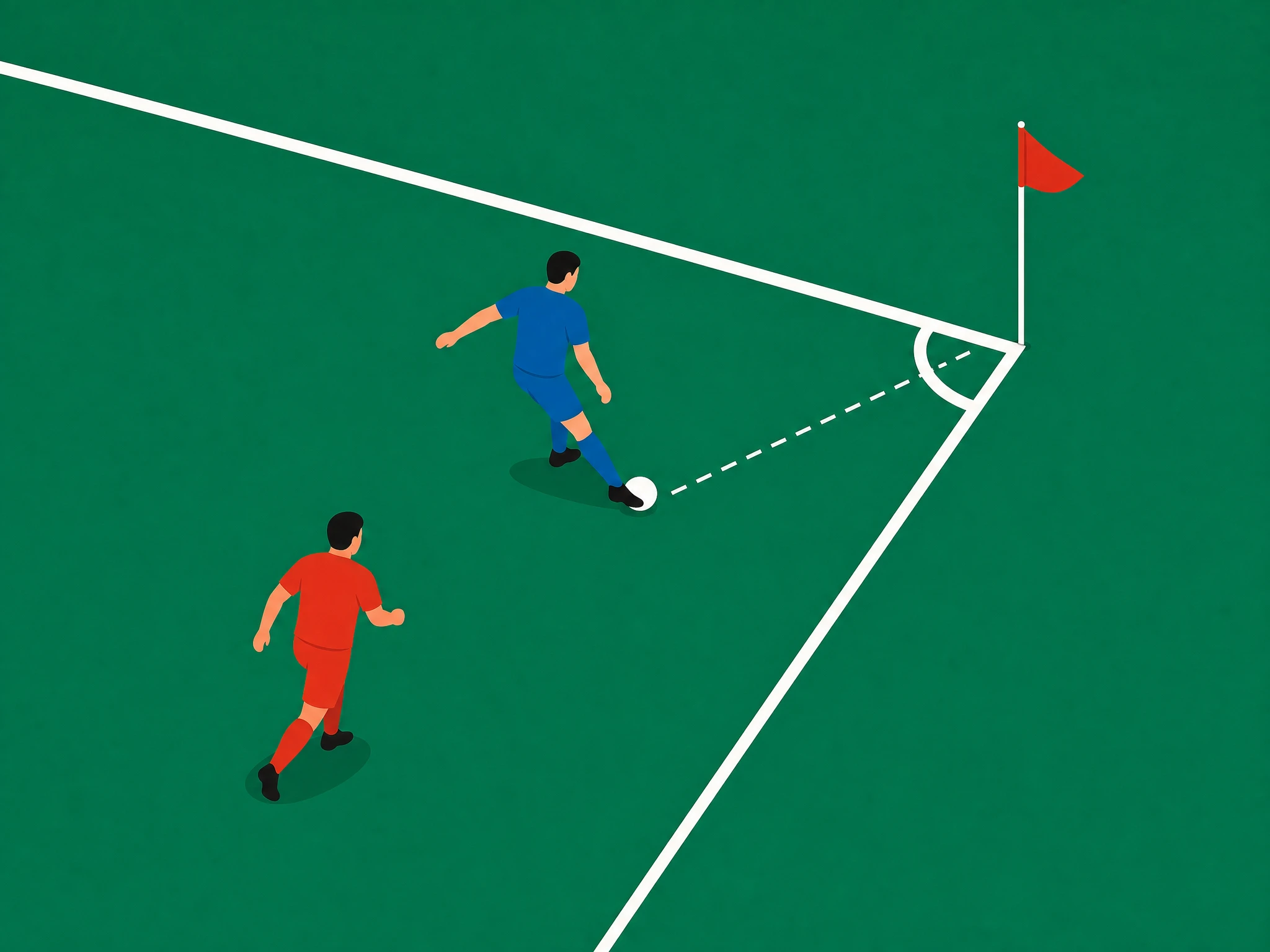
Can you score directly from a corner?
Yes. Law 17 states that a goal may be scored directly from a corner kick, but only against the opposing team. If the ball goes straight into the kicker’s own goal instead, the restart is a corner kick to the opponents, not a goal.
There is also no offside offence for a player who receives the ball directly from a corner, the same exemption that applies to a throw-in and a goal kick. The full offside rule, including that exemption, is covered on its own page. The short version for a corner specifically is that the exemption only lasts until the ball is played a second time, so a short corner followed by a cross can still produce a normal offside call on that second ball.
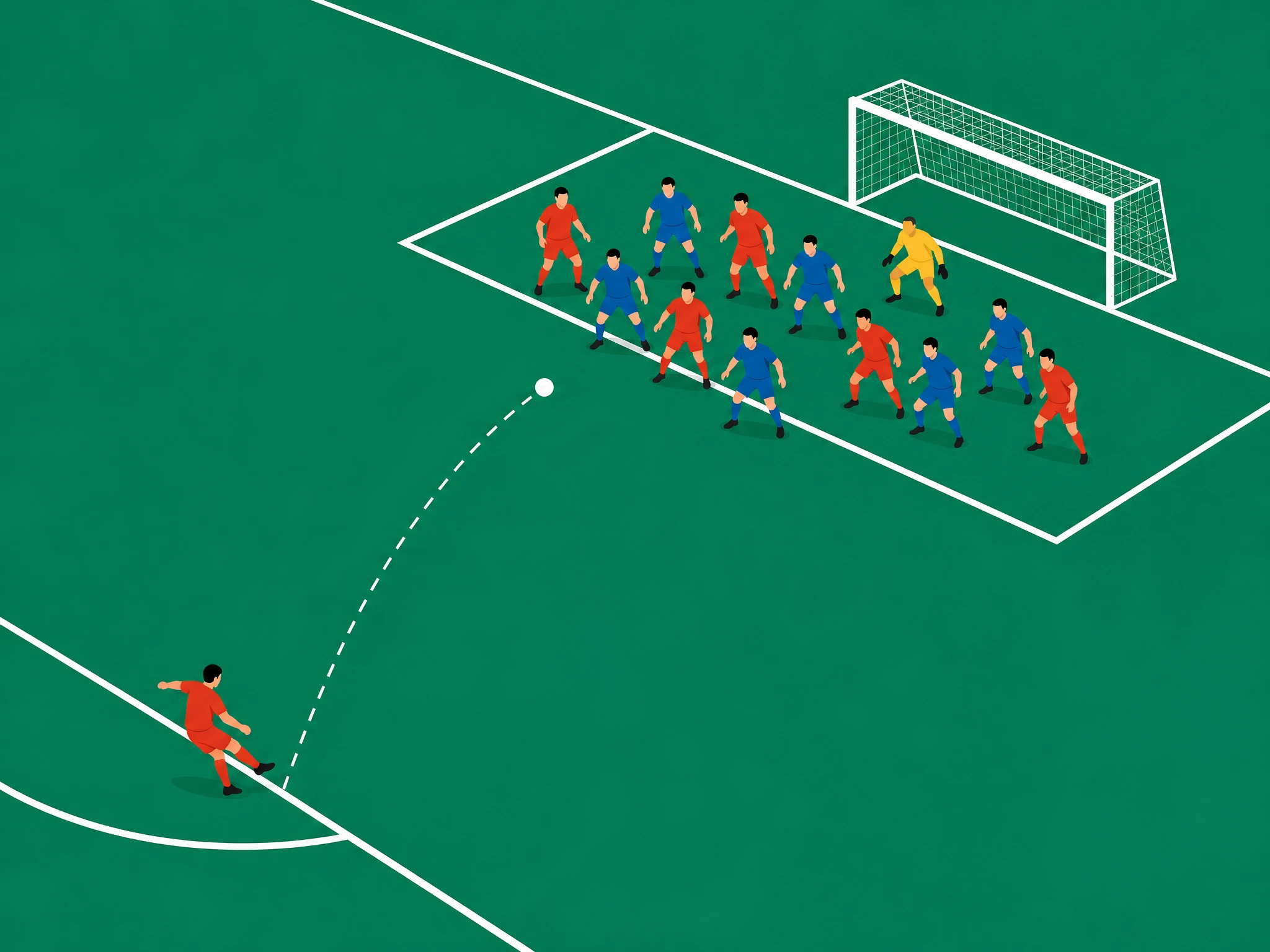
What counts for total corners betting?
This is where the law and the market rules pull apart slightly, because a bookmaker settles on what was actually kicked, not on what the referee awarded. Sportsbook rules for total corners and other corner markets are consistent on a few points.
Counts toward a total corners market
- Any corner that is actually taken, however it is played from there.
- A short corner passed along the byline before being crossed or worked in.
- A corner that has to be retaken for an offence during the same kick, but only once.
Does not count toward a total corners market
- A corner that is awarded but never taken, for example when the referee blows for half time or full time first.
- A second attempt at the same corner beyond the one retake, since a retake still settles as a single corner.
A corner that is awarded but never taken does not count. If the referee signals a corner and then blows for half time or full time before the kick is delivered, sportsbook rules settle that corner as not counted at all. The corner existed under the Laws of the Game the moment it was awarded, but for a betting market it never happened.
A short corner counts the same as a straight cross. How the corner is played, whether it is swung straight into the box or passed short along the byline first, makes no difference to the count. It is one corner kick once it is taken. The market only cares that the restart happened, not the pattern of play that follows it.
A retaken corner still counts once. If the same corner has to be retaken, for example because of encroachment inside the 9.15 metre distance or an offence during the kick itself, bookmaker rules settle that as a single corner, not two. Sky Bet's total corners rule states it directly: "Only corners that are actually taken will count. If a corner is re-taken, it will only count as one corner."
Corner lines explained: over and under
A total corners line is a number with a .5 on the end, so the match can only finish over it or under it. Over 9.5 corners needs 10 or more corners in the match. Under 9.5 needs 9 or fewer. The same logic applies to every half-point line.
| Line | Over wins with | Under wins with |
|---|---|---|
| 4.5 | 5 or more | 4 or fewer |
| 5.5 | 6 or more | 5 or fewer |
| 8.5 | 9 or more | 8 or fewer |
| 9.5 | 10 or more | 9 or fewer |
| 10.5 | 11 or more | 10 or fewer |
On a whole-number line such as over or under 9, a match that lands on exactly 9 corners is neither over nor under. How that is settled, usually as a refund, depends on the bookmaker’s own rules.
Which lines are popular depends on the league and the teams, so check how often a line has been hit before you back it. The corner statistics page shows hit rates for common lines and league averages, and team corner trends shows each team’s corners for and against.
Other corner markets
Betting on corners usually means one of a few markets. Which ones are offered, and the exact wording, differs between bookmakers.
- Total corners over or under: the combined corners for both teams, as above.
- Team corners over or under: only one team’s corners count.
- Most corners: which team takes more corners, sometimes with a draw option and sometimes as a two-way market without one.
- Corner handicap: one team starts with a corner head start or deficit, similar to an Asian handicap on goals.
- Odd or even corners: whether the total number of corners in the match is odd or even. Check the bookmaker’s rules for how a match with no corners is treated.
- First-half corners: only corners taken before half time count. As on the whole-match market, a corner awarded but not yet taken when the referee blows for half time does not count.
There is no limit in the Laws of the Game on how many corners a match can have, so the total depends on how the match plays out. Whether a corner also counts as a cross in a cross total depends on the stat provider’s definition and the bookmaker’s market rules, so check those for the market you are betting on.
Is a corner a player or team stat?
FootyMetrics tracks total corners, and corners for and against by team, across 115+ leagues. Corners are not tracked as an individual player prop the way shots or tackles are, since a corner is a team-level restart rather than an individual action, so FootyMetrics builds its corners trends and stats around team totals rather than a player market.
The full corners statistics page covers match totals, hit rates for common lines and the highest-averaging leagues across the season.