Half markets: first and second half betting
A half market settles on one half of a football match only, so goals and results in the other half do not count towards it. A first half over 0.5 bet is decided by whether a goal is scored between kick-off and the half-time whistle, and the second half could finish 3-0 without changing it.
Team FootyMetrics
Updated Jul 2026 · 6 min read
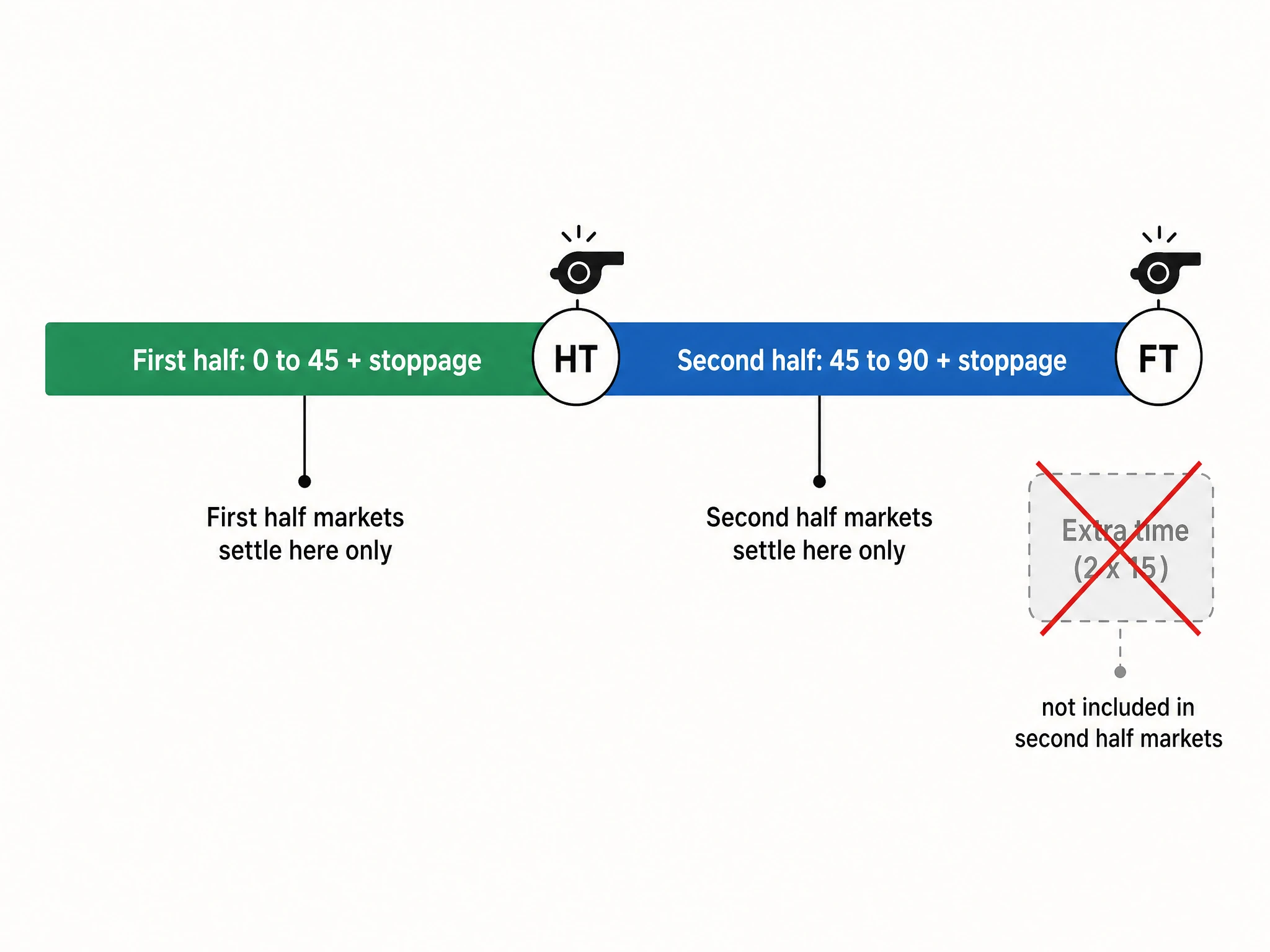
- First half markets settle strictly on the first 45 minutes plus first-half stoppage time. Nothing that happens after the break counts.
- Second half markets settle on the second 45 plus its stoppage time. In a knockout tie this usually does not include extra time, because extra time is a separate period under the Laws of the Game.
- Half-time/full-time (HT/FT) is one combined bet that needs two things right: who was leading at the break and who won the match.
- A '1-0 at half time' reading in a half market only counts goals in that half, so a 0-0 first half followed by a 1-0 win is still under 0.5 first half goals.
The mistake that costs people is reading a half market like a whole-match market. One half is in, the other is ignored completely. A team can win the half-time result market and lose the game, or lose the first half and win 4-1. That independence is the entire point of half markets, and it is where nearly every settlement surprise comes from.
What a half market actually settles on
A half market is any bet judged on the events of one half rather than the whole match. The common ones are half-time result (a 1x2 on who is leading at the break), first half and second half over/under goals, first half and second half Asian handicap, half-with-most-goals, and half-time/full-time. What ties them together is that each one ignores the other half.
On the FootyMetrics first half stats page you can see this directly: teams are ranked by how often they are winning at the break, and for a lot of sides that ranking looks nothing like the full-time table. This is a different question to how the whole-match markets settle. Those run to the end of normal time, 90 minutes plus stoppage time, covered on what is added time. Half markets carve that same 90 minutes into two separately-settled chunks.
First half markets
First half markets settle on the goals and result between kick-off and the half-time whistle, including first-half stoppage time. A goal in the 45th minute plus two of added time counts. A goal in the 46th, the first minute after the restart, does not.
The cut-off is the whistle, not the 45:00 mark on the clock, and that matters more than it used to now that stoppage time has grown. A goal scored deep into first-half added time is a first half goal even if the clock reads 47 or 48 minutes. The boundary works the same way as the whole-match convention on what is added time: the referee’s whistle is the line, not the number on the clock.
First half goals are structurally rarer than second half goals across almost every major league. Sides tend to be more cautious early, defensive shape is harder to break before fatigue sets in, and neither team has made substitutions to change the pattern. Over 0.5 first half goals still lands in most top-division matches, but at a lower rate than the second half equivalent. The first half stats page shows the current-season hit rates by team and by league.
Second half markets, and the extra time trap
Second half markets settle on the second 45 minutes plus its stoppage time. A first half goal does not count towards a second half over/under, and a first half lead does not count towards a second half result market.
The trap sits in knockout football, where a second half market almost never includes extra time. Under the Laws of the Game, extra time is “two equal periods of extra time not exceeding 15 minutes each”, a distinct phase played only when a competition needs a winner, separate from the two 45-minute halves of normal time (IFAB, Law 10). So the “second half” a second half market refers to is the second 45 of normal time, not the second half of extra time and not the whole passage from the break to the final whistle in a tie that goes the distance. A bet that runs through extra time has to be a market that says so, the same way a correct score has to be billed as after-extra-time to include those goals, covered on extra time and shootouts.
Check the market wording in a knockout
Half-time/full-time (HT/FT)
Half-time/full-time is a single bet that combines two results into one selection: the team leading at half time, and the team that wins at full time. You are backing a specific pair, such as home/home (home leading at the break and winning the match) or draw/away (level at half time, away side winning at full time).
There are nine combinations in total, three half-time states (home, draw, away) crossed with three full-time results. Because you have to get both right, the odds are longer than either result on its own, and the draw/draw and comeback selections (a team behind at the break winning at full time) usually carry the biggest prices. Full time here means the end of normal time, 90 minutes plus stoppage, so a cup tie that goes to extra time and penalties still settles HT/FT on the 90-minute scoreline.
A worked HT/FT example
Back home/away and you need the home team leading at half time, then the away team winning at full time. So the home side has to be ahead at the break, get overturned, and lose.
Half time home 1, away 0, then full time home 1, away 2: that settles home/away as a winner. The half-time lead satisfies the first leg, the away comeback satisfies the second.
Change the ending to home 2, away 2 and the bet loses, even though the home team still led at half time. The away side did not win, so the full-time leg fails. HT/FT needs both legs, and a single correct leg is worth nothing on its own.
The “1-0 at half time” trap
The common mistake is reading a scoreline like 1-0 and assuming it settles a half market the way it settles the match. It does not. A half market only counts goals in that half.
A match that finishes 1-0, with the goal scored in the second half, settles under 0.5 first half goals: no goal came before the break, so the first half itself was 0-0. That same 1-0 match settles over 0.5 second half goals, because the only goal landed after the restart. The full-time 1-0 is irrelevant to both half markets except as a pointer to where the goal actually happened.
Flip it around. A match that finishes 1-1 with both goals in the first half is over 1.5 first half goals and under 0.5 second half goals. The full-time 1-1 tells you nothing about either half market by itself. You have to know when the goals went in. The final score on its own will not settle a half market.
First half hit rates by team
See which sides are consistent fast starters, first half over 0.5 and over 1.5 rates, and half-time win rates across the leagues we cover, with a second half page for the other side of the match.
Half markets FAQs
Do first half goals count towards second half markets?
No. A first half goal only settles first half markets. Second half markets count goals scored between the restart and the final whistle of normal time, plus second-half stoppage time. A goal before the break has no bearing on a second half over/under or a second half result bet.
Does a second half market include extra time?
Usually not. Under the Laws of the Game, extra time is a separate period of two 15-minute halves played only when a knockout needs a winner, distinct from the two 45-minute halves of normal time. So a second half market normally settles on the second 45 of normal time only. Wording varies by bookmaker, so check the settlement rules on the specific market.
What does half-time/full-time (HT/FT) mean?
It is one bet combining two results: the team leading at half time and the team that wins at full time. You have to get both right for it to win. There are nine combinations, three half-time states crossed with three full-time results, and the comeback and draw selections carry the longest odds.
If a match finishes 1-0, is that over 0.5 first half goals?
Only if the goal was scored before half time. A 1-0 match where the goal came in the second half settles under 0.5 first half goals, because the first half itself was 0-0. Half markets count goals in that half only, so when the goal went in matters more than the final score.
Do first half stoppage time goals count towards first half markets?
Yes. The cut-off is the half-time whistle, including first-half stoppage time, not the 45:00 mark on the clock. A goal scored in first-half added time is a first half goal even if the clock reads 47 or 48 minutes.
Are more goals scored in the first or second half?
Second halves average more goals than first halves across nearly every major league. Teams open up after the break, substitutions change the shape, and defensive concentration drops. Over 0.5 first half goals still lands in most top-division matches, but at a lower rate than the second half equivalent.