What is added time (stoppage time)?
Added time, also called stoppage time or injury time, is the time the referee adds to the end of each half to make up for time the ball was out of play or the game was stopped. The fourth official's board shows a minimum, not a final number. If more time gets lost during the added period itself, the referee can add more on top.
Team FootyMetrics
Updated Jul 2026 · 6 min read
- Added time compensates for specific stoppages in that half: substitutions, injury assessment and treatment, time-wasting, disciplinary sanctions, permitted drinks and cooling breaks, VAR checks and reviews, goal celebrations, and any other significant delay to a restart.
- The number the fourth official holds up is a minimum. The referee can add more if the game is stopped again during the added time itself. It can never be reduced.
- Added time has grown noticeably since the 2022 World Cup and the 2023-24 season, because referees started timing stoppages more precisely rather than adding a rough estimate. The law itself did not change.
- In betting, “90 minutes” as a settlement phrase already includes added time. It means the score at the end of normal time, stoppage time included, not the literal 90:00 on the clock.
Most of the confusion around added time is not about what it is, it's about the board. People see a number and treat it as fixed, when the law treats it as a floor.
What added time is
Football is played over two 45 minute halves, but the ball isn't in play for all of that time. Every time it goes out for a throw-in, a goal is scored and celebrated, a player goes down injured, or VAR checks a decision, the clock keeps running but nothing is happening. Added time is how the referee gives that time back.
IFAB’s Law 7 (The Duration of the Match) sets this out under “Allowance for time lost.” The exact list: “Allowance is made by the referee in each half for all playing time lost in that half through” substitutions, assessment and/or removal of injured players, wasting time, disciplinary sanctions, medical stoppages permitted by competition rules such as drinks breaks and cooling breaks, delays relating to VAR checks and reviews, goal celebrations, and any other cause, including a significant delay to a restart.
That's not a vague allowance for stoppages in general. It's a defined list, and a referee totting up a couple of substitutions, a lengthy injury treatment, a booking and a goal celebration or two can easily reach five or six minutes without anything unusual happening in the game.
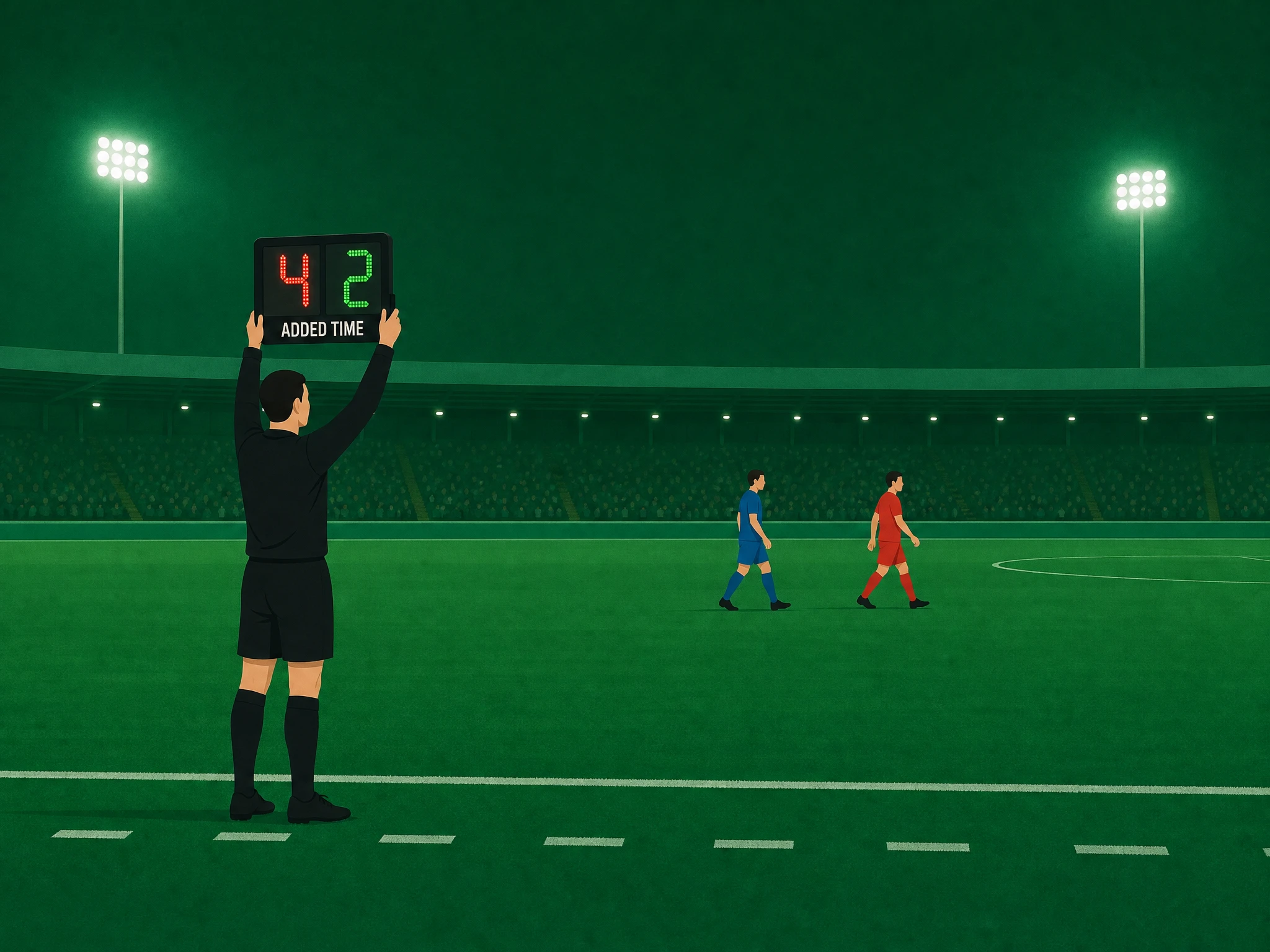
A minimum, not the final word
This is the part people get wrong. When the fourth official holds up the board at the end of a half, most people read the number as fixed: three minutes shown, three minutes played, done. That isn't what the law says.
IFAB is explicit that the board figure is a floor, not a ceiling. The fourth official indicates “the minimum additional time decided by the referee at the end of the final minute of each half,” and that additional time “may be increased by the referee but not reduced.”
The board number is a floor, not a ceiling
In practice, that means if the board shows 4 minutes and, in minute 2 of those 4, there's a bad injury or another goal and celebration, the referee is entitled to keep playing past the original 4 and add further time for what was just lost. The only figure the referee has to hit is the board number as a minimum. Going over it because more time was lost is normal, not a mistake.
Why added time has grown so much
Anyone who watched football before 2022 and watches it now will have noticed added time is longer, often into double figures at the end of a half. That isn't a change to the law. Goal celebrations and VAR checks were always compensable time under Law 7. What changed is how strictly referees started timing them.
At the 2022 World Cup, FIFA’s referees committee, headed by Pierluigi Collina, pushed officials to add the actual time lost to celebrations, substitutions, injuries and VAR checks rather than a rough estimate, partly because ball-in-play time in a match had fallen towards 50 minutes and FIFA wanted fans watching more actual football. The England vs Iran group game ran to 27 minutes of added time across both halves, a record for a World Cup group match. Source: NPR.
The Premier League followed the same approach from the 2023-24 season. PGMOL, working with IFAB’s guidance, moved away from the old habit of adding a flat 30 seconds per incident and started clocking the real time lost to celebrations, substitutions, penalties and cards, driven by the same concern that ball-in-play time had dropped to around 55 minutes a match in England. Source: Goal.com.
So the increase is enforcement, not legislation. The categories in Law 7 haven’t changed. Referees are simply better at adding up what those categories actually cost in a given match.
Added time and betting
For in-play markets and full-time result settlement, “90 minutes” is shorthand for the whole of normal time, added time included. A bet settling on “90 minutes” isn’t judged at the literal 90:00 mark on the game clock. It's judged on the score once the referee blows for full time at the end of normal time, whatever the clock happens to read by then, whether that's 90:00 or 97:30.
This is the same convention covered on win to nil explained, where match result markets, including win to nil, settle on the score at the end of normal time (90 minutes plus stoppage time), not after any extra time or penalties in cup competitions. Added time growing longer in recent seasons doesn’t change what counts as “90 minutes” for settlement. It just means that period of the match can now run considerably past the 90:00 mark on the clock before it ends.
Added time as a stat
FootyMetrics tracks match timing data, including how long each half runs past 45 or 90 minutes, across 115+ leagues, useful context for anyone comparing how strictly different leagues or referees apply the current timing rules.
Added time FAQs
Is the added time shown on the board the final amount?
No. It's a minimum set by the referee. Under IFAB's Law 7, additional time “may be increased by the referee but not reduced” if more time is lost during the added period itself.
What does added time compensate for?
IFAB lists specific categories: substitutions, injury assessment and removal, time-wasting, disciplinary sanctions, permitted drinks and cooling breaks, VAR checks and reviews, goal celebrations, and any other significant delay to a restart.
Why has added time got so much longer since the 2022 World Cup?
Referees started timing stoppages more precisely, adding the actual time lost to things like goal celebrations and VAR checks rather than a rough estimate. The law itself didn't change, only how strictly it's applied.
Does '90 minutes' in betting include added time?
Yes. Full-time result and in-play markets settle on the score at the end of normal time, which includes stoppage time, not the literal 90:00 mark on the clock.
Is added time the same as extra time?
No. Added time (stoppage time) is added within normal time to make up for the ball being out of play. Extra time is a separate additional period played after a draw in knockout competitions.
Can added time be extended again if something happens during the added period itself?
Yes. The board number is only a floor. If the board shows 4 minutes and a goal is celebrated at length in minute 2 of those 4, or a player goes down injured, the referee adds that extra delay on top and plays past the original 4. The additional time can go up as often as the game demands it. It never gets reduced once shown.