Predicted vs confirmed lineups: why the timing matters
A predicted lineup is a best guess made hours or a day out. A confirmed lineup is the one the club actually names, and it's the only version that decides whether your player prop has any chance of winning. Most of the risk in prop betting sits in the gap between those two moments.
Team FootyMetrics
Updated Jul 2026 · 6 min read
- Predicted lineups are a model, pundit or fan-consensus guess made well before kickoff. Confirmed lineups come only from the clubs, and most player props void or lose outright if your player isn't in the confirmed XI.
- Confirmed lineups tend to land roughly an hour before kickoff in the major leagues, though the exact window is set by the competition, not a universal rule.
- Betting before confirmation usually gets a better price but carries lineup risk. Waiting removes that risk but the price has often already moved, and some markets stop taking bets once teams are in.
- Rotation is the single biggest reason a predicted lineup turns out wrong, especially in cup ties against weaker opposition or dead rubbers once a team is already through or already out.
- The Super Sub offer only softens a mid-match substitution. It does nothing for a player left out of the squad entirely.
Most people find this out the expensive way: a player they backed was never in the squad at all, and the bet was dead before the match even kicked off.
What "predicted" actually means
A predicted lineup is somebody's best guess at the starting XI before the club has said anything official. It might come from a data provider's model weighing recent starts and minutes, a pundit reading training ground photos, or a fan consensus built from beat reporters. All three are working from the same limited picture: who trained, who's picked up a knock, who started last time out, and who the manager tends to favour in this fixture type. None of it is the team sheet. A manager can and does change their mind on the morning of a match, sometimes for reasons nobody outside the building knows about.
What "confirmed" actually means
A confirmed lineup is the starting XI the club releases through its own official channels, typically alongside the opposition's team news at the same point in the pre-match build-up. It's the only version a bookmaker will settle a prop against. Confirmed doesn't mean guaranteed to finish the match, a player can still be subbed, injured or sent off, but it does mean they were named to start.
How long before kickoff is confirmed
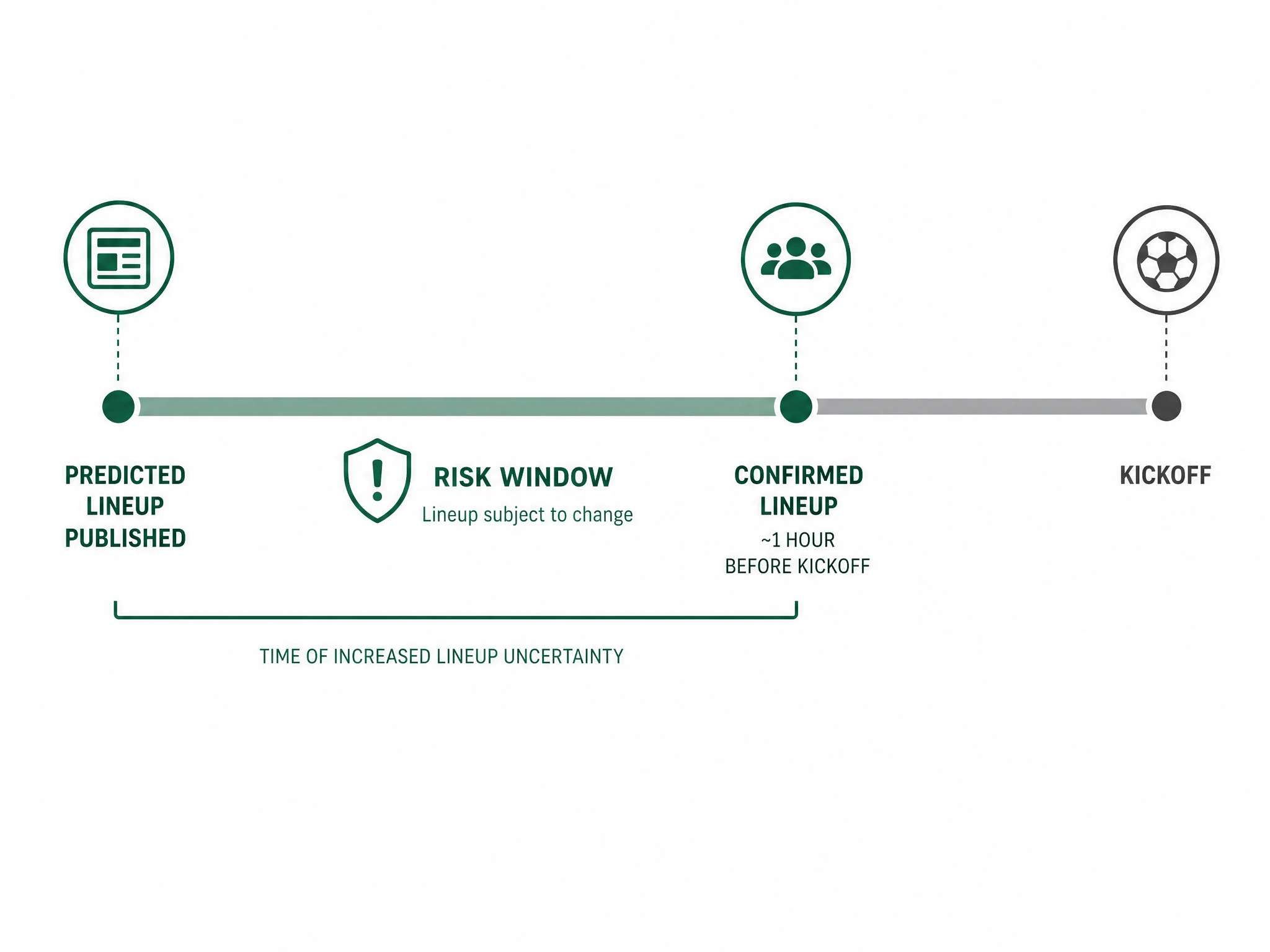
Where the risk actually sits
The gap between a predicted lineup going up and the confirmed one landing is where prop betting risk concentrates. If you've backed a player to hit a shots or cards line and they're left out of the squad entirely, or named among the substitutes instead of the starting XI, that bet is dead. Most bookmakers void the selection or settle it as a loss outright, unless a specific promotion applies. FootyMetrics has a full breakdown of the one mechanic that changes this outcome on the super sub offer and its many names, but it's worth being precise about what it actually covers here: it protects a bet once a named starter is substituted mid-match, rolling it onto whoever comes on. It does nothing for a player who was never named to start in the first place. Predicted-lineup risk and in-match substitution risk are two different problems, and only the second one has a bookmaker safety net attached to it.
Rotation is the biggest single cause
Injuries and suspensions are usually flagged well in advance and priced into a predicted lineup correctly. Rotation is the one that catches people out, because it can happen with no warning at all. A manager rests key players in a domestic cup tie against lower-league opposition, or fields a weakened side once qualification from a group stage is already settled either way.
A clean recent example: when Arsenal faced FK Kairat Almaty in the Champions League league phase in January 2026, Arsenal had already secured a top-two finish the previous week by beating Inter Milan, and Kairat had already been eliminated with one point from seven games. Neither side had anything left to play for in terms of the table. Arsenal used the match to hand debuts to two academy players, Brando Bailey-Joseph and Ife Ibrahim, the 18th and 19th academy players to debut under Mikel Arteta. That's the shape of the risk: a fixture where the result carries no consequence for one or both teams is exactly when a manager is most likely to hand out fringe starts, rest a first-choice player, or make changes a predicted lineup model has no way to see coming from training data alone.
- The team has already qualified from its group or is already mathematically out.
- It's a domestic cup tie against lower-league opposition.
- The match is the second of two games in a congested midweek run.
- A key player has just played a full 90 minutes in a bigger fixture days earlier.
- The manager has publicly flagged squad rotation before the match.
Betting early vs waiting for confirmation
This is a genuine trade-off and there's no universally correct side of it. Betting well before the confirmed lineup drops usually gets you a better price, because the market hasn't fully priced in a settled starting XI yet. Odds on player props tend to shorten once the team news is public and the uncertainty drops out of the price. The cost is that you're carrying full lineup risk: if your player doesn't start, the bet is gone regardless of how good the price looked.
Waiting for the confirmed lineup removes that specific risk. You know your player is in the XI before you stake anything. The cost there is that the price has often already shortened by the time confirmation lands, since everyone else with access to the same team news is doing the same thing at the same time. And on some markets, particularly ones that close early or don't accept in-play adjustments, the betting window can close before or shortly after confirmation, so waiting isn't always available as a strategy even if you want to use it.
Neither approach is right in every situation. A heavy favourite with a settled first-choice XI and no cup or rotation risk is a reasonable one to back early. A midweek cup tie for a team already through to the next round is exactly the kind of match where waiting for the confirmed team sheet is worth the shorter price.
What happens if your player gets subbed instead
Being left out of the confirmed XI and being substituted mid-match are different risks with different consequences. If your player starts as confirmed and is later subbed off, the prop bet settles on whatever they did while they were on the pitch, unless a Super Sub-style offer moves the bet onto the substitute. FootyMetrics covers the underlying law on this on substitution rules, including how many changes a team can make and why the timing of a substitution matters for a prop that's still unsettled at that point.
FootyMetrics shows both the predicted and confirmed lineup on the match page, plus each player's recent minutes and start pattern, so you can see how often a player has actually started recently before backing a prop tied to them. Reading a player's trend card the right way, particularly the started-only filter, helps separate a player who's a nailed-on starter from one who's been rotated in and out. See reading a player trend card for how to read the history strip. The Player Props Finder also has a lineup status filter you can set to confirmed only, which is the most direct way to cut predicted-lineup risk out of a search entirely: it only returns players from matches where the team sheet is already out.
Player props finder
Filter upcoming fixtures by lineup status, confirmed only, before backing a prop.
Predicted vs confirmed lineups FAQs
How long before kickoff are lineups usually confirmed?
Roughly an hour is the widely used convention in most major European leagues, but there's no single global rule. The Premier League specifically releases its lineups 75 minutes before kickoff, a change made for the 2024/25 season to align with UEFA's own timing for the Champions League and Europa League. Lower-level leagues and domestic cups can run a different window, so check the competition rather than assuming.
What happens to a player prop if my player isn't in the confirmed lineup?
Most bookmakers void the bet or settle it as a loss, since the player never took part in the match. This is different from a player being substituted after starting, where a mid-match sub is involved rather than a no-show from kickoff.
Does the Super Sub offer protect me if my predicted player doesn't start at all?
No. Super Sub and its equivalents (Impact Sub, Fresh Legs, Safe Sub and the rest) only apply once a named starter is substituted during the match. A player left out of the squad or the starting XI entirely was never a starter, so there's nothing for the offer to roll the bet onto.
Is it better to bet before or after the confirmed lineup is released?
Both have a real cost. Betting early usually gets a better price but carries the risk your player isn't named. Waiting for confirmation removes that risk but the price has often already shortened, and some markets close their betting window before or shortly after the team sheet lands.
Why do cup matches carry more lineup risk than league matches?
Managers use domestic cup ties and dead rubbers, matches where qualification or relegation is already decided, to rest first-choice players and give fringe or academy players minutes. A predicted lineup model working from training data and recent starts has no reliable way to anticipate that kind of squad rotation.
Can I filter for confirmed lineups only when researching props?
Yes. The FootyMetrics Player Props Finder has a lineup status filter that can be set to confirmed only, so a search only returns players from matches where the official team sheet is already public.