Scorecast and wincast explained
A scorecast is one bet that a named player scores and the match ends on an exact correct score. A wincast is one bet that a named player scores and their team gets the result you picked. Both are priced as a single correlated bet, not the two singles multiplied together, and an own goal never counts as your scorer.
Team FootyMetrics
Updated Jul 2026 · 6 min read
- A scorecast pairs a goalscorer with the correct score. A wincast pairs a goalscorer with the match result: home win, draw or away win.
- Both are priced shorter than multiplying the goalscorer price by the correct-score or result price, because the two legs are correlated.
- The scorer half comes in first, anytime and last variants. A first scorecast needs your player to open the scoring; an anytime scorecast just needs them to score at some point.
- An own goal is nobody's goal for the scorer half. On a first scorecast, an own-goal opener rolls the scorer leg on to the next real goal.
- If your player doesn't play, or comes on after the first goal, most bookmakers settle a first scorecast as a single on the correct score alone.
Both bets start from the same goalscorer half and bolt a second condition onto it. The detail worth getting right is why the price is shorter than you'd expect from multiplying two singles, and what an own goal does to the scorer leg.
What each one combines
A scorecast is a single bet with two conditions: a named player scores, and the match finishes on a specific correct score. Backing Erling Haaland and 2-1 is a scorecast. Both parts have to land. If Haaland scores but the game ends 3-1, the scorecast loses, and if the game ends 2-1 but Haaland doesn't score, it loses too.
A wincast swaps the exact scoreline for the match result. It combines a named player scoring with their team's outcome: a home win, a draw, or an away win. Backing Haaland and a Manchester City win is a wincast. You need Haaland on the scoresheet and City to win, but the exact score doesn't matter. A wincast is more forgiving than a scorecast because "City win" covers 1-0, 2-0, 3-1 and every other winning line, while a scorecast pins you to one of them.
The scorer half of either bet works exactly like the standalone goalscorer markets, so the first, anytime and last distinctions carry straight over. That whole mechanic, including how the market rolls on past an own goal, is covered on goalscorer markets: how they settle.
- Named player scores, plus the exact correct score.
- Pins you to one scoreline, so it pays more.
- Example: Haaland to score and it finishes 2-1.
- Named player scores, plus their team's result.
- Any winning scoreline counts, so it pays less.
- Example: Haaland to score and City to win.
Why it's one correlated bet, not two singles multiplied
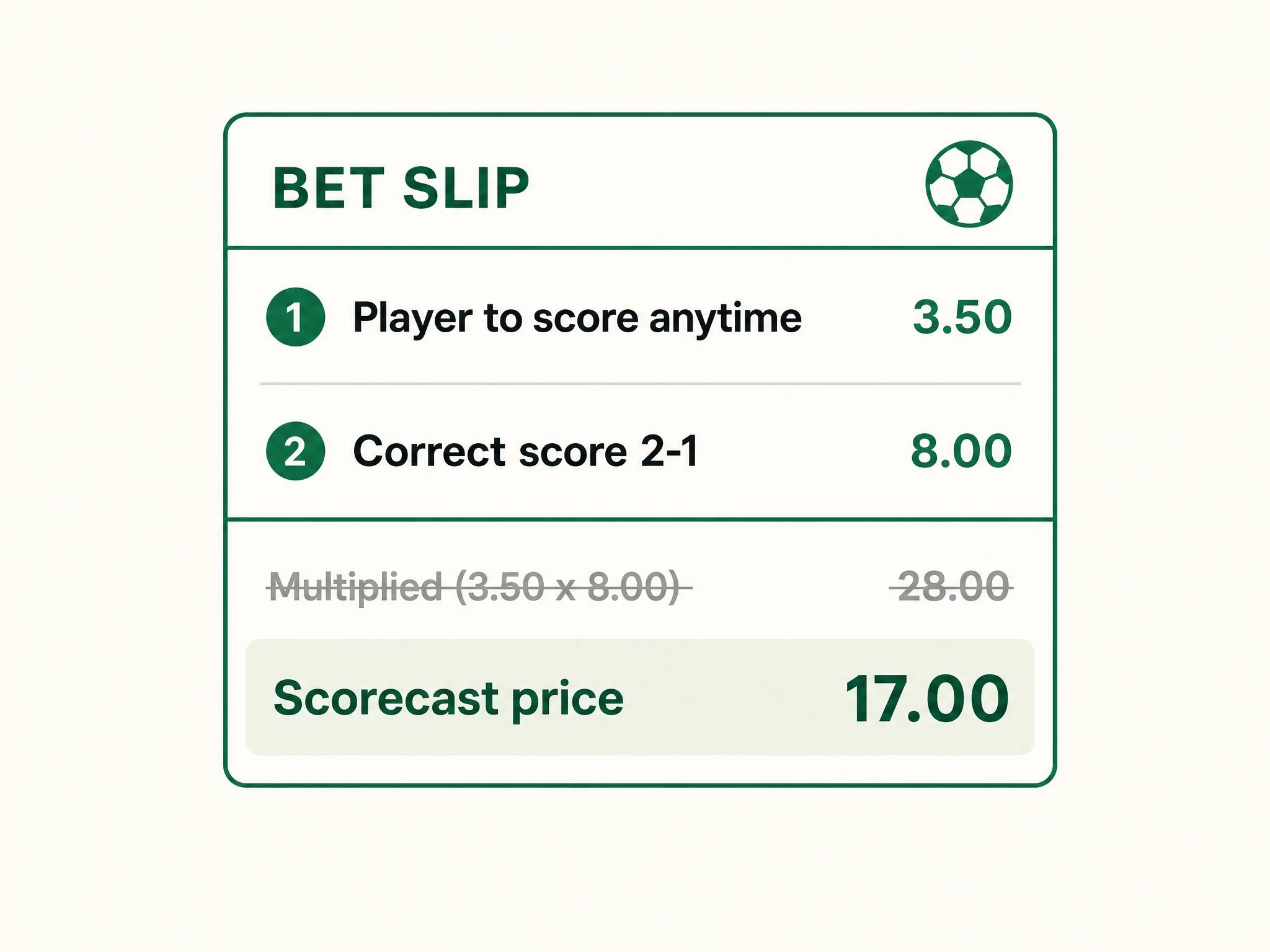
The obvious way to price a scorecast would be to take the anytime goalscorer price, multiply it by the correct-score price, and call that the combined odds. Bookmakers don't do that, and the reason is correlation.
The two legs aren't independent events. If your player scores, that goal itself moves the correct score and the result towards the ones you'd want. A striker scoring makes it more likely his team wins and more likely the match lands on a scoreline that includes his goal. Because the legs push each other in the same direction, their true combined chance is higher than treating them as unrelated coin flips implies. A higher true chance means a shorter fair price, so the bookmaker prices the whole scorecast as one number rather than multiplying the singles.
This is the same correlation maths that sits under a bet builder or same-game multi. We go through it in full, with the fair-price effect of positively correlated legs, on bet builders and correlation. A scorecast is really just a fixed, pre-priced correlated double that bookmakers have offered for decades under its own name.
The correlation is already in the price
Anytime scorecast vs first scorecast
The scorer leg comes in the same variants as any goalscorer bet, and the wording on the slip tells you which one you've got.
A first scorecast needs your player to score the opening goal of the match and the game to finish on your correct score. It's the tighter, longer-priced version, because your player has to get there first.
An anytime scorecast just needs your player to score at any point, plus the correct score. It's more forgiving on the scorer leg, so it prices shorter than the first-scorer version of the same combination.
Wincast is usually offered as an anytime-goalscorer bet paired with the result, though some books also list a first-scorer wincast. Check the slip: "player to score anytime and team to win" is the common form.
How own goals are handled
An own goal is never credited to a player as a scorer, so it can never complete the scorer half of a scorecast or wincast. That part follows the ordinary goalscorer rule: own goals don't count for goalscorer or scorecast markets. Sky Bet’s football goalscorer rules state exactly that, and set out what happens next.
On a first scorecast, an own-goal opener doesn't kill the scorer leg. It rolls on to the next real goal, the same as a plain first goalscorer bet. Sky Bet's rules put it plainly: in the event of an own goal, bets are settled on the next goalscorer and the correct score in the match. If the correct score is 1-0 and the only goal of the match is an own goal, the bet is settled as a correct-score single instead, because there's no player left for the scorer leg to land on.
The other settlement quirk is what happens if your player isn't involved. Sky Bet's rules state that if your selected player doesn't take part, or comes on after the first goal is scored, a first scorecast is settled as a single on the correct score alone. You aren't refunded and you don't lose outright: the bet drops the dead scorer leg and rides on the correct-score half.
Rules differ by bookmaker
See the match and score projections first
FootyMetrics predictions cover result and correct-score probabilities across 115+ leagues, the two halves a scorecast or wincast leans on.
A worked example
Say you back a first scorecast: your striker to score first, and the match to finish 2-1 to his team. Three ways it can go:
- Striker scores first, game ends 2-1. Both legs land. The scorecast wins at the combined price.
- Striker scores first, game ends 3-1. The scorer leg landed but the correct score didn't. The scorecast loses.
- An own goal opens the scoring, then your striker scores, and it finishes 2-1. The own goal doesn't count as anyone's goal, so the "first" leg rolls on to the next real goal, which is your striker's. Both conditions are met and the bet wins.
Now the same two legs as a wincast: your striker to score anytime, and his team to win. A 2-1 win, a 3-1 win and a 4-0 win all settle it as a winner, as long as your striker is among the scorers. That's the trade: the wincast asks for less precision on the scoreline, so it pays less than the scorecast on the same striker. If you're weighing which player is worth pairing with a scoreline, our player props finder surfaces the goalscorer side of that call.
Scorecast and wincast FAQs
What is the difference between a scorecast and a wincast?
A scorecast combines a named player scoring with the exact correct score of the match. A wincast combines a named player scoring with their team's match result, home win, draw or away win, without needing the exact score. A wincast is more forgiving because any winning scoreline counts, so it usually pays less than a scorecast on the same player.
Why is a scorecast priced shorter than the two odds multiplied together?
Because the legs are correlated. A player scoring makes his team's result and certain scorelines more likely, so the true combined chance is higher than treating the legs as independent implies. A higher chance means a shorter fair price, so the bookmaker prices the scorecast as one correlated number rather than multiplying the singles.
Does an own goal count for a scorecast?
No. An own goal is not credited to any player, so it can never complete the goalscorer half of a scorecast or wincast. On a first scorecast, an own-goal opener rolls the scorer leg on to the next real goal, the same as a first goalscorer bet, rather than voiding it.
What happens to a scorecast if my player does not play?
On most first scorecasts, if your player does not take part or comes on after the first goal, the bet is settled as a single on the correct score alone. Sky Bet's rules state this directly. You keep the correct-score leg and lose the dead scorer leg rather than having the whole bet void.
Can I make an anytime scorecast instead of a first scorecast?
Yes. An anytime scorecast needs your player to score at any point plus the correct score, so it is more forgiving than a first scorecast, which needs your player to open the scoring. The anytime version prices shorter because the scorer leg is easier to land.
Is a scorecast the same as a bet builder?
It is the same idea. A scorecast is a fixed, pre-priced correlated double: a goalscorer leg and a correct-score or result leg from the same match, priced as one number with the correlation built in. A bet builder lets you assemble your own correlated legs, but the pricing logic is the same.
Keep learning
Goalscorer markets: how they settle
First, anytime and last, and the own-goal roll-on rule
Bet builders and correlation
Why correlated legs price shorter than the multiple
Win to nil explained
Another combined result-and-goals market
Match predictions
Result and correct-score probabilities across 115+ leagues