Bet builders and correlation: how the price is made
A bet builder, or same game multi, is not priced by multiplying the single odds together, because legs from the same match affect each other. When two legs tend to happen together, the combined price comes out shorter than the naive multiplication, and the bookmaker adds a margin on top. That gap is the whole story of how a bet builder price is made.
Team FootyMetrics
Updated Jul 2026 · 7 min read
- A bet builder combines several legs from one match. The price is not the singles multiplied together, because legs in the same game are correlated.
- Positively correlated legs, like over 2.5 goals plus a striker to score, make each other more likely, so the true combined chance is higher than independent maths says and the fair price is shorter.
- Some combinations are blocked because they cannot both happen, or because the correlation is so strong the bookmaker won't price it.
- A voided leg, like a player who doesn't start, either recalculates the bet on the remaining legs or voids the whole thing, and that rule differs by bookmaker.
- Bet builders carry a bigger margin than the same legs placed as singles, so even a fair-looking build is priced against you more than a single is.
Why you can’t just multiply the odds
Put an accumulator together from separate matches and the maths is simple. Each result is independent, so you multiply the decimal odds. A 1.80 in one game and a 2.00 in another gives 1.80 times 2.00, which is 3.60. Nothing in the first match changes what happens in the second.
A bet builder breaks that assumption. Every leg comes from the same 90 minutes, so the legs aren’t independent. If one leg becomes more likely when the other happens, multiplying the two prices overstates the combined odds, because it double-counts how easy the pair is to land. The bookmaker prices the legs together, accounting for how they move with each other, then adds a margin. The result is almost always shorter than the multiplied singles.
That’s why the same two selections can look like a 3.60 accumulator across two games and a much shorter number as a same game multi on one.
What correlation means here
Correlation is just how two events move together. Two legs are positively correlated when one happening makes the other more likely, negatively correlated when one happening makes the other less likely, and independent when neither affects the other.
Football legs from the same match are rarely independent. A few concrete examples:
- Positively correlated: over 2.5 goals and a striker to score. A game with three or more goals is a game where a forward is more likely to have scored one of them. The two feed each other, so their true combined chance is higher than the two singles imply.
- Positively correlated: a team to win and that team’s winger to have two or more shots on target. A team on top tends to be the team creating chances, so the win and the attacking return tend to show up together.
- Negatively correlated: both teams to score and one team to win to nil. These pull against each other. If the underdog scores, the win-to-nil leg is already dead.
- Mutually exclusive: win to nil and both teams to score. These can’t both be true. A win to nil means the opponent didn’t score; both teams to score means they did. No bet builder will let you combine them, because the combined probability is zero.
The bookmaker’s model estimates the joint probability of the whole build, not each leg on its own. Positive correlation between legs pushes that joint probability up relative to the independent product, which pulls the fair price down.
A worked example
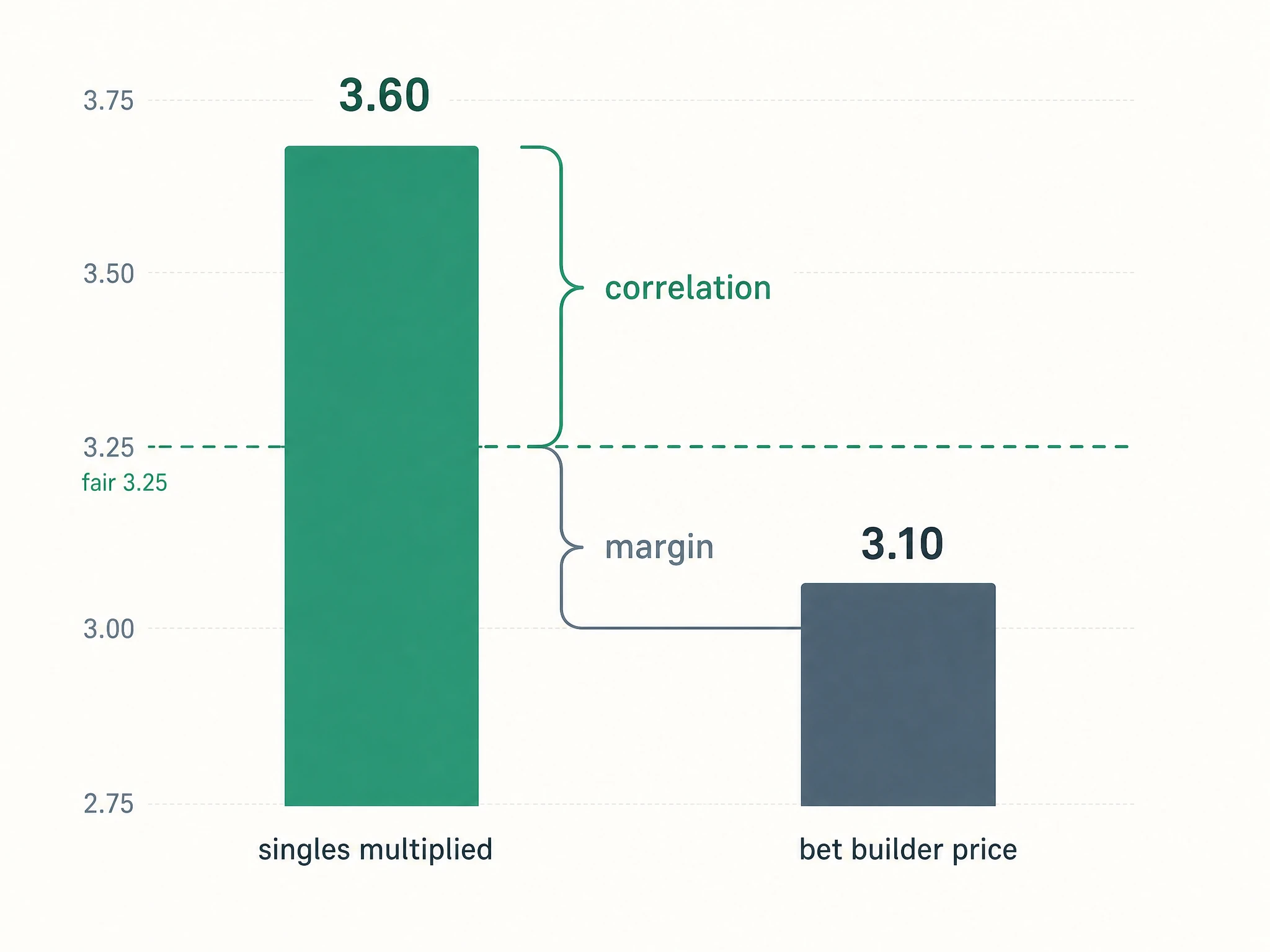
Take two legs, one at 1.80 and one at 2.00. Multiply them and you get 3.60, the price they’d make as a two-fold across separate matches. Now put them in the same game and assume they’re positively correlated, which most attacking bet builder legs are: over 2.5 goals at 1.80 and a named striker to score anytime at 2.00.
Because a high-scoring game and that striker scoring tend to happen together, the true chance of both landing is higher than the independent multiplication assumes. Higher chance means a shorter fair price. So before the bookmaker adds anything, the fair combined price is already below 3.60, somewhere around 3.20 to 3.30 depending on how strongly the model rates the link. Then the bookmaker adds its margin, and a typical offered price on those two legs might come out around 3.10.
| Price | Decimal | What it reflects |
|---|---|---|
| Singles multiplied | 3.60 | 1.80 x 2.00, treating the legs as independent |
| Fair correlated price | ~3.20 to 3.30 | After the correlation adjustment, no margin yet |
| Offered price | ~3.10 | Fair price with the bookmaker’s margin on top |
The gap from 3.60 down to 3.10 has two parts:
- The correlation adjustment: the drop from 3.60 to roughly 3.20 to 3.30, because the legs aren’t independent and the naive product over-prices them.
- The margin: the further drop from that fair figure down to the 3.10 you’re actually offered, the bookmaker’s built-in edge.
You never see those two parts split out. You see one shorter number. That’s the point of pricing the build as a whole rather than as a chain of singles.
Why some combinations are blocked
Two reasons a bet builder refuses a combination.
The first is that the legs are mutually exclusive: they can’t both be true, so the combined probability is zero and there’s no price to offer. Win to nil plus both teams to score is the clean example.
The second is that the correlation is so strong the bookmaker won’t take the risk of pricing it. If two legs almost always happen together, combining them is close to backing the same thing twice at inflated odds, and the model can’t price the near-certainty of the link cleanly. Books restrict these to protect themselves. The exact blocked list isn’t published and varies between bookmakers, so the only reliable way to find out is to try adding the legs and see whether the builder accepts them.
What happens when a leg is voided
The common case is a player prop where the player doesn’t start. Your bet builder had a striker to score, and he’s named on the bench or not in the squad at all. That leg can’t win or lose, so it’s voided. What happens to the rest of your bet depends on the bookmaker’s own rules, and this is where they genuinely differ.
- The voided leg is removed and the bet re-prices on the legs still standing.
- A four-leg build becomes a three-leg build at the adjusted odds.
- The more common treatment for a single voided leg.
- Any voided leg voids the entire bet builder.
- Your stake is returned in full.
- Applies at some bookmakers or on some specific market types.
Which one applies is set out in each bookmaker’s own settlement rules, and it isn’t safe to assume. Some operators publish the recalculation approach plainly: Bovada’s prop builder rules state that a user-built accumulator is settled on the remaining valid legs with the odds recalculated to factor out the voided one, and only voided in full if a single leg is left standing. Others void the whole bet builder if any leg goes.
Check the rules page, don't assume
Why bet builders carry a bigger margin
Even a fairly priced-looking bet builder is worse value than the same legs as singles, because the margin is bigger. Two reasons.
Each leg already carries a margin as a single. Combine several legs and, even after the correlation adjustment, stacking multiple margined prices into one means the total edge the bookmaker holds on the build is larger than on any one leg. It’s the same reason accumulators carry more margin than singles, set out in what is the overround: every extra selection is another price with the book’s cut baked in.
On top of that, bet builders are a discretionary, model-priced product with far less competitive pressure than a headline match-odds market. A 1X2 price gets compared across dozens of books in seconds, so it’s kept tight. A specific five-leg same game multi is priced by one book’s model and almost never compared like for like, so the book can hold a wider margin without losing the business. The overround baked into a bet builder is typically well above the overround on the single markets its legs come from.
If you want to see how much margin sits inside a set of prices, the method is the same as for any market: convert to implied probability and add up, covered in how to devig odds. It’s harder to run on a bet builder, because you don’t get the fair correlated price to compare against, only the single number you’re offered. That opacity is part of why the product holds a wider edge.
Price player legs from the player's own record
FootyMetrics' player props finder builds a fair price for a player stat market straight from that player's own numbers, so you can judge a bet builder's player legs against a fair line instead of the bookmaker's marked-up one.
Bet builder pricing FAQs
Why is a bet builder shorter than the accumulator price of the same legs?
Because the legs come from the same match and are correlated. When legs make each other more likely, multiplying their single odds overstates the combined price, so the bookmaker prices the build as a whole at a shorter number, then adds its margin on top.
What does correlation mean in a bet builder?
It means how two legs in the same match move together. Positively correlated legs, like over 2.5 goals and a striker to score, tend to happen together, which makes their true combined chance higher than independent maths implies. That higher chance means a shorter fair price.
Why won't the bet builder let me combine two selections?
Usually because they are mutually exclusive, so they cannot both happen and the combined probability is zero, like win to nil and both teams to score. Bookmakers also block combinations where the legs are so strongly linked that pricing them together is not viable.
What happens to my bet builder if a player doesn't start?
That leg is voided. Many bookmakers then recalculate the bet on the remaining legs at their combined odds, but some void the whole bet and refund your stake. The rule differs by bookmaker, so check the settlement rules page of the one you are betting with.
Do bet builders have a bigger margin than singles?
Yes. Stacking several margined legs into one price, plus the fact that bet builders face far less price competition than headline markets, means the overround baked into a bet builder is typically well above the margin on the single markets its legs come from.
Can I combine over 2.5 goals with a striker to score?
Yes, and it's a classic positively correlated build. Because a high-scoring game and a forward scoring tend to happen together, most bookmakers price this shorter than multiplying the two singles would, to account for the link between the legs.