xGChain and xGBuildup, explained
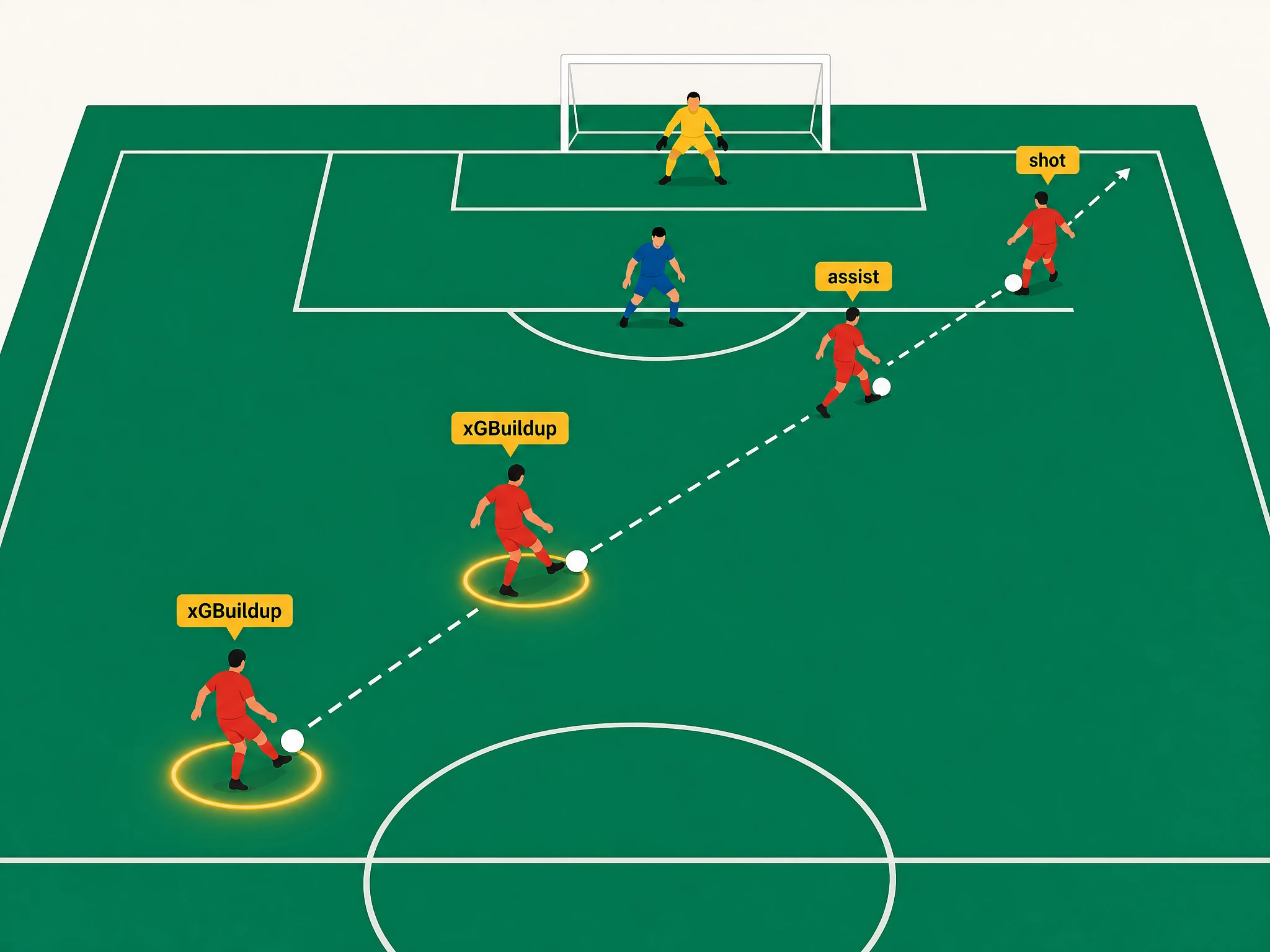
xGChain credits every player who touches the ball in a possession that ends in a shot with the full xG of that shot. xGBuildup does the same but strips out the shooter and the player who made the final pass, so it rewards the deep midfielders and defenders who start attacks without getting the goal or the assist.
Team FootyMetrics
Updated Jul 2026 · 6 min read
- xGChain finds every possession a player was involved in, adds up the xG of the shots those possessions produced, and gives that player the whole sum. One touch in the move earns the same credit as taking the shot.
- xGBuildup is xGChain with the shot and the final pass taken out, so the number reflects only the build-up phase before the ball reached the shooter or the assister.
- Both were introduced by StatsBomb. They exist to show the value of players whose work never lands in the goals or assists columns, the deep-lying playmaker who sets the move going.
- The obvious flaw: everyone in the chain gets identical credit. The player who splits the defence with one pass scores the same as the team-mate who took a five-yard sideways touch in the same move.
What a possession chain is
Both metrics start from the same building block: a possession chain. That is a single unbroken sequence where one team keeps the ball, from the moment they win it to the moment they lose it or take a shot. Every touch by every player on that team during the sequence belongs to the same chain.
If the chain ends in a shot, that shot has an expected goals value: a number between 0 and 1 for how likely a shot from that position and situation is to be scored. xGChain and xGBuildup both take that xG figure and share it out among the players in the chain. The difference is who gets a share.
How xGChain shares out the credit
xGChain takes the xG of every shot a player’s team produced from possessions that player was part of, and hands the full total to that player. Not a slice weighted by how important the touch was. The whole thing.
StatsBomb spelt this out when they introduced the metric. To work out a player’s xGChain, you find all the possessions each player is involved in, find all the shots within those possessions, sum their xG and assign that sum to each player “however involved they were”. The article is blunt about what “however involved” means: whether you make the first pass in a 30-pass build-up, or take the final shot yourself, you get just as much credit as anyone else in that move.
So a possession that ends in a shot worth 0.3 xG gives 0.3 to the striker who took it, 0.3 to the winger who crossed it, and 0.3 to the centre-back who played the first pass out of defence, as long as all three touched the ball in that move. Add every such possession across a match or a season and you have each player’s xGChain.
Why xGBuildup removes the shot and the key pass
Goals and assists already reward the last two actions in a move. The shooter gets the goal, the passer gets the assist. What no traditional stat captures is the player three passes back who broke the opposition press and made the whole attack possible.
xGBuildup isolates exactly that player. It is xGChain with the shot and the final pass stripped out. StatsBomb built it to exclude shots and assists from the possession chains, so the number concentrates on build-up play alone. Take those two actions away and the credit that remains sits with everyone who moved the ball through the earlier phase of the attack: the deep midfielders and defenders who never appear on the scoresheet.
There is one condition. Removing the shot and the assist does not mean a shooter or assister can never score xGBuildup. StatsBomb note it is fine to make the assist or the shot yourself, but you also have to be involved in the earlier parts of the move to get credit. A player only earns xGBuildup for a possession if they touched the ball before the final pass, whatever they did later in the same move.
What these reveal that goals and assists miss
A holding midfielder or a ball-playing centre-back can go a whole season with a handful of goals and assists and still be central to how their team creates chances. Goals and assists cannot see that contribution. xGBuildup can.
That is the whole point of the pair. The regista who dictates tempo from deep, the full-back who starts moves with the first forward pass, the centre-back who steps out and finds a midfielder between the lines: these players show up high in xGBuildup while sitting near the bottom of the goals and assists tables. It puts a value on involvement in dangerous possessions, not on being the one who finishes them.
Chances created, key passes and assists all still only credit the final pass. xGChain and xGBuildup are the version that shares credit across the whole move instead, which is why StatsBomb built them.
The limits worth knowing
The flat credit is the big one. Everyone in the chain gets the same figure regardless of how important their touch was. A player who takes one loose touch in a 20-pass move earns exactly what the player who threaded the defence-splitting pass earns. The metric cannot tell the difference between a decisive contribution and a bystander who happened to be on the ball.
That has knock-on effects:
- A player in a team that dominates possession will post a high xGChain almost regardless of their own quality, because they are involved in more chains.
- A single early touch is enough to bank the full xG of a shot that came 15 passes later, which the player had nothing to do with.
- It says nothing about defensive work, off-the-ball movement, or the quality of any individual pass.
Use it as a flag, then watch the game
What FootyMetrics tracks instead
FootyMetrics does not track or display xGChain or xGBuildup. They need full possession-chain data with every touch tagged and an xG model behind every shot, which is not part of what we cover.
For the build-up and creativity side of a player’s game, the closest reads on our site are chances created, key passes, assists and expected assists (xA), all of which we track across the leagues we cover. What we don’t hold is the possession-chain data that xGChain and xGBuildup are built from.
Compare two deep playmakers
Put two players' passing and creative output side by side on the numbers we do hold, across 115+ leagues.
xGChain and xGBuildup FAQs
Is xGChain the same as xGBuildup?
No. xGChain shares a shot's xG among every player involved in the possession that produced it, including the shooter and the assister. xGBuildup is the same idea with the shot and the final pass removed, so it only credits the players involved in the earlier build-up phase.
Who invented xGChain and xGBuildup?
Both were introduced by StatsBomb, in an article titled Introducing xGChain and xGBuildup. They were designed to measure the contribution of players who help create chances without taking the shot or making the assist.
Does every player in a possession chain get the same xGChain credit?
Yes, and that is the metric's main weakness. StatsBomb state that whether you make the first pass in a 30-pass buildup or take the final shot yourself, you get just as much credit as anyone else in that move. A single touch earns the full xG of the shot, the same as a defence-splitting pass.
Can a striker or assister still have xGBuildup?
Yes, as long as they were also involved earlier in the move. StatsBomb note it is fine to make the final shot or assist yourself, but you must also touch the ball in the earlier part of the possession to earn xGBuildup credit for it.
Does FootyMetrics show xGChain or xGBuildup?
No. FootyMetrics does not track or display either metric. For the build-up and chance-creation side of a player's game we track chances created, key passes and assists across the leagues we cover.
What is a possession chain?
An unbroken sequence where one team keeps the ball, from winning it to losing it or taking a shot. Every touch by that team during the sequence is part of the same chain, and xGChain and xGBuildup share the xG of any resulting shot across the players in it.