What are shot-creating actions (SCA)?
A shot-creating action (SCA) is one of the two attacking moves right before a shot: the pass, take-on, drawn foul, rebound or ball-winning tackle that led into it. FBref popularised the metric and credits both the final action and the one before it, so two players can each pick up an SCA for the same shot. It is not the same stat as key passes or chances created, and it does not come from FootyMetrics.
Team FootyMetrics
Updated Jul 2026 · 6 min read
- SCA credits the last two attacking actions before a shot. Both the player who played the final ball and the player one step earlier get an SCA for the same shot.
- The action can be a live-ball pass, a dead-ball pass, a successful take-on, a shot that rebounds into another shot, a foul drawn, or a defensive action that starts the move.
- Goal-creating actions (GCA) is the same idea narrowed to goals: the two attacking actions before a goal instead of before any shot.
- FBref built SCA on Opta data (StatsBomb before 2022). Sports Reference removed the whole advanced-stats set from FBref on 20 January 2026 after Opta terminated its data access, so the public FBref numbers stopped there.
None of that makes SCA a rebadged Opta stat. It counts more actions, more types of action, and more players per shot than chances created does, and it comes from a different place.
What SCA is, in FBref’s own words
FBref defines a shot-creating action as “the two offensive actions directly leading to a shot, such as passes, take-ons and drawing fouls.” Read that carefully: it is two actions, not one. Every shot in a match generates up to two SCAs, handed to the last two attacking involvements before the ball was struck.
That second slot is the whole point of the metric. A key pass rewards the player who slid the final ball through. SCA also rewards the player who set that passer up, the one who won the ball, dribbled past a man, or drew the foul that started the sequence. The pre-assist gets counted, which key passes and assists ignore completely.
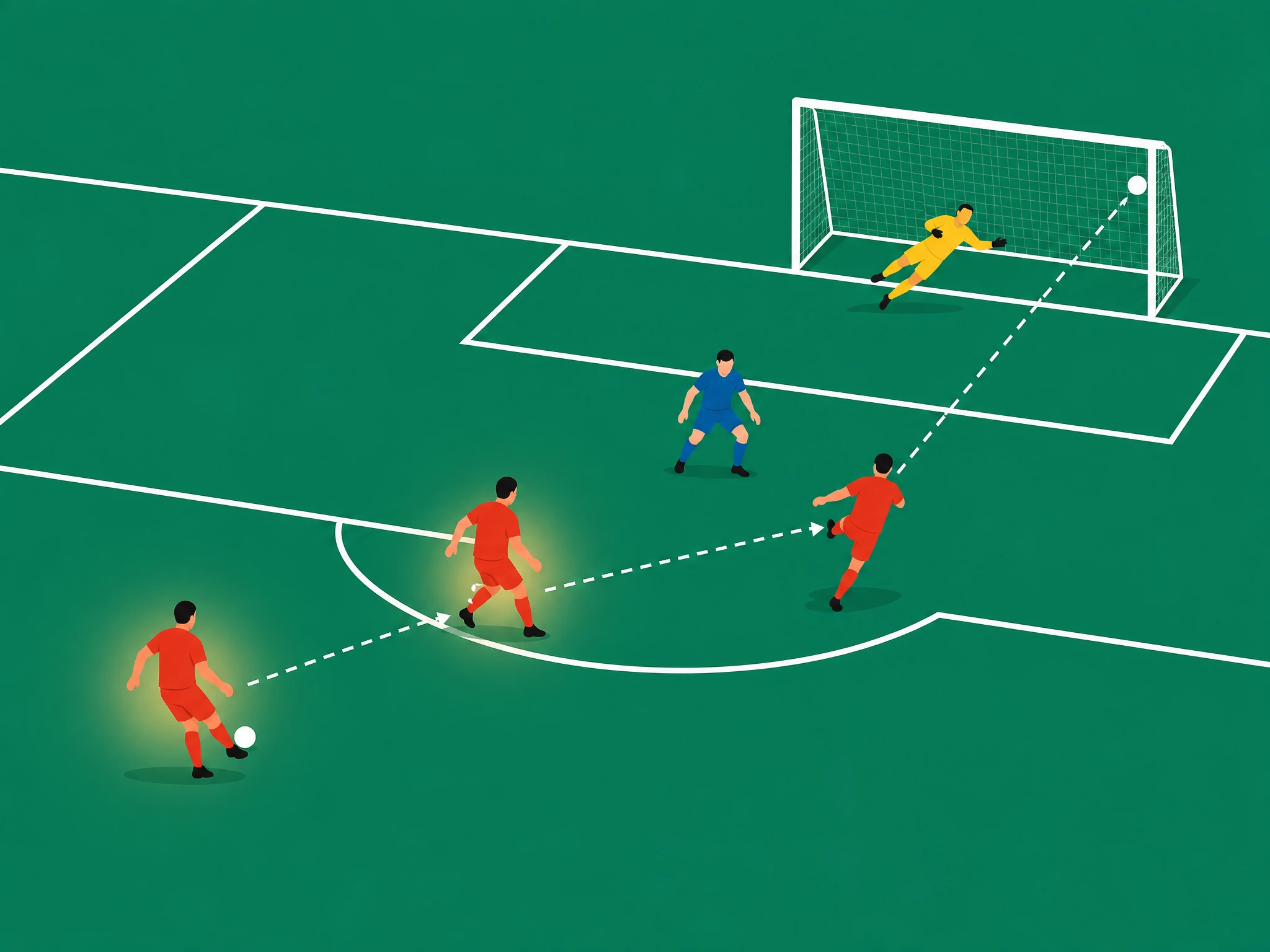
Because two players can be credited per shot, one shot can produce two SCAs for two different names. A winger beats his full-back, cuts it back, a midfielder squares it, the striker shoots: the striker’s shot hands one SCA to the midfielder for the final pass and one to the winger for the take-on before it.
The six action types it counts
FBref splits SCA into six categories, and its own column tooltips spell each one out.
- Live-ball pass: a completed pass in open play that leads to a shot attempt. This is the bulk of most players’ totals.
- Dead-ball pass: a completed pass from a set piece, a corner, free-kick or throw-in, that leads to a shot attempt.
- Take-on: a successful take-on, beating a defender one-on-one, that leads to a shot attempt.
- Shot: a shot that leads to another shot attempt, a rebound off the keeper or a block that falls to a team-mate who shoots again.
- Foul drawn: a foul won that leads to a shot attempt, most obviously winning the free-kick a team-mate then shoots from.
- Defensive action: a tackle or interception that wins the ball back and leads to a shot attempt.
Those last three are what make SCA broader than any pass-based creativity stat. A defender who wins the ball in midfield and starts a break that ends in a shot picks up an SCA without touching the ball in the final third. A striker who wins a box free-kick does too. If you want the underlying idea behind that Def column, the defensive actions guide covers what counts as one.
- A completed open-play pass into a shot.
- A set-piece pass, corner or free-kick, into a shot.
- Beating a defender one-on-one, then a shot follows.
- Winning a foul that a team-mate shoots from.
- A tackle or interception that starts a move ending in a shot.
- Any action more than two steps before the shot.
- A pass or dribble that never leads to a shot.
- The shot itself for the shooter (that's their shot, not their SCA).
- The quality or danger of the shot, SCA ignores it.
Why two actions, not one
Football rarely creates a chance from a single pass. The ball gets worked into space first, and the player who does that work, the one who beats a man or wins the tackle, is often more responsible for the chance than whoever played the obvious final ball into the box.
SCA tries to catch that. By counting two deep instead of one, it credits the build-up action a final-ball stat throws away. It is closer to how a coach watches a goal back and says the move really started three passes earlier. That is also where it overlaps with, but doesn’t equal, xGChain and xGBuildup, which share possession credit across everyone who touched the ball in the move. SCA is narrower: only the last two actions, and only attacking or ball-winning ones, count.
GCA: the goals-only version
Goal-creating actions (GCA) is SCA with the finish added. FBref defines it as “the two offensive actions directly leading to a goal, such as passes, take-ons and drawing fouls.” Same six action types, same two-deep window, but the sequence only counts if the shot at the end goes in.
So GCA is to SCA roughly what assists are to key passes: the subset where the chance was actually converted. GCA totals are much smaller and much noisier over a season, because they depend on team-mates finishing. SCA is the higher-volume, steadier version, which is why analysts lean on it more for judging a creator over a run of games.
How SCA differs from key passes and chances created
This is where SCA gets mixed up with Opta terms it isn’t. FootyMetrics settles creative stats on Opta’s public event definitions, and under those definitions a key pass is the final pass before a shot that does not score, one player, the final ball only. Chances created is key passes plus assists, again the final ball only. We cover the exact split in chances created explained.
SCA is a different shape. It counts two actions, not one, so it credits the pre-assist. It counts take-ons, drawn fouls, rebounds and ball-winning tackles, which key passes and chances created never touch. And it can credit two players per shot, while a key pass or an assist only ever goes to one.
Put simply: chances created answers “who played the final ball into a shot?” SCA answers “who made the last two attacking moves before the shot?” A player can be near the top of one and mid-table in the other. A pure final-ball creator racks up key passes; a dribbler who beats his man and lays it off racks up SCA through the take-on column without many key passes to show for it.
Same theme, three different stats
Where SCA falls short
The metric treats both credited actions as equal, and they very often are not. A routine square pass to a team-mate who then unpicks the defence with a brilliant through ball earns the same one SCA as that through ball. Both get counted, both are worth exactly one, even though one did almost nothing and the other created the chance.
SCA also ignores quality. A tap-in chance and a thirty-yard shot with almost no chance of scoring both generate the same two SCAs, because SCA counts the actions leading to a shot, not the danger of the shot. A player can pad an SCA total by feeding low-value shots that will rarely trouble a keeper. And it stops at two: a brilliant piece of skill three actions before the shot gets nothing, even if it was the moment that broke the defence open.
The FBref data is frozen
One practical note. SCA and GCA were FBref stats, built on Opta’s event feed, and they ran on StatsBomb data before 2022. On 20 January 2026, Sports Reference removed the entire advanced-stats set from FBref after Opta, owned by Stats Perform, terminated its data access. The public SCA and GCA numbers on FBref stopped updating from that point. The metric itself still makes sense as a way to think about creativity, but if you go looking for live SCA figures on FBref you may not find them past that date.
FootyMetrics doesn’t publish SCA. What we track instead is the raw creative and shot events a props line actually settles on, shots, shots on target, key passes and fouls, filtered by opponent and venue.
Find the shots and creative props behind a fixture
Search upcoming games for players hitting shots, shots on target, key passes and fouls, filtered by their real match history.
Shot-creating actions FAQs
Is SCA the same as chances created?
No. Chances created is Opta's term for a player's key passes plus assists, and it only counts the final ball, credited to one player. SCA is an FBref metric that counts the last two attacking actions before a shot, including take-ons and drawn fouls, and it can credit two players for the same shot.
Can two players get an SCA from the same shot?
Yes. SCA credits the last two attacking actions before the shot, so the player who played the final pass and the player one action earlier can each be awarded a shot-creating action from a single shot.
What is the difference between SCA and GCA?
GCA (goal-creating actions) is the goals-only version. It uses the same two-action window and the same six action types as SCA, but the sequence only counts if the shot at the end is scored. SCA counts the actions before any shot; GCA counts them only before goals.
What actions count towards SCA?
Six types: a completed live-ball pass, a completed dead-ball pass, a successful take-on, a shot that leads to another shot, a foul drawn, and a defensive action that wins the ball back. Each one must directly lead to a shot attempt.
Does FootyMetrics show shot-creating actions?
No. SCA is an FBref metric, not one we publish. We track the underlying Opta-standard events a props line settles on, such as shots, shots on target, key passes and fouls, which you can search and filter by player and fixture.
Is SCA still available on FBref?
Not reliably. Sports Reference removed the advanced-stats set, including SCA and GCA, from FBref on 20 January 2026 after Opta terminated its data access, so those numbers stopped updating from that point.