Defensive actions: the composite stat
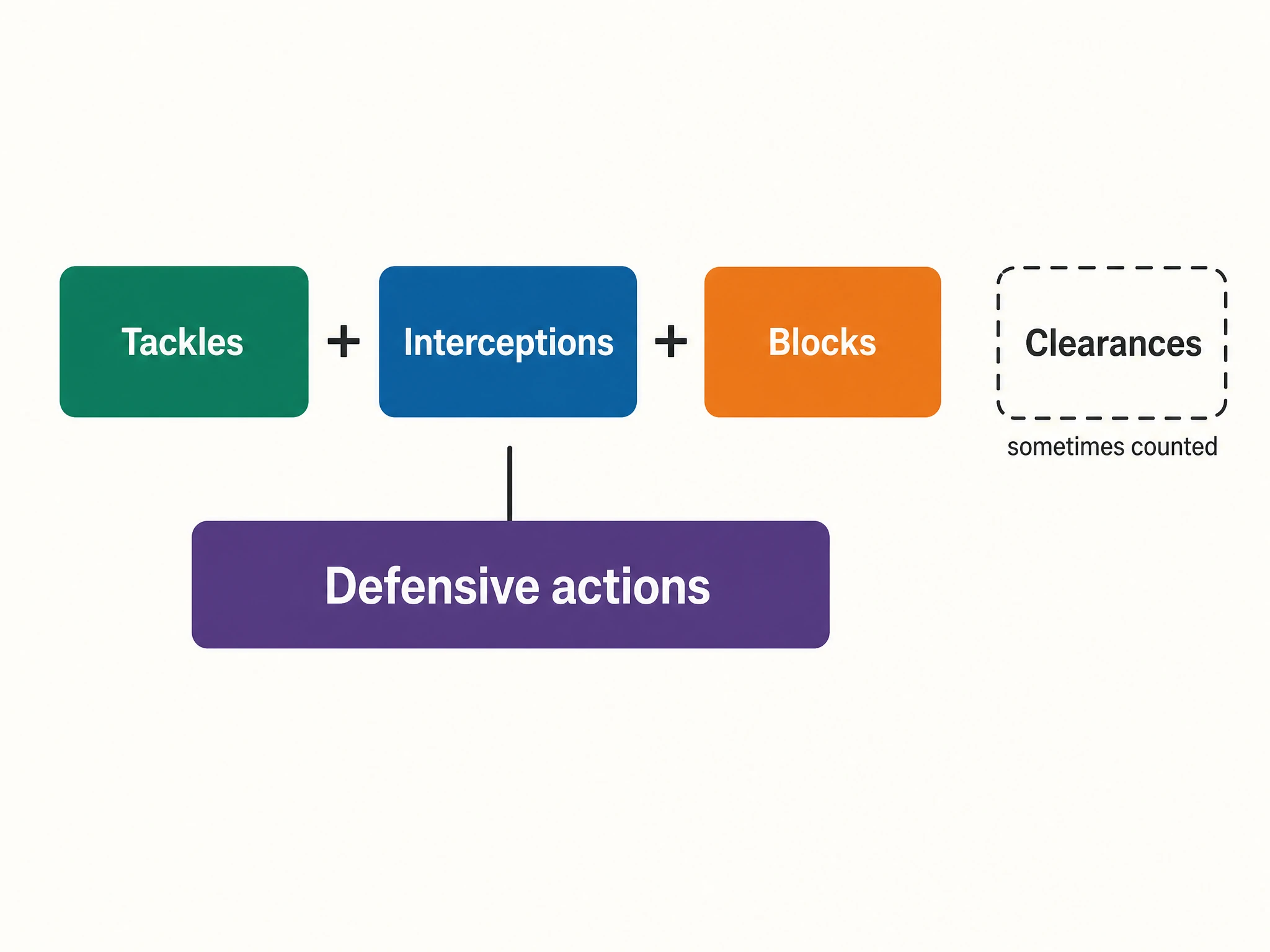
Defensive actions is a composite stat: it adds a player's separate defensive events into one number, most commonly tackles plus interceptions plus blocks, with clearances sometimes included too. There is no single official recipe. Every data provider, fantasy game and bookmaker picks its own list of events, which is why the same performance can produce different totals in different places.
Team FootyMetrics
Updated Jul 2026 · 6 min read
- Defensive actions is not one recorded event. It's a total built from separate stats, usually tackles, interceptions and blocks, with clearances the most common extra ingredient.
- Opta's public event definitions treat tackles, interceptions, blocks and clearances as separate events. Anyone quoting a defensive actions figure has chosen their own combination of them.
- The number depends heavily on position and on how much defending a player's team has to do. A centre-back at a dominant side can defend well all season and still post low totals.
- For betting, the recipe in the bookmaker's market rules decides settlement. A performance that clears one book's defensive actions line can miss another's if their event lists differ.
What the stat adds together
Defensive actions is an umbrella total, not a single thing a player does. The most common recipe is tackles plus interceptions plus blocks. Plenty of versions add clearances. Some go further and count failed tackle attempts, fouls or ball recoveries. The label stays the same while the contents change, and that’s the part that catches people out.
The reason there’s no fixed answer is that the underlying data doesn’t contain a “defensive action” event at all. Opta’s public event definitions define tackles, interceptions, blocks and clearances as four separate events, each with its own rules. The phrase defensive actions only appears descriptively on that page, for instance when sequences are defined as passages of play ended by them. So a defensive actions total is always someone’s arithmetic on top of the raw events, and the person doing the arithmetic decides what goes in.
The component definitions matter more than they look. A challenge that concedes a foul isn’t a tackle. A body in front of a cross is a blocked pass, not a block. If those boundaries are fuzzy for you, they’re covered properly on interceptions vs tackles vs blocks and how clearances are counted; this page takes them as read.
Why the composite exists
Individual defensive stats are small numbers, and small numbers are noisy. A midfielder might attempt a handful of tackles in a match, so one refereeing call or one opponent choosing to attack the other flank swings the count by a large percentage. Judging a defender on a single match’s tackle column is close to reading nothing. Adding tackles, interceptions and blocks together gives you more events per match, which makes one game’s total slightly less random and a per-90 average stabilise faster.
The composite also irons out differences in style. Some defenders win the ball by challenging for it, others by reading the pass and stepping in front of it, and as how tackles are counted explains, the second type can defend superbly with a near-empty tackle column. A combined total credits both jobs instead of rewarding whichever one the stat you happened to pick measures.
That’s the honest case for the stat. It’s a reasonable answer to a real problem. The trouble starts when people treat the total as if it were one official, universal number.
Same label, different recipes
Three real, published recipes, side by side.
Fantasy Premier League. Since 2025/26, a defender who reaches 10 combined clearances, blocks, interceptions and tackles (CBIT) in a match scores two points for defensive contribution. Midfielders and forwards also get ball recoveries counted, but need 12. Two recipes inside one game, split by position, both capped at two points.
PPDA. The pressing metric counts tackles, interceptions, challenges and fouls as its defensive actions. No blocks, no clearances, and it only counts them in part of the pitch. Covered on what is PPDA.
Spreadex. The spread firm publishes definitions for its player performance markets in which tackles, interceptions and blocked shots are listed as separate scoring events, two points each, with no combined defensive bucket anywhere in the list.
One fantasy game, one analytics metric and one betting operator, and between them clearances are in, out and irrelevant, while fouls count in exactly one of the three. If someone quotes a player’s defensive actions at you, the only useful follow-up question is: counted how?
What a high number actually tells you
Less than it seems, for two structural reasons.
Position first. Centre-backs and holding midfielders live where the defending happens, so they dominate any defensive actions leaderboard by default. A winger posting three actions might have done their defensive job perfectly; a centre-back posting three has probably had either a very quiet or a very bad evening. Comparing totals across positions tells you about roles, not about defenders.
Second, and less obvious: defensive actions measure how much defending happened, and defending happens most to teams under pressure. A struggling side that spends 70 minutes without the ball hands its defenders a steady supply of tackles to make and crosses to block. A dominant side does the opposite. Its centre-backs can go 20 minutes without a defensive event to record, and their season totals end up looking modest next to defenders at relegation-threatened clubs. High defensive action counts cluster at teams that defend a lot, which is usually not a compliment to the team.
The mix matters too, and the composite hides it. Thirteen actions built from nine clearances is a team pinned in its own box hacking the ball away. Thirteen built from a spread of tackles, interceptions and blocks is a different defender having a different game. Same total, opposite stories.
Read the total against the game, not on its own
Defensive actions as a betting prop
Player tackles lines are now common, and some bookmakers go a step further with combined lines, usually labelled tackles + interceptions or defensive actions. This is where the recipe stops being a nerdy detail and starts deciding whether your bet wins.
Take a centre-back who finishes with 3 tackles, 2 interceptions, 1 block and 7 clearances. On a tackles + interceptions recipe that’s 5 actions. Add blocks and it’s 6. On a CBIT-style recipe that includes clearances it’s 13. Against a line of 7.5, the identical performance is a comfortable winner under one recipe and a clear loser under another. Nothing about the match changes, only the arithmetic.
The recipe lives in the market rules, and bookmakers aren’t obliged to share one. The books we checked handle it differently, and we can’t verify a published event list for every operator that uses the defensive actions label, so treat this as the rule: before backing any combined defensive line, open the market rules page and check exactly which events count and which data feed settles it. Player stat markets are typically settled on a named provider’s data, and if the rules don’t name the events in the total, that’s a reason to leave the market alone rather than guess.
Find value in defensive props
Check a player's tackles and interceptions record against a line before you back it.
Defensive actions FAQs
What are defensive actions in football?
A composite stat that adds a player's separate defensive events into one total. The most common recipe is tackles plus interceptions plus blocks, and some versions add clearances or ball recoveries. There is no single official definition, so the exact contents depend on who is counting.
Do clearances count as defensive actions?
It depends on the recipe. Fantasy Premier League's defensive contribution stat includes clearances, PPDA's defensive action count excludes them, and bookmakers differ market by market. Check the definition attached to whichever number you are reading.
Are defensive actions an official Opta stat?
No. Opta's public event definitions record tackles, interceptions, blocks and clearances as separate events, and do not define a single combined defensive actions event. Any defensive actions total is a combination someone has built on top of those separate events.
Why do defenders at top teams post low defensive action numbers?
Because defensive actions measure how much defending a player did, and dominant teams defend less. A centre-back whose side controls possession faces fewer attacks, so there are fewer tackles, blocks and clearances available to record, however well they play.
How are defensive actions betting props settled?
On the event list in that bookmaker's market rules. One book's defensive actions line might be tackles plus interceptions only, while another includes blocks or clearances, so the same performance can settle as a winner at one and a loser at the other. Always check the rules page before placing the bet.
Is FPL's defensive contribution the same as defensive actions?
It's one specific recipe. Defenders score two points for 10 or more combined clearances, blocks, interceptions and tackles in a match, while midfielders and forwards need 12 with ball recoveries also counted. Other sites and bookmakers using the phrase defensive actions may count a different set of events.
Keep learning
Interceptions vs tackles vs blocks
The three events most recipes are built from
How clearances are counted
The ingredient that's in some recipes and not others
What is PPDA
A pressing metric with its own defensive action list
Ball recoveries explained
The extra event FPL counts for midfielders and forwards