Interceptions vs tackles vs blocks: the difference
An interception happens before the original player ever controls the ball. A tackle only happens after they already have it under control and lose it to a clean ground challenge. A block is a shot stopped by a defender's body, and even a pass or cross stopped the same way is logged as a different event.
Team FootyMetrics
Updated Jul 2026 · 7 min read
- An interception happens before the intended receiver ever controls the ball. A tackle happens after an opponent already has it under control. That single test separates the two.
- A block only applies to a shot on goal stopped by an outfield player's body. A pass or cross cut out by a body without a tackle is a separate event, a blocked pass, not the same stat.
- A defender who gets a foot in just as the ball arrives, before the receiver touches it, is credited with an interception, not a tackle, because there was no controlled possession to tackle.
- Commentary calls most defensive actions a tackle. The data does not, so reading a defender's stat line means checking interceptions and blocks alongside tackles, not instead of them.
These three actions get mixed together constantly in commentary and in casual reading of a stat line, but Opta records them as separate events with separate rules. Getting the boundary right matters for anyone reading tackles, interceptions or blocks as a betting stat, because a player can defend extremely well and still have a low count in any one of the three. The deeper detail on how a tackle itself is won, lost, or wiped out by a foul is on how tackles are counted.
The three definitions
All three are defined by Opta.
Interception. Opta's wording is that an interception is where a player reads an opponent's pass and intercepts the ball by moving into the line of the intended pass. Nobody has to be challenged directly. The defender is anticipating where the ball is going and getting there first.
Tackle. The tackle definition is stricter and has already been verified precisely on the tackles page: a tackle is a legal, ground-level challenge where the tackler connects with the ball and takes it away from an opponent who is in controlled possession of it. Controlled possession is the key word. If the opponent never had the ball under control, there is nothing to tackle.
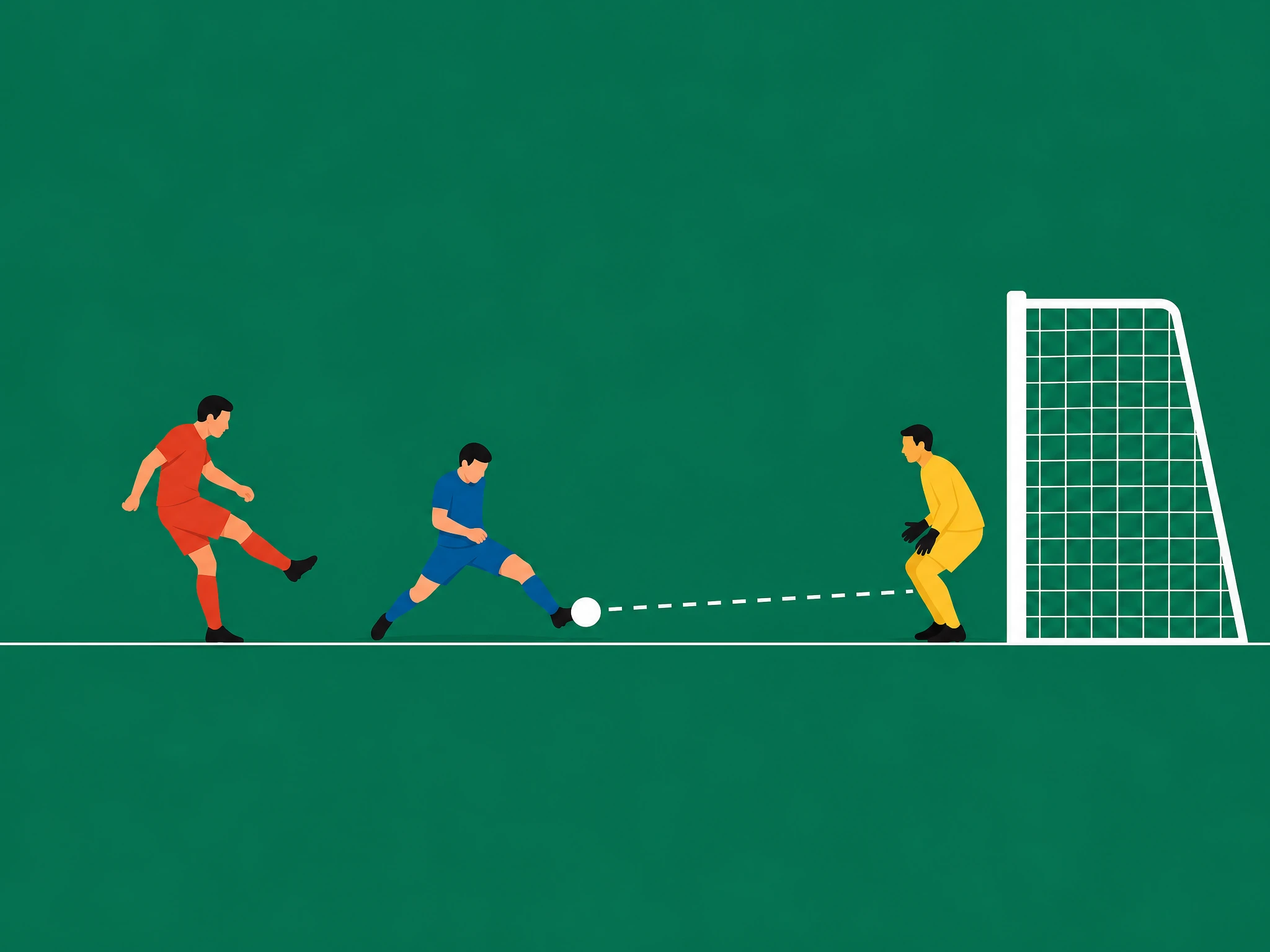
Block. A block is when an outfield player stops an attempt on goal from an opposition player with their body. If the attempt was already going wide of the goal, no block is awarded at all, since there was nothing on target to stop.
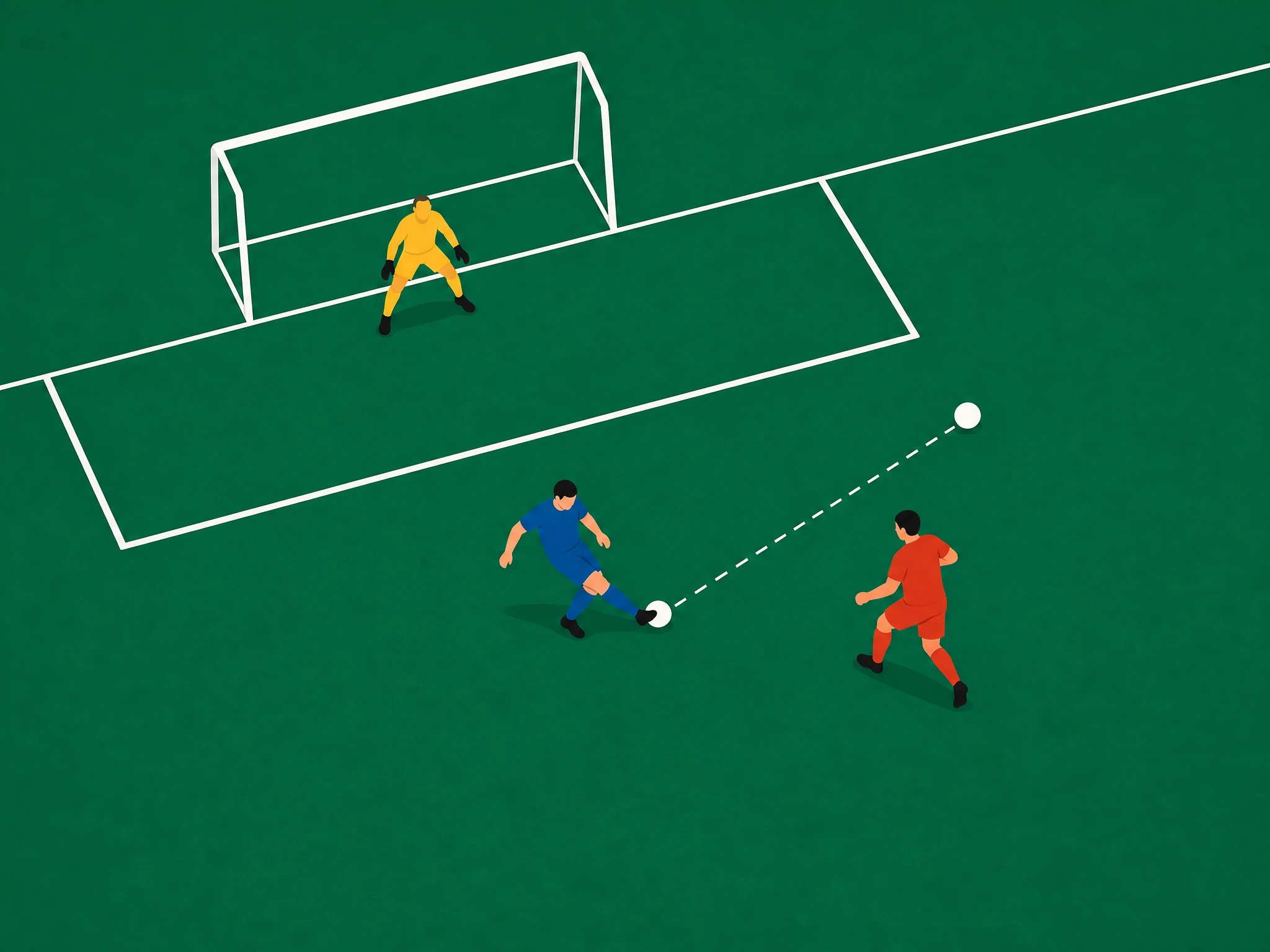
The test: who had the ball under control
Every one of these three events can be told apart by asking the same thing: did the original player targeted by the ball ever have it under control?
- The intended receiver never touched or controlled the ball.
- The defender read the pass and got there first.
- Recorded as an interception.
- The opponent had the ball under control, even briefly.
- A clean, ground-level challenge then wins it back.
- Recorded as a tackle.
- No player gains controlled possession from the action.
- A shot on goal is stopped by an outfield player's body.
- Recorded as a block, or a blocked pass if it was not a shot.
Edge cases that are hard to call
A foot in just before the receiver controls the ball
A common close call is a defender sliding or stretching to get a touch on the ball a split second before the intended receiver would have controlled it. Because the test is controlled possession, this is an interception, not a tackle, no matter how tight the timing looks. The tackle definition requires the tackled player to already be in controlled possession before the challenge happens. If they never had it, there is no tackle to record, only an interception.
Blocking a shot vs blocking a pass or cross
This is the boundary case that most people assume works one way and does not. A block, in Opta's schema, applies only to an outfield player stopping an attempt on goal, and explicitly does not count if the attempt was already going wide of the target. Stopping a pass or a cross with the body, when there is no shot involved, is a different event entirely, a blocked pass. Opta's own comparison describes a blocked pass as similar to an interception except with much less reading of the pass involved, since it is more often a reactive block than an anticipated step into a passing lane.
Block and blocked pass are not the same number
A header that cuts out a cross
Neither of the two primary sources used for this page spells out a single dedicated label for a header that cuts out a cross before it reaches an attacker. Applying the general rule: if the defender reads the cross and reaches it before any attacker touches it, with no direct aerial challenge against a specific opponent contesting the same ball, it fits the interception definition regardless of whether the contact is a header or a foot, since the test is about reading and cutting the pass, not the body part used. If instead it is a genuine aerial duel against an onrushing attacker going for the same ball, that is a separate header/duel event rather than an interception. This is the one area on this page based on applying the general rule rather than a single explicit quoted ruling, worth a sanity check against a live match if it matters for a specific market.
Why commentary blurs all three together
Commentators say "great tackle" for almost any defensive action that stops an attack, including ones that were really interceptions or blocks. That loose usage is harmless for watching a match, but it is the wrong lens for reading a stat line. A centre-back who reads the game well and rarely needs to dive into a challenge can have few tackles and still be defending excellently, because most of their work is interceptions and blocks rather than tackles. The full detail on how a tackle itself is won, lost, or wiped out entirely by a foul is covered on how tackles are counted.
A worked passage of play
- Minute 1. A winger plays a low ball infield aimed at a striker. A centre-back reads it early and steps across to cut it out before the striker gets a touch. That is an interception, because the striker never controlled the ball.
- Minute 1, seconds later. The loose ball breaks to a midfielder, who gets it under control for a stride before a fullback slides in on the ground and wins it cleanly. That is a tackle, because the midfielder had controlled possession before the challenge.
- Minute 2. Two passes later the same team works a shooting chance from range, and a defender's body stops the shot from going in. That is a block.
Change the final action only slightly and the label changes too: if instead of a shot that last action had been a cut-out cross with no shot involved, it would be a blocked pass, not a block, even though the physical action looks almost identical from the stands.
FootyMetrics tracks tackles for every player and team across 115+ leagues, settled the way described above and on the tackles page.
See player tackle trends and team tackle trends for the history behind a tackles line, and the tackles vs interceptions stats hub page for the player and team leaderboards side by side. The full football stats glossary covers blocked shots and blocked passes as their own entries too.
Interceptions, tackles and blocks FAQs
Is an interception the same as a tackle?
No. An interception happens before the intended receiver ever controls the ball, when a defender reads the pass and moves into its path. A tackle can only happen after an opponent already has the ball in controlled possession, because Opta's definition of a tackle specifically requires that.
Is a blocked shot the same stat as a blocked pass?
No. A block in Opta's data applies only to an outfield player stopping an attempt on goal with their body, and it does not count if the shot was already going wide. Stopping a pass or cross with the body, with no shot involved, is logged separately as a blocked pass.
If a defender gets a foot in just before the receiver controls the ball, is that a tackle?
No, it is an interception. The test is whether the original receiver ever had controlled possession. If they never controlled it, there is nothing to tackle, so the action is logged as an interception even if the timing looks tight.
Does a defender's clearance count as a block or an interception?
Neither. A clearance is tracked as its own separate category: the defender gets the ball away from a dangerous area, often under pressure, with no specific team-mate targeted. It involves no read of a pass into a lane and no shot stopped by the body, so it sits outside both definitions.
Why does a good defender sometimes have a low tackle count?
Because tackles, interceptions and blocks are tracked separately, and a defender who reads the game well often prevents danger with an interception or a block before a tackle is ever needed. A low tackle count on its own does not mean weak defending.