How clearances are counted
A clearance is any action that removes the ball from immediate danger near your own goal, whether that's a header away from a corner, a defender hoofing a loose ball upfield under pressure, or the ball knocked away after a shot has already been partly stopped. It doesn't matter where the ball ends up. It matters that the danger is gone.
Team FootyMetrics
Updated Jul 2026 · 6 min read
- A clearance is any action that gets the ball out of immediate danger near your own goal. Where it lands afterwards, even out for a throw-in or corner, doesn't change whether it counts.
- A block stops a shot or a cross in flight. A clearance is wider than that: it also covers picking up a loose ball on the ground, with nothing being shot or crossed at the time.
- An interception happens before the receiving player controls the ball. A clearance can happen after a defender has already got the ball under their own control, if they then kick it away under pressure.
- Clearances-specific betting markets are less common than tackles or shots markets, so treat settlement detail here as the general provider convention rather than a single universal rule.
Most of this is straightforward once you separate it from a block and an interception, which is where people usually get tangled up. The interceptions vs tackles vs blocks guide covers those two from the other side and is worth reading alongside this page.
What counts as a clearance
Opta’s public event definitions describe a clearance as a defensive action that removes the ball from a dangerous position without a specific team-mate being targeted, typically inside or near a team’s own penalty area. That covers a wide range of situations that all look different on the pitch but do the same job: get the ball away from where it can hurt you.
A headed clear from a corner is the clearest example. The ball comes in, a defender gets their head to it and sends it back out, usually without any real thought for who’s picking it up. A defender under pressure in their own box who just hoofs a loose ball upfield is doing the same thing with their foot instead of their head. Both count.
A clearance off the goal line, after a shot has already been stopped or partially stopped, also counts. Say a shot cannons off the crossbar and drops back down in the six-yard box with the goalkeeper stranded. A defender who reacts first and knocks it clear has made a clearance, on top of whatever happened to the original shot.
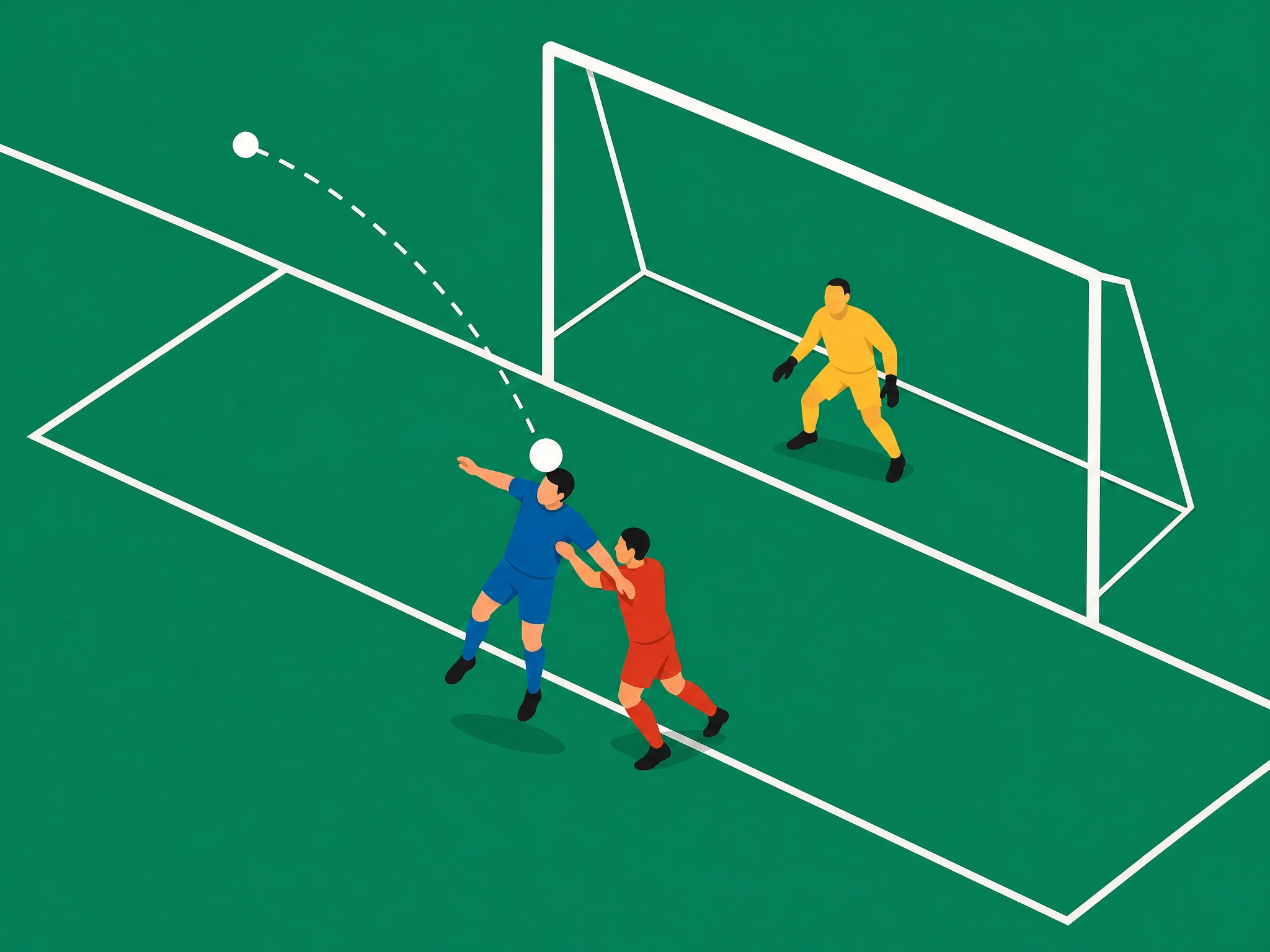
None of this depends on where the ball ends up next. A clearance that flies straight out of play for a throw-in still counts, and so does one that loops up and over for a corner. The stat is measuring whether the danger was dealt with, not whether the clearance was tidy.
- A header away from a corner or a cross into the box.
- A defender hoofing a loose ball upfield under pressure.
- A ball knocked away after a shot has already been partly stopped.
- A clearance that flies out for a throw-in or a corner.
- Stopping a shot or cross while it's still in flight (a block).
- Cutting out a pass before the receiver controls it (an interception).
- A controlled pass out of defence with a team-mate targeted.
Clearance vs block: the difference that trips people up
A block and a clearance look similar from the stands, both involve a defender’s body stopping the ball, so it’s worth being precise about where they split.
A block specifically stops a shot or a cross while it’s in flight. If an opponent has struck an effort on goal, or is delivering a cross, and a defender’s body gets in the way of that specific ball, that’s a block. It requires there to be a shot or a cross actually happening at the moment of contact.
A clearance is a wider action. It includes situations with no shot or cross involved at all, like a defender picking up a loose ball rolling around the box and putting it away, or heading clear a bouncing ball that nobody has struck yet. The test isn’t what body part is used, it’s whether there was a shot or cross in flight when the defender made contact. If yes, it leans toward a block. If the ball was just loose, or already dealt with once, it’s a clearance.
Read this alongside blocks and interceptions
Clearance vs interception: the difference that trips people up
An interception happens before the receiving player ever gets the ball under control. A defender reads a pass, steps into its path, and cuts it out before the intended target touches it. Nobody had the ball, so nobody’s possession is being broken.
A clearance can happen after a defender has already controlled the ball themselves. Picture a centre-back who brings down a long ball, has it at their feet for a stride, and then, with a striker closing them down, just puts it into the stand rather than trying to play out. That’s a clearance, not an interception, because the defender had the ball under control before choosing to get rid of it.
The practical difference for reading a stat line: a defender with a high interception count is reading the game and cutting out danger before it develops. A defender with a high clearance count is dealing with danger that’s already arrived, often under direct pressure in their own box. Both are useful defensive numbers, but they describe different kinds of night.
Does a goalkeeper's clearance count the same as an outfield defender's?
This is genuinely inconsistent territory. A goalkeeper punting the ball clear, or coming out to head it away from a cross, is doing the same job as an outfield defender clearing under pressure. Whether it’s logged under the same “clearance” stat, or split out separately as part of the goalkeeper’s own distribution numbers, can genuinely vary by data provider and by which market you’re looking at. If a specific clearances line matters to a bet you’re weighing up, check whether goalkeeper actions are included before you rely on a season total that mixes outfield and keeper numbers together.
Does a headed clearance off the woodwork count?
Say a shot is struck, a defender gets a header to it, and the ball comes back off the post or crossbar before finally going out of play. Is that a clearance, a block, or both?
There’s a reasonable argument for either label depending on the exact sequence. If the header happens before the shot is properly on its way, cutting out a cross or a loose ball that then happens to loop onto the bar, that reads as a clearance that unluckily hit the woodwork afterwards. If the header is stopping a shot that was already goal-bound, that leans toward a block, with the ball’s path off the post being incidental to the action itself. We can’t point to a single universal rule that resolves every version of this cleanly, so if a woodwork situation like this is central to a bet, it’s worth checking the specific market rules rather than assuming either label.
Reading a clearance stat for betting
Clearances-specific markets aren’t as common as tackles or shots on target markets, so you’ll see clearance counts more often used as context for a defender’s workload than as their own standalone bet. A high clearance count usually says something about the game state: a team defending a lot of crosses and long balls into their own box will rack up clearances fast, while a team that dominates possession in the opponent’s half might barely need any.
FootyMetrics tracks clearances for players and teams across 115+ leagues, following the same public event-definition standard used for our other defensive stats like tackles and interceptions. Where a clearances market does exist, settlement generally follows the same provider convention as the site’s other defensive stats, meaning the definitions above are the ones to check against rather than what commentary calls a clearance in the moment.
See the wider picture on player and team trends, and the football stats glossary for every defensive stat defined in one place.
Clearances FAQs
Does a clearance that goes out for a throw-in or corner still count?
Yes. The stat cares whether the danger near goal was dealt with, not where the ball ends up afterwards. A clearance that loops out for a corner counts exactly the same as one that's collected calmly by a team-mate.
What's the difference between a clearance and a block?
A block specifically stops a shot or a cross while it's in flight. A clearance is broader and also covers picking up a loose ball, or heading away a ball that nobody has struck yet, with no shot or cross happening at the moment of contact.
What's the difference between a clearance and an interception?
An interception happens before the receiving player controls the ball. A clearance can happen after a defender has already controlled the ball themselves, if they then choose to kick it away under pressure instead of playing out.
Does a goalkeeper's clearance count the same as an outfield defender's?
It can vary by provider and by market. Some feeds fold goalkeeper clearances into the same total as outfield defenders, others track goalkeeper distribution separately, so check the specific stat or market you're using before relying on a season total.
Does a headed clearance off the crossbar count as a clearance or a block?
It depends on the exact sequence, and there isn't one universal rule that covers every version of it. A header that cuts out a loose ball before it hits the bar reads as a clearance; a header stopping an already goal-bound shot that then cannons off the post leans toward a block. Check the market rules if a specific woodwork situation matters to your bet.
Why are clearances-specific betting markets less common than tackles or shots markets?
Clearances tend to be used as context for a defender's or a team's workload rather than as a standalone market in their own right, which is why you'll see the stat quoted more often on stats pages than as its own bet type.