Exchange or bookmaker: which should you use?
Neither wins outright. A betting exchange like Betfair generally won't limit or close a winning account, since it earns commission regardless of who wins, but its prices carry that commission and its liquidity on smaller markets like player props is often too thin to get matched at the price you see. A bookmaker offers boosts and enhanced prices an exchange never will, but the better you get, the more likely it is to restrict your stakes.
Team FootyMetrics
Updated Jul 2026 · 6 min read
- An exchange charges commission (typically 2% to 5%, sometimes up to 8%) on net winnings, not on turnover, and it doesn't care who wins.
- A bookmaker doesn't charge commission, but it can and does limit, stake-factor or close accounts once they show a consistent edge.
- Exchange liquidity thins out fast away from big match-odds markets. Football player props, like a specific player's shots on target, are a common example.
- Boosts, price enhancements and promos are a bookmaker tool exchanges don't have, and they can outweigh a raw price advantage on a single bet.
The actual trade-off
Ask a professional bettor whether to use an exchange or a bookmaker and most will say “it depends on the bet,” and mean it literally. An exchange such as Betfair, the dominant one in the UK, doesn’t take a side against you. It matches you with another user and takes a cut of the winnings, so a customer who wins every week is exactly as welcome as one who loses every week. That single fact is why serious, long-term bettors gravitate toward exchanges: there’s no risk of being gubbed for being good at this. Sharp vs soft bookmakers covers why traditional bookmakers behave the opposite way, restricting or closing accounts once they spot a consistent winner, and why bookmakers limit accounts goes into how that actually happens.
But an exchange price is only worth what you can actually get matched at, and that’s where the comparison gets messier. On a Saturday 3pm Premier League match odds market, Betfair’s liquidity is deep enough that a few hundred pounds barely moves the price. On a player shots on target market for a Championship fixture, or first goalscorer in a lower-league match, the best price on screen might have five pounds sat behind it. Try to back £50 and you’re wading through worse and worse prices to fill the stake, which is called slippage. A bookmaker doesn’t have that problem in the same way, because it prices the market itself and takes on the risk rather than waiting for another user to take the other side.
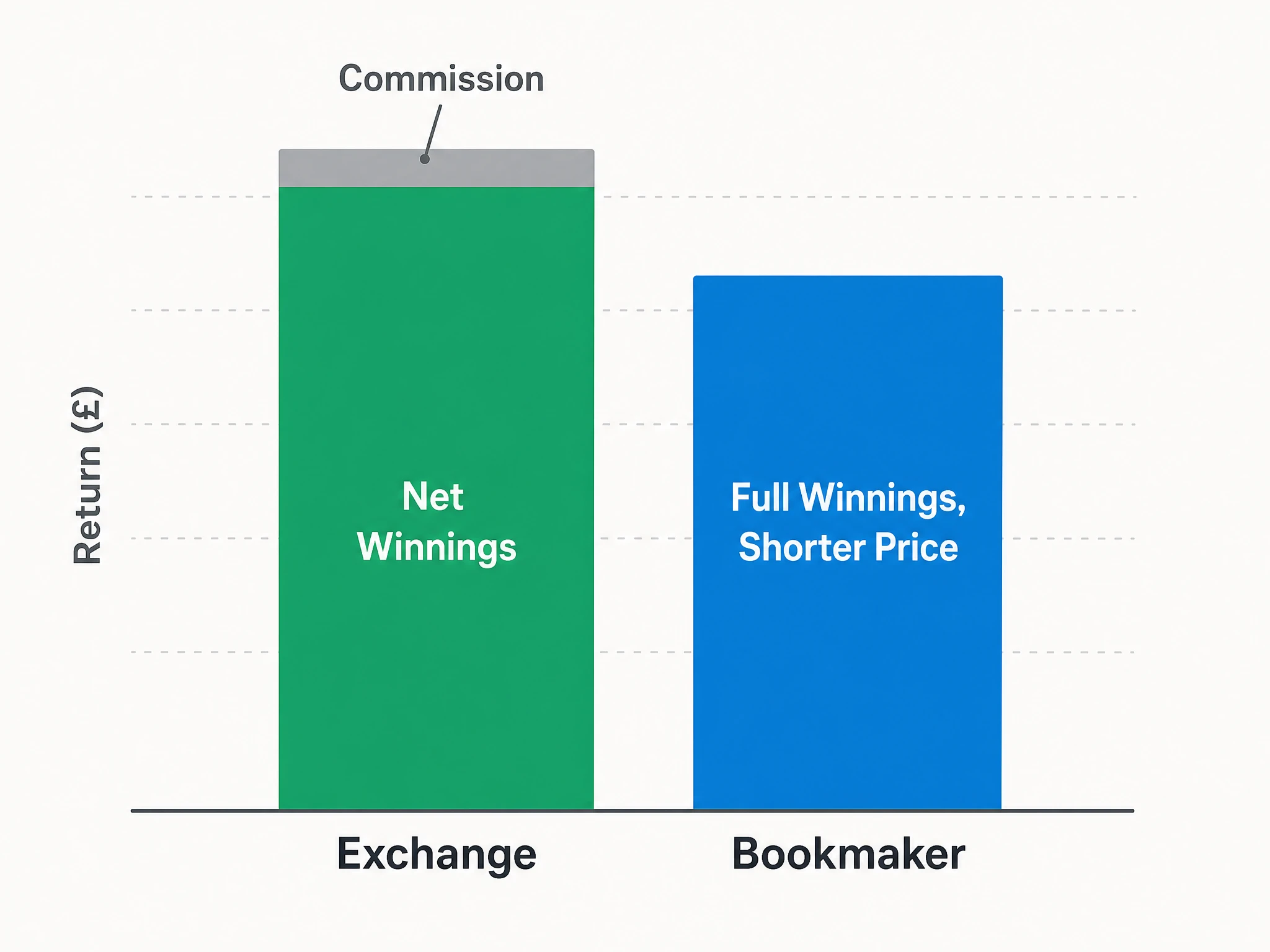
Commission eats into the price you think you're getting
The other thing that gets glossed over is commission. What a betting exchange is covers the mechanics of back and lay and how commission is charged in full, but for this comparison the short version matters: Betfair charges commission on net winnings, not on the odds themselves, and the rate depends on which rewards tier a customer sits in. According to Sporting Life’s Betfair exchange guide, the default rate is 5%, with a Rewards+ tier at 8% and a Basic tier at 2%, depending on which package a customer selects.
That means a price that looks better on the exchange than at a bookmaker isn’t automatically better once you settle up. Back a selection at odds of 2.10 on the exchange and win £10 profit on a £10 stake, and at 5% commission you keep £9.50 of it. A bookmaker quoting 2.05 with no commission pays out the full £10.50 return, £10.05 net profit, and beats the exchange price on this bet even though its headline odds were shorter. The exchange only wins the comparison once its price is enough better than the bookmaker’s to absorb the commission and still come out ahead.
Compare the payout, not the odds
Where a bookmaker earns its keep
Bookmakers have tools an exchange structurally cannot offer, because an exchange isn’t setting the price and isn’t the one bearing the risk on it. Price boosts, enhanced odds on a specific outcome, money-back offers and profit boosts are all things a bookmaker can hand out to attract and keep customers. A well-timed boost can turn an already fair price into one that beats anything available on the exchange, commission included, for that specific bet. The catch is the one already covered above: none of that changes the fact that once an account is clearly beating the book over time, most bookmakers will act on it, whether that’s a lower maximum stake, a request-a-bet-only account, or a closure. A bettor who leans heavily on bookmaker promos and boosts has to accept that the relationship has a shelf life if they keep winning.
Which venue actually suits which bet
There isn’t a single right answer here, and pretending otherwise would be dishonest. A few patterns hold up in practice.
- High-volume, liquid markets: match odds, over/under goals, Asian handicaps on major leagues.
- Any bet where the no-limiting guarantee matters most, betting regularly at real size.
- Laying a position, which a bookmaker doesn't let you do at all.
- Niche and player-prop markets where exchange liquidity is thin.
- Bets where a live boost or enhanced price beats the exchange's commission-adjusted number.
- New accounts, while limiting risk hasn't kicked in yet.
Most serious bettors end up running both: a bookmaker account for boosted prices and markets an exchange doesn’t cover well, and an exchange account as the fallback once the bookmaker accounts start getting restricted. Betting only through bookmakers eventually runs into the ceiling that why bookmakers limit accounts describes. Betting only through an exchange means giving up promos and sometimes taking a worse price on thin markets. Whichever side of that trade you land on for a given bet, work out the number you’d actually be paid rather than trusting the number on the screen. What are fair odds covers how to strip a bookmaker’s margin out of a price so you can compare it properly against an exchange’s commission-adjusted one.
Exchange vs bookmaker FAQs
Is Betfair better than a bookmaker for football betting?
Not universally. Betfair's exchange tends to offer better prices and no limiting risk on high-volume markets like match odds, but commission eats into the advantage and liquidity can be thin on markets like player props, where a bookmaker's fixed-odds price may actually pay out more once you account for the cut.
Do exchanges ever limit or restrict accounts?
Not for winning. Exchanges make money from commission regardless of which side wins, so there's no incentive to restrict a profitable customer the way a bookmaker has. Exchanges can still restrict accounts for other reasons, such as suspected fraud or breaching their terms, but not simply for winning bets.
Why is exchange liquidity worse on player prop markets?
Fewer people trade those markets compared with match odds, so there's less money sat behind each price. A market like a specific player's shots on target or cards for a mid-table fixture might only have a small amount matched at the best price, meaning a larger stake gets filled at progressively worse odds.
How much commission does Betfair charge?
The default rate is 5% of net winnings, with a Rewards+ tier at 8% and a Basic tier at 2%, depending on which rewards package a customer selects. Commission only applies to winnings, never to the stake itself, and never on a losing bet.
Can I use both a bookmaker and an exchange?
Yes, and most serious bettors do. Bookmakers offer boosts and promos an exchange never will, while an exchange offers a stable place to keep betting once bookmaker accounts start getting restricted.
Is exchange betting only worth it for big markets?
That's where the advantages line up best, but thin markets can still be worth backing on an exchange when the price is good enough to survive the commission and the stake is small enough that liquidity isn't an issue.
Keep learning
What is a betting exchange?
Back and lay mechanics, and how commission works
Sharp vs soft bookmakers
Which bookmakers actually let winners keep betting
Why bookmakers limit accounts
What gubbing actually looks like in practice
What are fair odds and no-vig lines?
The maths behind stripping out a bookmaker's margin