Drop ball: when and how it works
A drop ball is how the referee restarts a match after stopping play for a reason that is not a foul or an out-of-play ball: an injury, the ball striking the referee, or outside interference. The referee drops the ball to one player of the team that last touched it, everyone else stands at least 4 metres back, and the ball is in play the moment it touches the ground. If play stopped inside the penalty area, it goes to the defending goalkeeper instead.
Team FootyMetrics
Updated Jul 2026 · 5 min read
- A drop ball restarts play after the referee stops the game for something other than a foul or the ball leaving the field: injury, outside interference, or the ball hitting the referee.
- Since the 2019/20 Laws it is uncontested. The ball is dropped to a single player of the team that last touched it, not contested between two players.
- Everyone except the receiving player must stay at least 4 metres from the ball until it touches the ground, which is the moment it is in play.
- You cannot score straight from a drop ball. It must touch at least two players first, or the restart becomes a goal kick or a corner.
Most restarts are obvious: a throw-in, a corner, a free kick. The drop ball is the one people struggle to place, because it only appears when the referee has stopped play and nobody has done anything wrong. It is also the restart that changed the most in recent years.
When a drop ball is used
A drop ball comes out when the referee has stopped play with the ball still on the field, but there is no foul to punish and no throw-in, corner, goal kick or free kick to give. The whistle went for something outside the run of play.
The usual reasons are a serious injury the referee wanted to stop for, outside interference such as a second ball or an animal coming onto the pitch, or the ball hitting the referee in a way that changed the game. There is no offence by either team, so there is no free kick. The restart has to be neutral, which is what the drop ball is for.
Under IFAB’s Law 8, the referee drops the ball instead of handing possession to either side by decree. This is the law that also covers kick-offs, so a drop ball sits alongside the kick-off as one of the two ways the referee personally restarts a stopped game.
How a drop ball works now
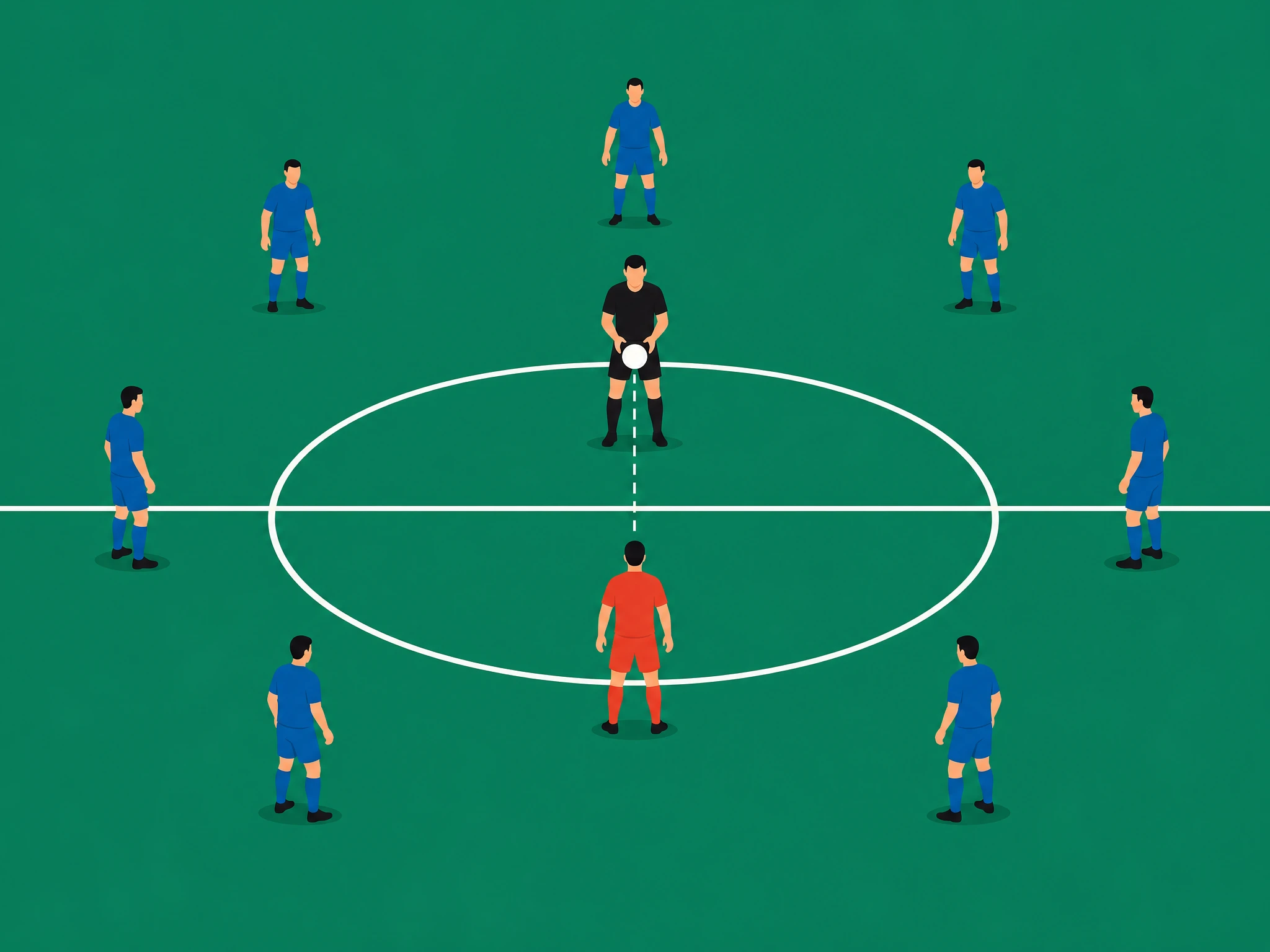
The current procedure is short and uncontested. The referee drops the ball for one player, and every other player from both teams has to be at least 4 metres (4.5 yards) away until the ball is in play. The ball is in play the instant it touches the ground.
Who the ball goes to depends on where play stopped. Law 8 splits it two ways:
- If the ball was outside the penalty area, the referee drops it for one player of the team that had, or would have, kept or won possession. If that cannot be worked out, it goes to one player of the team that last touched it.
- If the ball was inside the penalty area, the referee drops it for the defending team’s goalkeeper, in their own penalty area.
In practice the two teams sort it out informally. The player who receives the drop ball will usually knock it back to the opposition, because the side that last had the ball is the one being given it back. That courtesy is a convention, not a rule: the Laws decide who gets the ball, they do not require the receiver to return it.
The receiving player does not have to wait for a second signal. Once the referee has dropped the ball and it touches the ground, it is live.
What changed in 2019
Before the 2019/20 Laws of the Game, a drop ball was contested. The referee dropped the ball between one player from each team and they challenged for it as it landed. That version is gone.
IFAB replaced it because the old contested drop ball too often produced a “manufactured” restart. Sides would agree in advance to let one team win it back, or the drop would turn into an unnecessary confrontation as two players lunged at a bouncing ball. IFAB’s 2019/20 law changes switched to returning the ball to the team that last played it, so the restart reflects what was actually lost when the referee stopped play, rather than becoming a fresh 50-50.
This is also why you see the sporting manual return so often now. Because the ball is handed back to the team that last touched it, and the game is being restarted from a neutral stoppage rather than a foul, players treat it as an honesty restart and give the ball straight back to the other side. The Laws do not script that return, the possession rule just makes it the natural thing to do.
The ball hitting the referee
The referee is treated as part of the pitch. If the ball hits the referee, or an assistant, and play carries on, nothing happens. That was the rule for years, and it still holds most of the time.
The 2019/20 change added an exception. Under Law 9, the ball is out of play, and play restarts with a drop ball, when it hits a match official, stays on the field, and one of three things follows:
- a team starts a promising attack, or
- the ball goes directly into the goal, or
- the team in possession changes.
So a shot that deflects in off the referee does not count as a goal. A pass that ricochets off the official straight to the other team does not stand as a turnover. In each case play stops and the referee drops the ball for the side that would have kept or gained possession if the deflection had never happened, at the spot where the ball struck the official. If that is inside the penalty area, it goes to the defending goalkeeper.
A rare restart the referee's own body decides
You cannot score directly from a drop ball
A drop ball cannot go straight into the net. Law 8 requires it to be touched by at least two players before a goal can count.
If a drop ball enters a goal without touching at least two players, the restart is:
- a goal kick, if it went into the opponents’ goal, or
- a corner kick, if it went into the team’s own goal.
That mirrors the way you cannot score directly from a throw-in either, where a throw straight into the opponents’ goal becomes a goal kick and one into your own goal becomes a corner. The drop ball adds the “two players” wording because, unlike a throw, it can legitimately be played by more than one person before anyone shoots.
Two more edge cases sit in the same section. If the dropped ball touches a player before it touches the ground, or if it touches the ground and then leaves the field without any player touching it, the referee simply drops it again. The restart only stands once the ball has hit the ground with nobody having jumped in early.
Referees on FootyMetrics
Drop balls, advantage and card calls all come down to the referee in the middle. Browse referee profiles and their match records.
Drop ball FAQs
Who gets the ball from a drop ball?
One player of the team that last touched it, or that would have kept or won possession, if play stopped outside the penalty area. If play stopped inside the penalty area, the ball is dropped for the defending team's goalkeeper. Every other player has to stay at least 4 metres away until it touches the ground.
Is a drop ball still contested between two players?
No. That ended with the 2019/20 Laws of the Game. Before then the referee dropped the ball between one player from each side and they challenged for it. Now it is dropped to a single player, uncontested, and everyone else stays 4 metres back.
When is a drop ball given?
When the referee stops play with the ball still on the field for a reason that is not a foul or an out-of-play ball. The common reasons are a serious injury, outside interference such as a second ball or an animal on the pitch, or the ball hitting the referee and changing the game.
Can you score directly from a drop ball?
No. The ball has to touch at least two players before a goal can count. If a drop ball goes straight into the opponents' goal it becomes a goal kick, and if it goes into the team's own goal it becomes a corner kick.
What happens if the ball hits the referee?
Usually nothing, play carries on. But if the ball hits a match official, stays on the pitch, and it leads to a goal, a change of possession, or a promising attack, play is stopped and restarted with a drop ball for the team that would have kept or gained possession.
How far do players have to stand from a drop ball?
All players except the one receiving it have to be at least 4 metres (4.5 yards) from the ball until it is in play, which is the moment it touches the ground.