What is advantage in football?
Advantage is when the referee lets play continue after a foul or other offence instead of stopping the game, because the team that was fouled already benefits more from carrying on than they would from the free kick. It is one of the referee's own powers under IFAB's Law 5, not a separate numbered law.
Team FootyMetrics
Updated Jul 2026 · 6 min read
- Advantage is the referee's own call, under Law 5, to let play run on after an offence because the fouled team is already better off continuing.
- It can be reversed. If the anticipated advantage does not happen at that time or within a few seconds, the referee can still stop play and penalise the original offence.
- Playing advantage does not cancel a card. An ordinary cautionable foul still gets a yellow card at the next stoppage. The one exception is a DOGSO foul where the anticipated goal is actually scored, in which case IFAB says no card is shown.
- VAR does not review the advantage decision itself, only whatever it eventually produces, if that falls into VAR's four reviewable categories.
The part that catches people out is not the idea of playing on, everyone understands that. It is what happens next: whether the referee can still go back, and whether the original foul still earns a card.
What is advantage?
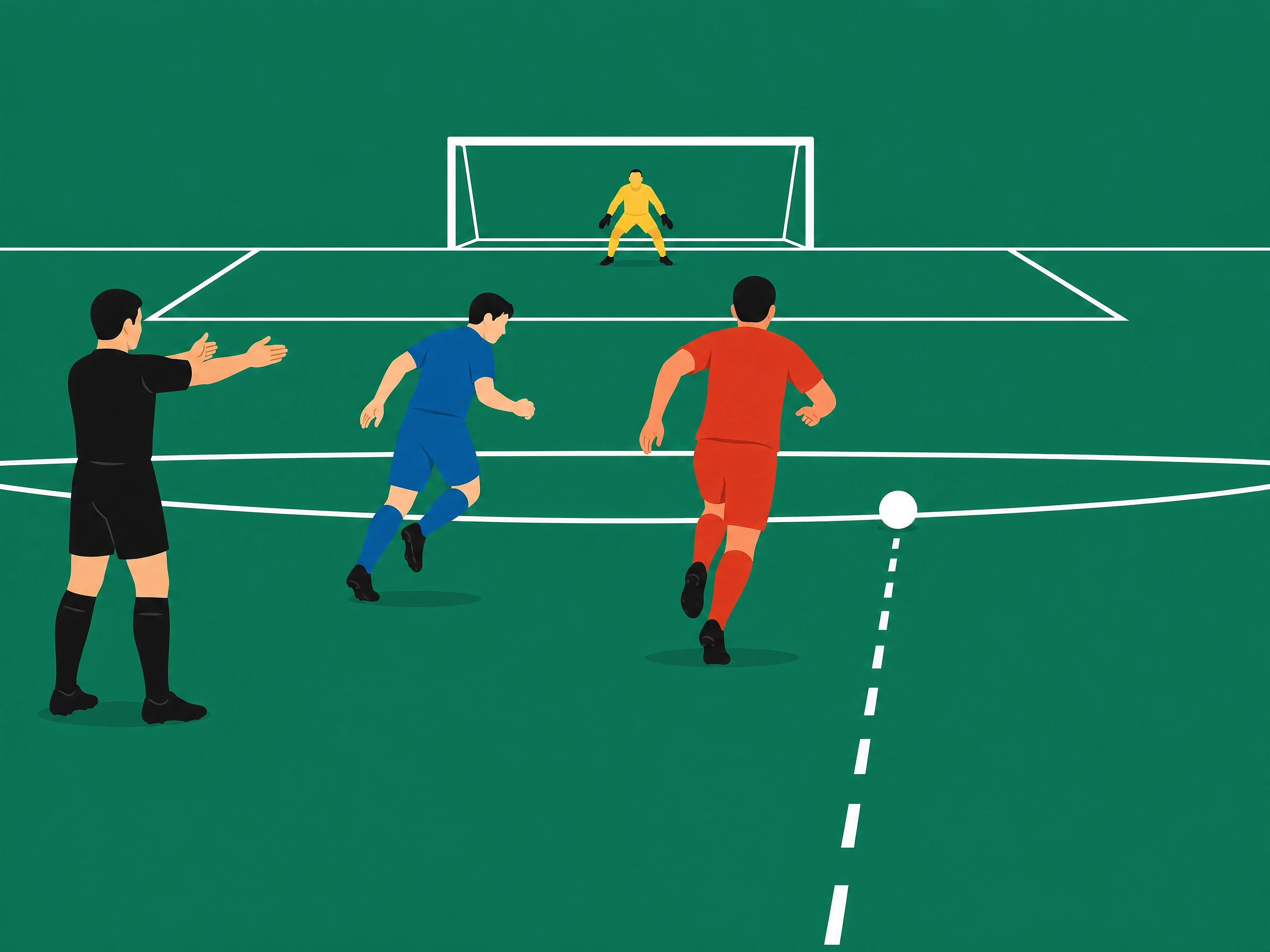
Under IFAB’s Law 5, the referee “allows play to continue when an offence occurs, or a restart is incorrectly taken and the ball is in play, and the non-offending opposing team will benefit from the advantage.” In plain terms, the referee spots a foul, but instead of blowing the whistle, judges that the fouled team is already in a better position carrying on than they would be from the free kick that follows. A common example is a foul on a player who has already slipped the ball through to a team-mate running clear on goal. Stopping play there would hand the advantage back to the team that just committed the foul.
This is the referee’s own decision, made in the moment, as part of their general authority over the match under Law 5. It is a separate mechanism from denying a goal-scoring opportunity outright, covered in what is DOGSO. DOGSO is about a foul that stops a clear chance from happening at all. Advantage is about the referee deciding the chance is still on, despite the foul, and choosing not to interrupt it.
Can advantage be reversed? The pull-back rule
Advantage is not final the instant it is played
Note the exact wording: “at that time or within a few seconds.” IFAB does not attach a specific number of seconds to this window. Commentators sometimes talk about a two or three second rule, but that is shorthand, not the law’s own text. The real test is whether the anticipated advantage actually develops, not a stopwatch.
Does playing advantage cancel the card?
Playing on does not mean the referee forgets the original foul ever happened. For an ordinary cautionable challenge, the card still comes. IFAB’s own published guidance on Law 5 covers this directly: after a reckless challenge where advantage is played because the fouled team keeps the ball and keeps moving forward, the offending player “must be cautioned (yellow card, YC) when play next stops.” The free kick itself never gets taken, but the yellow card still gets shown once the ball is next out of play.
There is one narrower, specific exception, and it is worth stating precisely rather than generalising it. It applies to a DOGSO foul, denying an obvious goal-scoring opportunity, covered fully in what is DOGSO. IFAB’s own worked example for Law 5 states: “The referee plays the advantage following a DOGSO offence and, as a result, the attacking team scores, so the goal is awarded, and the goalkeeper is not cautioned or sent off.” So if the anticipated advantage after a DOGSO foul is an actual goal, no card is shown at all for the original offence, not even a delayed one. That is different from the general rule above, where the card still arrives later. The reasoning IFAB gives is that the disciplinary sanction for DOGSO is tied to whether a goal-scoring opportunity was actually denied. If the goal goes in anyway, it was not denied, so the card falls away rather than being delayed.
Do not read this as “any advantage cancels any card.” The two examples above are deliberately different outcomes for different offences: an ordinary reckless foul still earns a delayed yellow card after advantage, while a DOGSO foul followed by an actual goal specifically removes the card altogether. What happens to a red card or a second yellow afterwards, in terms of the ban that follows, is covered separately in red card suspensions, and if you bet on card markets, the delayed-caution pattern is exactly the kind of thing that shows up in player card trends.
Why advantage is a judgement call, not a checklist
DOGSO comes with four named factors a referee weighs, distance to goal, direction of play, likelihood of keeping the ball, and the number of defenders and attackers, set out in full on what is DOGSO. Advantage does not have an equivalent published checklist. Law 5’s wording describes an outcome, whether the non-offending team will benefit, and a short reversal window, but it does not list named criteria the way the DOGSO test does. In practice, that means advantage leans more heavily on the referee’s own real-time read of the game than DOGSO’s more structured test. The law offers nothing more concrete, so arguments about whether a referee should have played advantage are arguments about judgement, not text.
Can VAR review an advantage call?
VAR does not review the advantage decision itself, the in-the-moment call to wave play on. VAR is limited to four categories: goals, penalties, direct red card incidents, and mistaken identity, listed in the Premier League's own VAR FAQs and covered in full in how does VAR work. Advantage is not a fifth category. What VAR does check is whatever the advantage eventually produces, if that outcome happens to land in one of those four categories. If playing advantage leads to a goal, that goal gets checked like any other, for offside, handball or an offence earlier in the build-up. If a referee plays advantage and, as a result, never returns to what should have been a red card offence, that missed sending-off can be picked up as a missed direct red card incident. The underlying advantage call, whether the referee was right to think the team would benefit from playing on, is not itself something VAR is set up to check.
Advantage FAQs
Can a referee change their mind after playing advantage?
Yes. If the advantage the referee expected does not happen at that time or within a few seconds, the referee can stop play and award the original free kick or penalty instead.
Does playing advantage mean no card is shown for the foul?
Not usually. For an ordinary foul, the referee still cautions the player once play next stops, even though advantage was played. The exception is a DOGSO offence where the anticipated advantage is an actual goal, in which case IFAB's own guidance says no card is shown at all.
Is there a fixed number of seconds for the advantage window?
No. IFAB's own wording is that the referee can still penalise the offence if the anticipated advantage does not develop at that time or within a few seconds. It is not tied to an exact count.
Can a referee play advantage on a DOGSO foul?
Yes. If the referee judges the fouled team already has a better chance carrying on than from the free kick, they can play advantage even on a foul that denies a goal-scoring opportunity. If the anticipated goal is actually scored, no card is shown for the original foul.
Does the advantage rule apply the same way in every competition?
Yes. The Laws of the Game are written by IFAB and apply at every level, so the advantage clause in Law 5 is identical from the World Cup to Sunday league. What varies is VAR: competitions without it have no way to pick up a missed red card after advantage is played.
Is advantage a separate law in football?
No. Advantage is one of the referee's powers under IFAB's Law 5, the law covering the referee, rather than a numbered law of its own.
Does VAR check advantage decisions?
Not the advantage decision itself. VAR only reviews goals, penalties, direct red card incidents and mistaken identity, so it steps in on whatever the advantage eventually produces, not on the in-the-moment call to wave play on.