What is DOGSO in football?
DOGSO stands for denying an obvious goal-scoring opportunity. It is a sending-off offence under Law 12: a player fouls an opponent who had a genuinely clear run at goal. There is one major exception. Inside the fouling team's own penalty area, if the offence was a real attempt to play the ball, the referee gives a yellow card and a penalty instead of a red.
Team FootyMetrics
Updated Jul 2026 · 6 min read
- DOGSO means denying an obvious goal-scoring opportunity, one of the sending-off offences in Law 12 alongside serious foul play, violent conduct, and biting or spitting.
- IFAB judges whether a chance was obvious using four factors: distance to goal, direction of play, likelihood of keeping the ball, and the number of defenders and attackers.
- Inside the penalty area only, a DOGSO foul that is a genuine attempt to play the ball gets a yellow card and a penalty, not a red. Everywhere else, or if it was not a genuine attempt to play the ball, it is a straight red.
- DOGSO by handball is a separate offence with its own card outcomes, not the same as a DOGSO foul.
The part that trips people up is not the headline rule, it is the exception: plenty of viewers think any professional foul inside the box earns a yellow card automatically. It does not. IFAB sets a specific test for when the exception genuinely applies, and it turns on intent, not just location.
What is DOGSO?
DOGSO stands for Denying an Obvious Goal-Scoring Opportunity. Under IFAB’s Law 12, a player is sent off for “denying a goal or an obvious goal-scoring opportunity to an opponent whose overall movement is towards the offender’s goal by an offence punishable by a free kick.” In plain terms, a defender commits a foul, most often the last player back, that stops an attacker who was clearly going to have a shot or a clean run at goal.
Not every foul on a forward counts. The offence has to actually deny a chance that was genuinely obvious, not just promising or dangerous. DOGSO sits alongside serious foul play, violent conduct, and biting or spitting as one of the sending-off offences in Law 12.
How do referees decide if a chance was obvious?
Referees do not decide DOGSO on instinct. Law 12 sets out four factors to weigh when judging whether a goal-scoring opportunity was genuinely obvious:
- Distance between the offence and the goal
- General direction of the play
- Likelihood of keeping or gaining control of the ball
- Location and number of defenders and attackers
Each factor cuts against DOGSO if it is weak. A foul thirty yards from goal with three covering defenders still in place is unlikely to be DOGSO, even if the attacker was technically through, because the distance and the number of defenders both work against it. Direction of play matters too: the attacker’s overall movement has to be towards the offender’s goal, not just forward or sideways. Likelihood of keeping the ball asks whether the attacker was actually in control, or chasing a bouncing ball they might not have reached anyway. All four get weighed together, not ticked off one at a time.
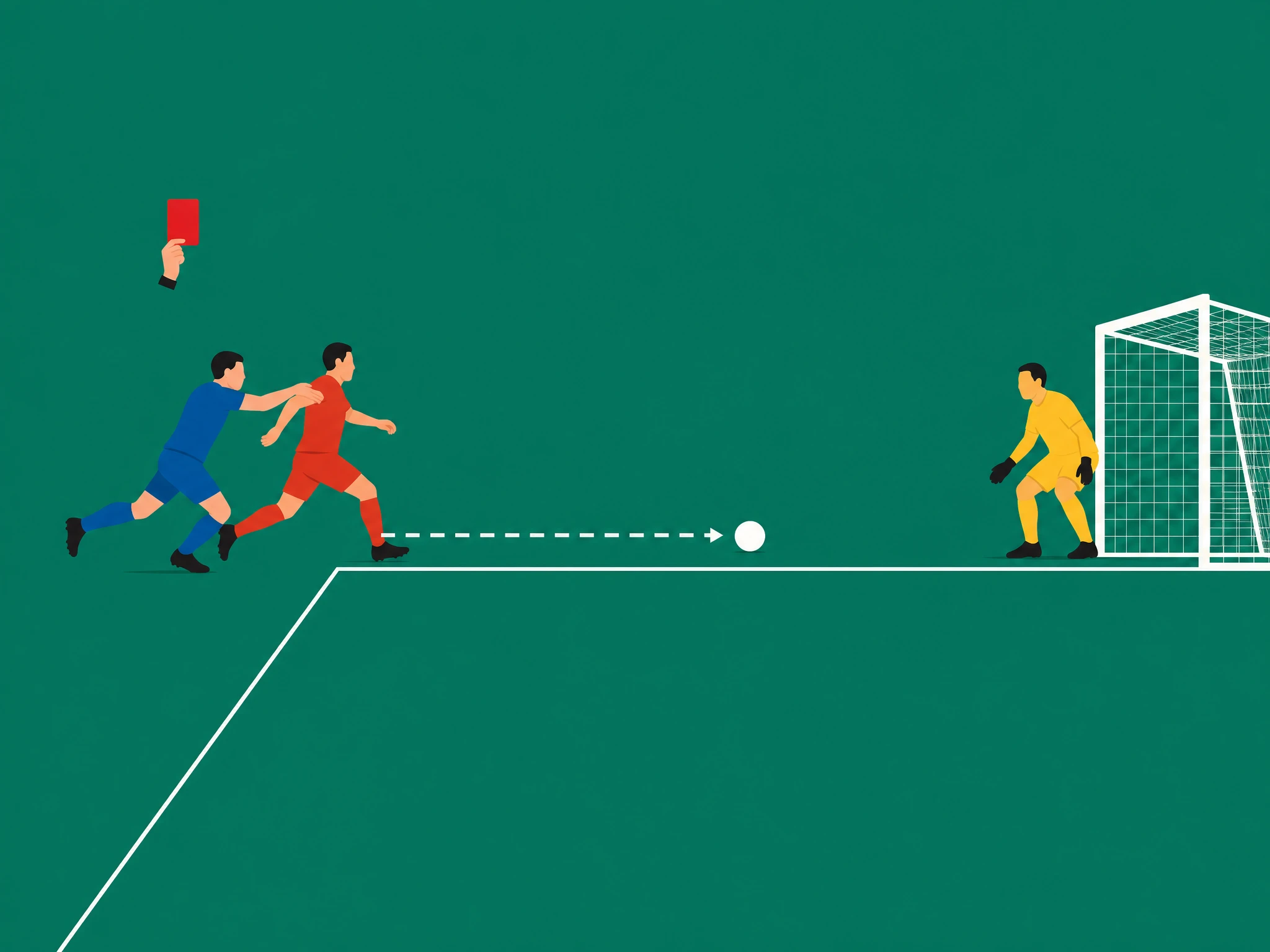
Foul on a clear run at goal, just outside the box. Straight red card.
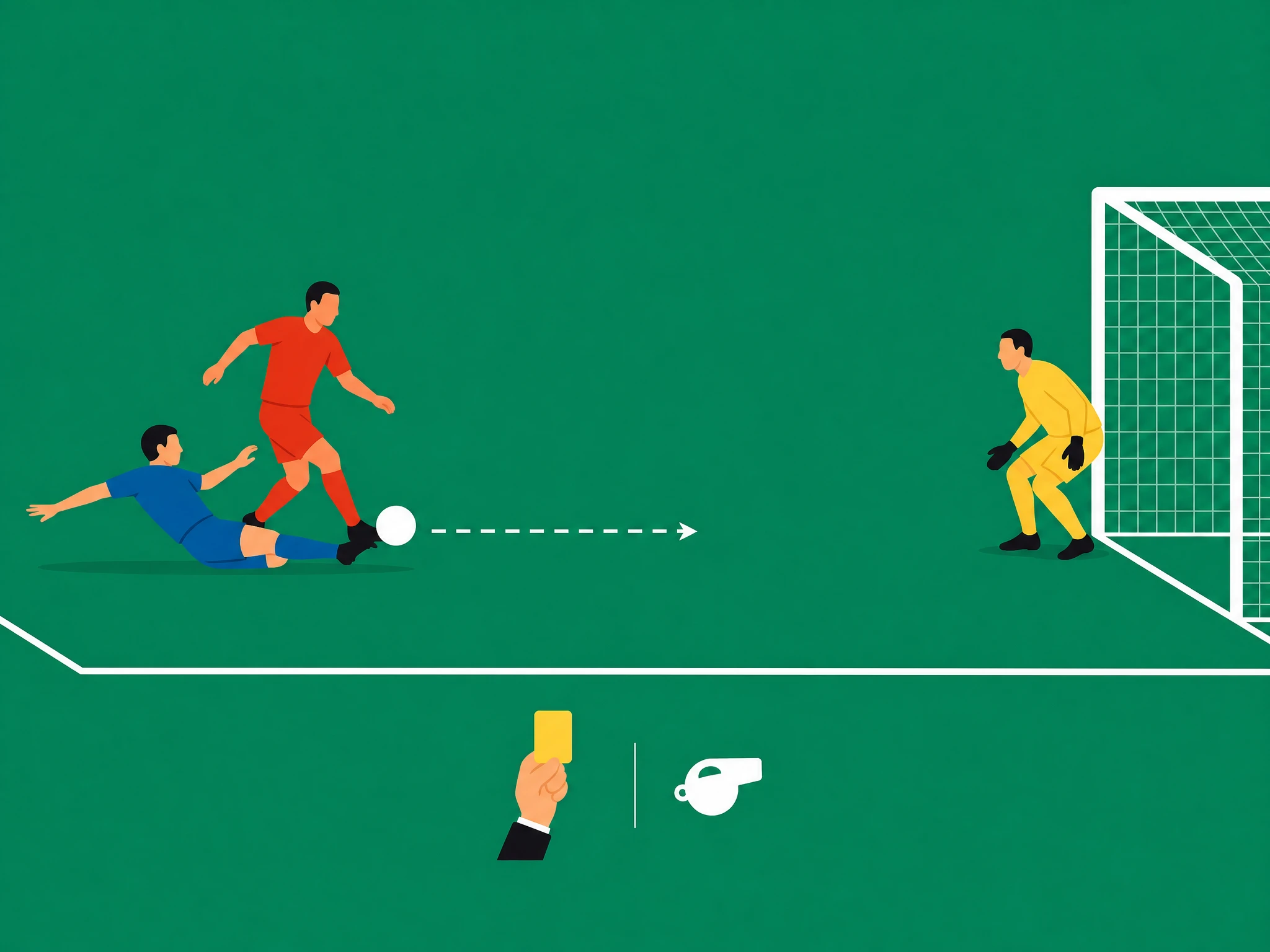
Same run, foul just inside the box, genuine attempt to play the ball. Yellow card and penalty.
The yellow-card-in-the-box exception, worded precisely
Why the box exception gets misread
The common shorthand, “professional foul in the box is a yellow,” skips the actual test. The exception is not about location alone, it is about what the defender was trying to do. Referees have to judge intent and contact, which is why two visually similar fouls in the same penalty area can produce different cards: one defender genuinely stretches for the ball and just catches the attacker’s foot, the other grabs a shirt with no attempt on the ball at all. Outside the penalty area, none of this applies. There is no yellow-card route for a DOGSO foul outside the box; it is always a straight red, whatever the defender was attempting.
DOGSO by a foul vs DOGSO by handball
A direct foul, tripping, holding, pushing and the like, follows the rule above: red card, unless the in-box attempt-to-play-the-ball exception applies. Denying a goal or an obvious scoring chance with the hands is judged separately, with its own outcomes.
- Red card, wherever on the pitch it happens.
- The only exception is a goalkeeper inside their own penalty area.
- Red card if it happens outside the penalty area.
- Yellow card, with a penalty, if it happens inside the penalty area.
So the two systems overlap in outcome but are not the same rule. Deliberate handball punishes intent regardless of where it happens on the pitch. Non-deliberate handball follows the same inside-the-box softening as a foul, but the trigger is whether the handling was deliberate at all, not whether it was a genuine attempt to play the ball with the feet.
DOGSO and VAR
A DOGSO sending-off is a direct red card incident, and direct red card incidents are one of the four categories VAR is allowed to review, alongside goals, penalties, and mistaken identity. If a referee sends a player off for DOGSO, shows only a yellow under the box exception, or waves play on entirely, VAR can flag it as a possible clear and obvious error. The full check-versus-review process, and what VAR can and cannot touch, is covered in how does VAR work, so this page will not repeat the protocol here. It is also worth remembering that a goal-scoring opportunity cannot be denied by a foul on a player who was offside in the first place, which is one reason a DOGSO review and an offside review often happen back to back. See what is offside in football for that rule.
DOGSO as a stat
FootyMetrics tracks red cards and sending-offs for every referee and team across 115+ leagues, so a DOGSO decision shows up in a referee’s own disciplinary record rather than disappearing once the match ends.
Referee red card records
See which referees send off the most players for DOGSO fouls, across 115+ leagues.
DOGSO FAQs
What does DOGSO stand for?
Denying an Obvious Goal-Scoring Opportunity. It is one of the sending-off offences in Law 12, alongside serious foul play, violent conduct, and biting or spitting.
Is a professional foul in the box always a yellow card?
No. It is only a yellow card, with a penalty, if the referee judges the offence to be a genuine attempt to play the ball or a challenge for the ball. Shirt-pulling, holding, pushing, or a foul with no chance to play the ball is still a straight red card plus penalty, even inside the box.
Does the yellow-card exception apply outside the penalty area?
No. The exception only applies inside the fouling team's own penalty area, and only when the referee awards a penalty kick. A DOGSO foul outside the box is always a straight red card.
Is denying a goal with your hands the same as a normal DOGSO foul?
It is a related but separate offence with its own outcomes. Deliberate handball that denies a goal or an obvious scoring chance is a red card wherever it happens, except a goalkeeper inside their own area. Non-deliberate handball that denies a goal or a chance is a red card outside the box, but only a yellow card, with a penalty, if it happens inside the box.
Can VAR review a DOGSO decision?
Yes. A direct red card incident, which includes DOGSO, is one of VAR's four reviewable categories, along with goals, penalties, and mistaken identity.
How do referees decide if a chance was obvious?
They weigh four factors together rather than ticking them off one at a time: distance between the offence and the goal, the general direction of play, the attacker's likelihood of keeping or gaining control of the ball, and the location and number of defenders and attackers around the ball.
Can a player still be sent off for DOGSO if they were offside?
No. A goal-scoring opportunity cannot be denied by a foul on an attacker who was offside at the point the ball was played, since that player was never going to be awarded the chance in the first place. This is why a DOGSO review and an offside review often happen back to back.