Total passes props: how they settle
A total passes prop settles on attempted passes, not just the ones that find a team-mate. Opta defines a pass as the attempted delivery of the ball from one player to another player on the same team, so the count includes every attempt, whether it arrives, is blocked, or runs out of play.
Team FootyMetrics
Updated Jul 2026 · 7 min read
- A pass is logged on the attempt, not the outcome. Opta's definition is the attempted delivery of the ball to a team-mate, so total passes includes both completed and incomplete passes.
- A blocked pass still counts as an attempt for the passer. It just fails to count as completed, since the ball never reached the team-mate untouched.
- A long ball that runs straight out of play still counts as an attempted pass, as long as it was aimed at a team-mate.
- Total passes props run on attempted volume, which is why centre-backs and holding midfielders, who see the ball constantly in build-up, post the highest counts in the game.
That single distinction, attempted versus completed, is where most of the confusion around a total passes line starts. It is also why position drives this market harder than form or opponent does.
The plain definition: attempted vs completed
Start with Opta’s own wording, because it settles the confusion in one line. A pass is “the attempted delivery of the ball from one player to another player on the same team.” That is the whole test for whether an event gets logged as a pass at all: did a player try to send the ball to a team-mate. It does not require the ball to arrive.
A completed pass, which Opta and most data providers also call an accurate pass, is a narrower category sitting inside that total. It is the successful delivery of the ball from one player to another player on the same team, and the pass has to go directly to the team-mate without a touch from an opposition player. So every accurate pass is also an attempted pass, but plenty of attempted passes are not accurate. Total passes is the attempts. Accurate passes is the subset that actually found their man.
Crosses, goalkeeper throws and throw-ins sit outside the plain pass count in Opta’s own categorisation, tracked as their own separate event types. Corners and free kicks played short as a pass do count.
Does a blocked pass still count as an attempt
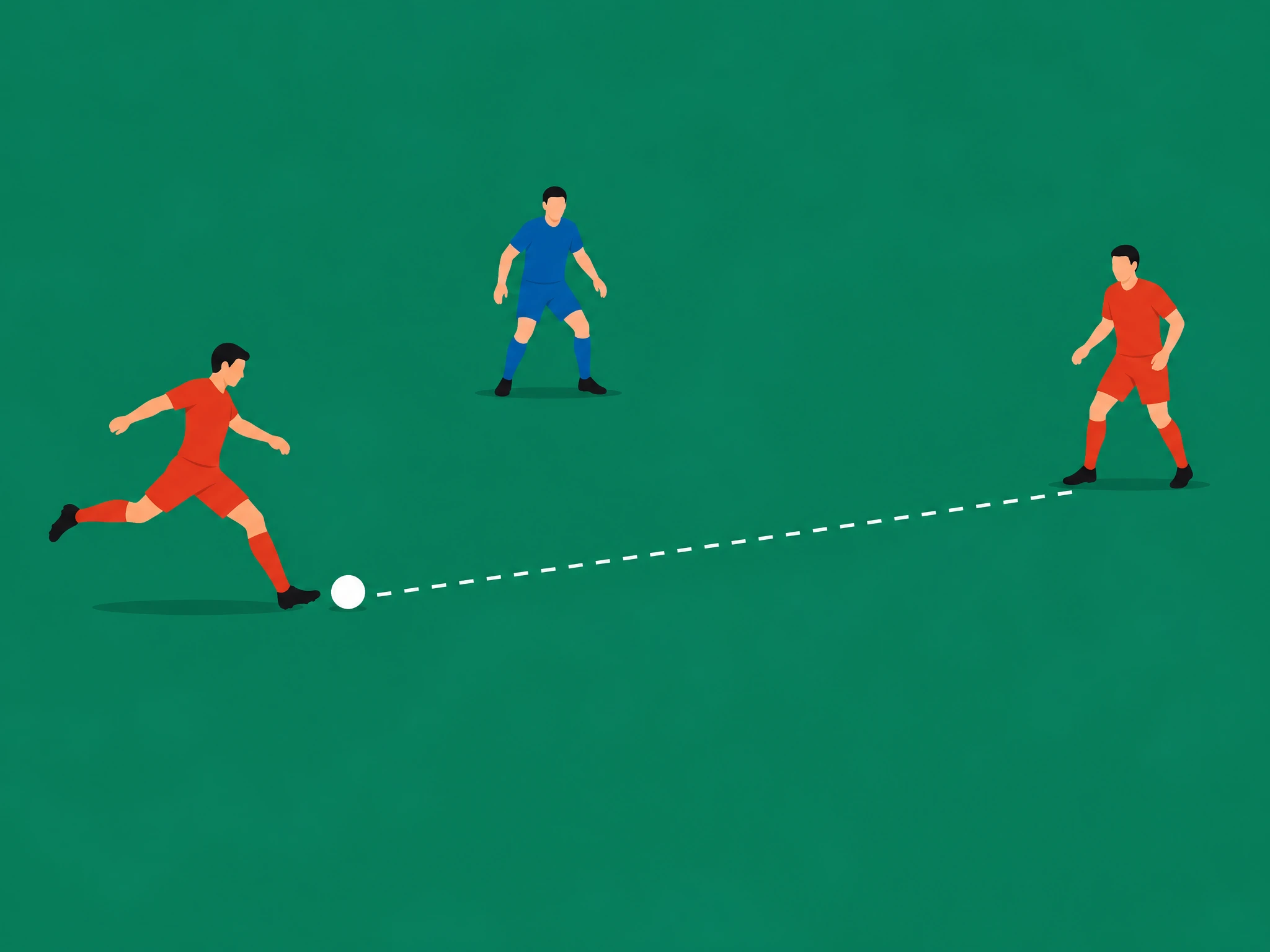
Yes, with one distinction worth knowing. Opta’s own guidance on a blocked pass is that if the pass has been cleanly struck and the ball is already clearly travelling on the intended line before a defender gets a touch, the action is logged as a blocked pass: a defensive action for the blocker, and an incomplete pass for the player who played it. The attempt still belongs to the passer’s total passes number. It just fails to count as completed, because the ball never reached the team-mate untouched.
For a props market, the detail that matters is simple. A blocked pass still adds one to the passer’s attempted total. It does not disappear from the count just because a defender got in the way.
- A pass that is blocked by a defender after being cleanly struck at a team-mate.
- A long ball that runs straight out of play untouched.
- A pass that is deflected but still reaches its target.
- A cross, a goalkeeper throw or a throw-in. These are separate event types in Opta's categorisation.
- Any action where the player never intended to find a team-mate at all.
Passes that go straight out of play
The test is intent, not result. If a player aims the ball at a team-mate, that is a pass attempt whether it arrives, is blocked, or sails out of play completely untouched. A hopeful diagonal ball that a full-back knocks long, hoping to find a winger, and which runs out of play for a goal kick, is still one attempted pass on that full-back’s total. It simply will not count as completed, since nobody on their team touched it.
A total passes prop rewards volume of intent, not tidy build-up play. A team knocking the ball around patiently in their own half racks up attempts the same way a team hitting longer, riskier balls forward does. The counting rule does not care which style produced the pass.
Attempted passes convention
Why “total passes” usually means attempted
FootyMetrics tracks a player’s passes as the attempted total, the plain pass count, across every league it covers. That is the figure shown on the player stats hub as total passes per game, kept separate from pass accuracy, which is its own column. Bookmakers follow the same convention. Sky Bet, for example, keeps its market-by-market settlement wording on a football rules hub, the page to confirm how its passes markets settle before taking a line there.
Why position matters so much for this market
This is the single biggest factor in a total passes prop, more than form or opponent. Centre-backs and holding midfielders post the highest total-passes counts in the game because of where they stand and how often the ball comes to them, not because they are the most skilful passers on the pitch.
Modern centre-backs are heavily used in build-up. Teams that build from the back position their centre-backs to receive possession constantly from the goalkeeper and circulate it before play moves forward, and a holding midfielder drops between or alongside them to offer another central passing option. Virgil van Dijk, a centre-back, led the Premier League in passes completed in the 2025-26 season with 2,482, ahead of fellow centre-backs Lewis Dunk and Jan Paul van Hecke, while Rodri, a holding midfielder, holds the highest passes-completed-per-match rate of any player in Premier League history at just over 77 per game. Both are central positions that see the ball early and often in a team’s own half, where there is time and space to keep finding a team-mate.
Wingers and strikers, by contrast, touch the ball in tighter areas further forward, get fewer clean sight-of-goal touches per match, and often have the ball played to them under pressure rather than circulating it themselves. Their total passes numbers sit well below a centre-back’s or a holding midfielder’s even in a match where they play every minute and are heavily involved in the final third.
Player passes trends
Check a player's total passes history before backing a line, filtered by home, away and opponent.
Pass completion percentage is a different, related stat
Total passes and pass completion percentage are commonly confused, but a props line only ever runs on one of them at a time. Total passes is a volume count: how many attempts a player made. Pass completion percentage is a ratio: how many of those attempts were completed, expressed as a percentage. A player can have a very high volume of passes and a modest completion percentage, or a low volume and an excellent percentage, since the two numbers do not move together in any fixed way. Pass completion has enough quirks of its own to deserve a separate guide, so treat the distinction above as the short version.
How a change in role can shift a player’s passing volume
Passing volume is tied to role and position on the pitch, so a tactical change can move a player’s total passes number without their underlying ability changing at all. A full-back who tucks into a back three or a double pivot in possession sees far more of the ball than one who stays wide and waits for it to be worked out to the touchline, simply because central areas of the pitch see more traffic than the flanks. The same logic applies to a winger dropped into a more central role, or a striker asked to drop deep and link play rather than stay high against the last defender.
This is worth checking before backing a total passes line, especially for a player whose manager has changed formation, personnel around them, or their specific job in possession recently. A player who has moved from a wide role into a more central one, or who is suddenly playing behind a lone striker instead of out on the touchline, can see their total passes number shift meaningfully from one system to the next, independent of the opponent or the scoreline.
Total passes props FAQs
Does a total passes prop count completed passes only or every attempt?
Every attempt. Opta defines a pass as the attempted delivery of the ball from one player to another player on the same team, and a total passes market runs on that attempted count, not the narrower completed passes figure.
Does a blocked pass still count toward total passes?
Yes. If the pass was cleanly struck at a team-mate before a defender got a touch, it is logged as an attempt for the passer and a blocked pass for the defender. The block stops it from being a completed pass, but it still adds one to the passer's total attempts.
If a long ball runs straight out of play, does it still count as a pass?
Yes, as long as it was aimed at a team-mate. The test is intent, not result. A hopeful long ball that nobody touches before it goes out for a goal kick is still one attempted pass, it just does not count as completed.
Why do centre-backs and holding midfielders have the highest total passes counts?
Because of where they play, not because they are the best passers on the pitch. Centre-backs and holding midfielders see the ball constantly in build-up, in central areas with time and space to keep finding a team-mate. Virgil van Dijk led the Premier League in passes completed in 2025-26 with 2,482, and Rodri holds the highest passes-completed-per-match rate in league history, both central roles that touch the ball far more often than a winger or striker.
Do crosses and throw-ins count toward a total passes prop?
No. Crosses, goalkeeper throws and throw-ins are tracked as their own separate event types in Opta's categorisation, so they sit outside the plain pass count a total passes market settles on. Corners and free kicks played short as a pass do count.
Can a change of role move a player's total passes number?
Yes, and often sharply. Passing volume is tied to position, so a full-back tucking into a back three, a winger moved central, or a striker asked to drop deep and link play can all see their total passes shift from one system to the next without their ability changing at all. Check for a recent formation or role change before backing a line.
Is total passes the same stat as pass completion percentage?
No. Total passes is a volume count of attempts. Pass completion percentage is a ratio of how many of those attempts were completed. A player can have a high volume of passes and a modest completion percentage, or the other way round, since the two numbers do not move together.