Stake factoring: how your personal max bet is set
A stake factor is a multiplier a bookmaker attaches to your account that scales the maximum stake it will accept from you. A factor of 1.0 lets you bet the full advertised market maximum; a factor of 0.1 caps you at a tenth of it. The book sets it per account, often differently by sport or market, and it moves down when your betting starts to look sharp.
Team FootyMetrics
Updated Jul 2026 · 6 min read
- A stake factor is a per-account multiplier on the bookmaker's advertised maximum stake. At 1.0 you can bet the full market max; at 0.1 you are capped at 10% of it; near zero the account is open in name only.
- It is usually applied per sport or per market type, so a factor of 1.0 on Premier League match odds can sit next to a much lower factor on player props or obscure markets.
- What triggers a cut is a betting pattern the book reads as sharp: consistently beating the closing price, arbing, sniping boosted prices, or hammering the max on thin markets.
- Most people never see the number. They notice their maximum stake has quietly shrunk when a bet gets partially accepted or rejected.
This is the mechanics of the max-stake multiplier. The wider question of why books restrict accounts, the business model that depends on the recreational majority losing over time, is covered on why bookmakers limit winning accounts, and isn’t repeated here. This page is the how: how the multiplier is applied, what moves it, and what a factored account can still do.
What a stake factor is
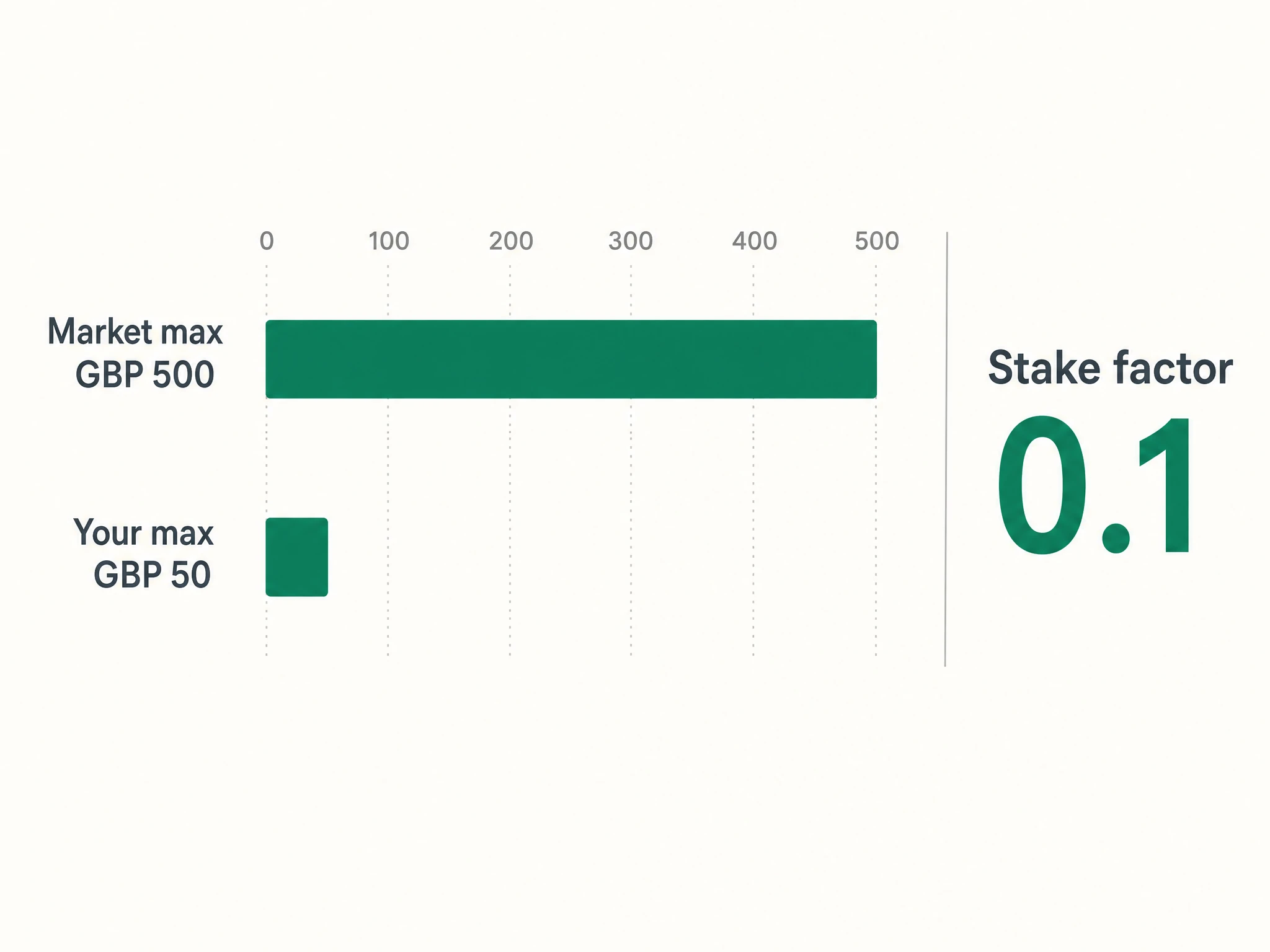
A stake factor is a number between 0 and 1 that a bookmaker multiplies against its advertised maximum stake to work out the most it will let a specific account bet on a given market. If a market’s published maximum is £500 and your factor on it is 1.0, you can stake the full £500. If your factor is 0.1, the book accepts £50 and no more. Push the factor towards zero and the practical maximum falls to loose change.
The factor is invisible to the customer. There is no page in your account showing “your stake factor is 0.25”. You infer it from what the bet slip will and will not accept.
How the multiplier works in practice
The number is applied at the moment you try to place a bet. The bookmaker’s system takes the market’s maximum for that selection, multiplies it by your factor for that market or sport, and that product is the ceiling on your stake. Ask for more and the slip either caps you at the allowed figure or bounces the bet.
A factor of 1.0 is the default a new account usually starts on: you get the full advertised maximum. From there it tends to move one way only. A cut to 0.5 halves your ceiling, 0.25 quarters it, and the severe end sits below 0.1, where a market that once took £500 now takes £50, £20 or less.
A Gambling Commission data collection exercise, published on its blog, shows how far these cuts go in practice. Among accounts that had a stake factor applied, 36.22% were factored down to between 1% and 9% of the normal maximum, and a further 22.41% were cut below 1%. At the milder end, 6.04% sat between 90% and 100%, and 7.50% between 50% and 89%. So the common outcome of a stake factor is not a gentle trim. Most factored accounts land in the bottom brackets, where meaningful betting is no longer practical, according to the Gambling Commission’s blog on commercial restrictions.
It is per sport and per market, not one number
A stake factor is rarely a single global setting on your account. Books apply it granularly, so the ceiling that applies depends on what you’re betting.
The usual pattern is that heavily traded markets, Premier League match odds and the like, carry a higher factor than thin ones. A book has huge amounts of its own data and other operators’ prices to lean on for a Premier League result, so it’s comfortable taking size there. A niche player prop, a lower-division corner line or an obscure overseas market is priced with far less confidence, so the factor on it is cut harder and sooner. That’s also why sharp bettors who load up on soft-priced props tend to get factored on exactly those markets first, while their match-odds factor stays untouched for a while.
One market tells you nothing about another
What triggers a cut
Nothing about the mechanics is published, so what follows is how the practice is understood from the Commission’s data, matched-betting communities and the behaviour bettors report, not a rule any book has confirmed. Books guard the exact triggers precisely so they cannot be gamed.
The pattern a risk system looks for is an account that behaves like it has an edge rather than one betting for fun. The signals that come up repeatedly:
- Beating the closing price consistently: your bets keep landing at odds longer than where the market settles at kick-off, which shows closing line value
- Arbing: betting both sides of a market across operators to lock in a profit leaves a footprint risk systems are built to spot
- Sniping boosted prices and offers: only ever betting the price boosts and promotions, never the ordinary book, marks an account as an offer-hunter
- Maxing out thin markets: repeatedly staking the maximum on obscure selections where the book's price is softest
The pattern where bets keep beating the closing price is the clearest of these, and it has its own page: what closing line value is explains why a book treats it as the strongest sign an account is picking off mispriced lines. The Commission’s own figures line up with the general point: in its data, 46.78% of restricted customers were in a net profit position, against 25.42% of all active customers. Restriction skews heavily towards accounts that are winning.
How you find out you have been factored
Almost nobody is told. There is no email that says your factor has been cut, and the number never appears in your account. You discover it the next time you try to place a normal-sized bet.
The tells are familiar to anyone who has been through it. A stake you’ve placed a dozen times is suddenly rejected. The slip accepts £40 of a £200 bet and refuses the rest. A market that took your full stake last month now caps you at a fraction. The maximum has been quietly turned down, and you’re left inferring the new factor from what the book will accept.
Can a stake factor recover
Rarely, and there’s no published route back. Because the whole thing is a commercial decision the book keeps to itself, there is no appeals process and no threshold of “good behaviour” that restores your old ceiling. The Gambling Commission has been explicit that this sits outside what it regulates: in the same blog post it states that “gambling operators are entitled to act in their commercial interests and manage liabilities” and that “it is not within our regulatory remit to mandate how individual operators manage their commercial liabilities.” What the Commission does expect is transparency, that operators are clear “about how, when and why an account might be restricted”, not that they reverse a cut.
In practice a factor can drift back up if an account’s profile changes, for instance if it starts losing or its betting looks more recreational, but no book advertises this and none will confirm a number. Treat a heavy factor as permanent for planning purposes rather than a temporary setback you can appeal.
What a factored bettor can actually do
If a soft book has cut you to the point where the account is useless, the realistic options are structural rather than a workaround at the same book.
- Betting exchanges: you bet against other users, so the operator doesn't lose when you win and has little reason to factor you
- Sharp books: operators that price thin and take professional action don't factor winners the same way
- Spreading across operators: splitting stakes keeps each account's turnover lower and delays when any one factors you
- Appealing to the bookmaker: there's no process, and support can't reverse a commercial decision
- Waiting it out: no fixed period of good behaviour restores an old ceiling
- Betting bigger to look confident: larger stakes on soft markets tend to cut the factor faster, not restore it
On an exchange the limit is how much another user will match at a given price, not a multiplier on your account, which is why exchanges don’t factor winners. Operators at the sharp end of the market run on volume rather than recreational losses, so a winning customer adds turnover rather than threatening the model. None of these is a trick that keeps a soft book betting at full size forever. Account limits are a standing cost of betting with an edge at fixed-odds books, worth planning around rather than fighting.
Find the soft prices before they get factored
Props Edges compares our player projections against bookmaker prices to surface the lines a soft book has mispriced, the same edges that get an account factored fastest.
Stake factoring FAQs
What is a stake factor in betting?
A stake factor is a multiplier between 0 and 1 that a bookmaker applies to its advertised maximum stake to set the most a specific account can bet. At 1.0 you can stake the full market maximum; at 0.1 you are capped at 10% of it. It is set per account and usually varies by sport and market type.
How do I know what my stake factor is?
You cannot see it directly. Bookmakers do not publish an account's stake factor, so you infer it from what the bet slip accepts. If a stake you have placed before is now rejected or only partly accepted, your factor on that market has been cut.
Why is my maximum bet different on different markets?
Because stake factors are applied per sport and per market type, not as one global setting. Heavily traded markets like Premier League match odds usually carry a higher factor than niche player props or obscure markets, where the book prices with less confidence and cuts harder.
Can a stake factor be increased again?
Rarely, and there is no published route. There is no appeals process, because the Gambling Commission treats restriction as a commercial decision for the operator. A factor can drift up if an account's betting looks more recreational over time, but no bookmaker will confirm a figure or reverse a cut on request.
Is stake factoring legal in the UK?
Yes. UK gambling law does not require a bookmaker to accept any bet or offer the same maximum stake to every customer. The Gambling Commission has said this sits outside its regulatory remit and is a commercial decision for the operator, though it expects operators to be transparent about how and when accounts get restricted.
What can I do if I have been stake factored?
The realistic options are betting exchanges, where you bet against other users rather than the book, sharp bookmakers that do not factor winners the same way, and spreading stakes across several operators to slow how quickly any one account restricts you. None guarantees a soft book keeps taking full stakes.
Keep learning
Why bookmakers limit winning accounts
The business reason behind stake factoring
Account restrictions explained
Which markets and features get pulled, beyond stake size
Sharp vs soft bookmakers
Which books factor winners and which don't
What is closing line value?
The clearest signal that gets an account factored