Account restrictions: what gets taken away and why
A bookmaker rarely closes a winning account in one go. It removes things a layer at a time: first the promotions, then your stake size, then whole markets, and only rarely the account itself. Each layer is triggered by something different, and each one changes how you can bet afterwards.
Team FootyMetrics
Updated Jul 2026 · 7 min read
- Restriction is tiered, not a single switch. The mildest and most common step is quietly pulling offers. Full closure is rare and usually tied to identity checks or abuse, not just winning.
- Gambling Commission data on 14.9 million active accounts found 4.31% were restricted. Stake factoring was the most common at 2.68% of active accounts, then closure at 2.23%, withdrawn betting facilities at 0.83%, and market limiting at 0.25%.
- Offers-only bettors tend to get gubbed while price-sensitive winners get stake-factored. Which lever a bookmaker pulls tells you what it thinks you are.
- Each tier changes something different. A promo ban still lets you bet at full stake, factoring shrinks how much you can get on, and a market block leaves match odds open but shuts player props or the bet builder.
This page is about the sequence: which things get removed, in what order, and what triggers each step. Why bookmakers do any of this is covered on why bookmakers limit accounts, and the maths of the stake multiplier itself is on stake factoring explained. Here the focus is the ladder of restrictions and what each rung means for how you carry on betting.
The tiers, from mildest to worst
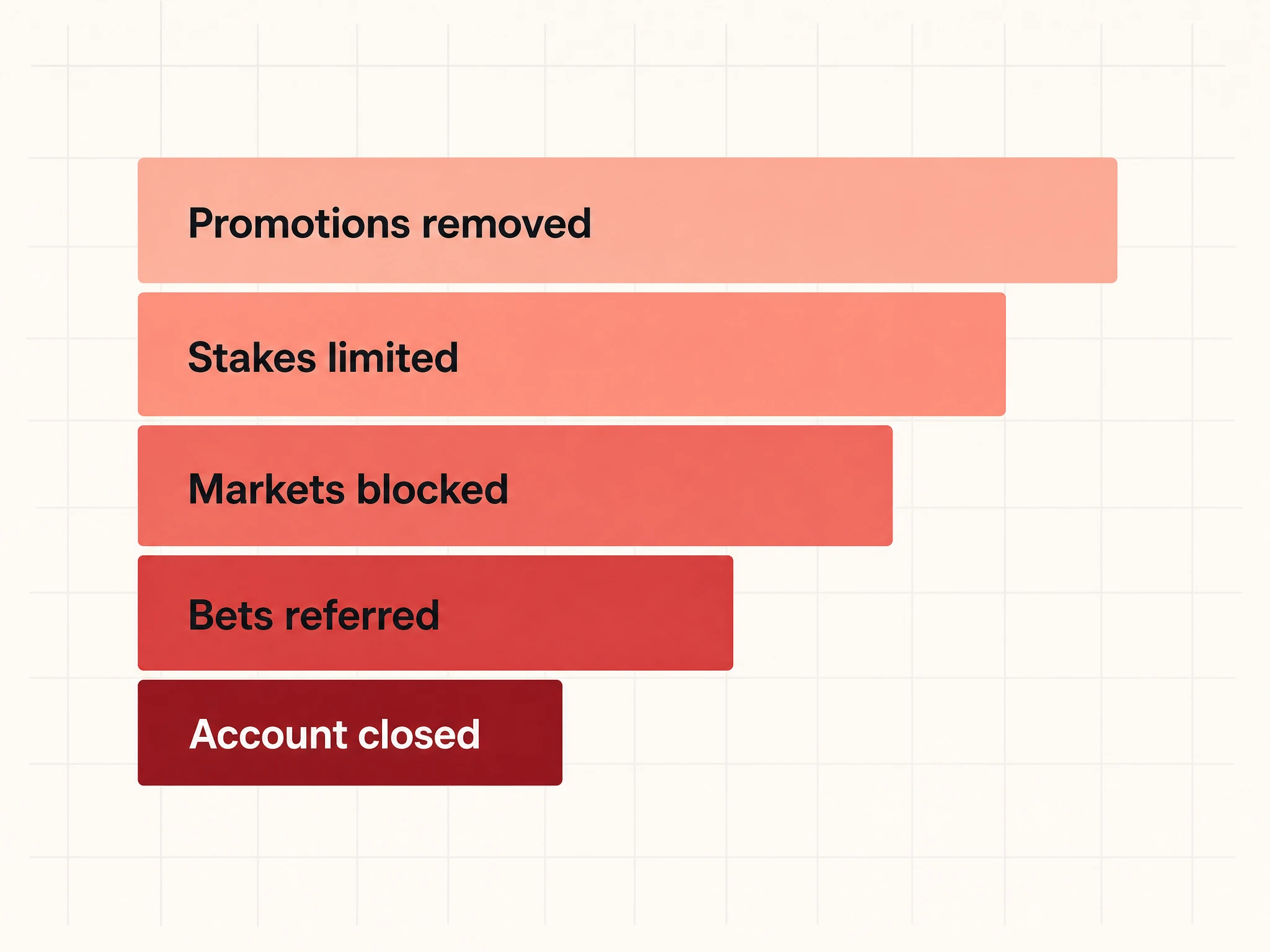
Restriction runs on a rough ladder. A bookmaker usually starts at the top and only moves down if your account keeps looking like a problem for its book. From gentlest to most severe:
- Promotion ban (gubbing): no more free bets, price boosts, money-back specials or acca insurance. Often the first sign, usually announced by email or just quietly switched off.
- Stake limits (factoring): your maximum bet is cut to a fraction of the book's normal maximum. You can still bet, just for less.
- Market-level restrictions: in-play betting blocked, player props or bet builder access pulled, while straightforward match odds stays open.
- Delayed acceptance and manual referral: your bet doesn't confirm instantly. It sits pending while a trader decides whether to take it.
- Full closure: the account is shut. Rare, and usually about identity checks or abuse rather than winning.
These aren't mutually exclusive. A bookmaker will often stack several of them on the same account at once, and a stake-factored account is frequently promo-banned as well.
Promotion bans (getting gubbed)
The gentlest tier. The bookmaker stops offering you promotions: no free bets, no price boosts, no money-back-if-your-player-doesn't-score, no acca insurance. Your account still works at full stake on ordinary prices. You just stop getting the extras.
The trigger is a betting pattern that lives on offers. If almost every bet you place is tied to a promo, a boost or a money-back special, the bookmaker reads you as an offers-only customer whose activity only makes sense because of the free value. Matched bettors and bonus-hunters are the classic case. The account isn't beating the book on price, it's beating the marketing budget, so the marketing gets switched off.
Not much changes afterwards for a recreational bettor who rarely used offers. For anyone whose edge came from the promos, though, the edge is gone the moment they stop arriving. Because it's the mildest step, a promo ban is often the earliest warning that a bookmaker has started paying attention to an account.
Stake limits (factoring)
The next tier down, and the one most people mean by getting limited. Instead of removing offers, the bookmaker cuts how much you can stake. A market with an advertised maximum of £2,000 might let your account through £40, or £4, or less.
The trigger is taking value on price rather than on offers. A bookmaker factors accounts it thinks are sharp, meaning you consistently take a price before it shortens, or you beat the closing line often enough that the book expects to lose to you over time. That's a different profile from the offers-only bettor above, and it's why the two groups get different treatment: gubbing for the promo hunters, factoring for the price-sensitive winners.
The mechanics of the multiplier, how the factor is set and how far it drops, are on stake factoring explained. The short version for this page: it's a percentage of the normal maximum, and it can fall a long way. Gambling Commission data found that among restricted customers, 36.22% were held to between 1% and 9% of normal stakes, and 22.41% were held below 1%, according to the Gambling Commission's data on commercial restrictions.
You can still bet once you're factored, but not for anything meaningful. When the factor is deep enough, placing a bet worth the effort stops being possible even though the account is technically open. This is the point where a lot of winning bettors move to an exchange, which doesn't factor accounts for winning, covered on exchange or bookmaker.
Market and bet-type limits
A more surgical tier. Rather than touching your stake on everything, the bookmaker shuts specific markets. In-play betting gets blocked while pre-match stays open. Player props or the bet builder get pulled while match odds carries on as normal. Some accounts are pushed to accumulators only, able to place multiples but not singles.
The trigger is an edge the bookmaker can trace to a particular kind of bet. In-play is the most manipulable and the most often restricted, because a fast bettor watching the game can beat a price that hasn't caught up with what just happened on the pitch. Player props are priced with thinner models than match odds, so a bettor who is consistently right about a specific player's shots or cards can be blocked from props while left alone on the main result. Singles get restricted before accas because a sharp bettor's edge shows clearest in a single bet on one market, while a multiple spreads the book's margin across every leg.
You keep the markets the bookmaker isn't worried about and lose the ones it is. If your edge was in the exact market that got shut, the restriction is as good as a stake cut on the bet you actually wanted.
Restrictions usually stack
Delayed acceptance and manual referral
Not a removal so much as a brake. Your bet doesn't confirm the instant you tap it. It goes pending while a trader reviews whether to accept it, and often comes back accepted for a smaller stake than you asked for, or rejected.
The trigger is an account flagged as sharp but not yet fully factored, or a bet large or sudden enough to trip the book's risk checks. Manual referral is how a bookmaker keeps taking your action while deciding, bet by bet, how much of it it wants. It's common on player props and in-play, where prices move fast and the book wants a human in the loop before it commits.
The cost to you is losing the ability to get on cleanly at the price you saw. By the time a delayed bet is accepted, the price may have moved, or the stake may have been trimmed. Manual referral often sits just before or alongside stake factoring on the same account.
Full closure
The rarest tier, and the one people fear most. The account is shut. You can usually still withdraw the balance, but you can't bet.
Most of the time closure isn't about winning at all. Closures cluster around identity and compliance: failed or incomplete know-your-customer checks, suspected multi-accounting, or a genuine breach of terms such as bonus abuse. A book that simply wants to stop losing to a sharp customer has cheaper options, since it can factor the stake to nothing and leave the account open. Outright closure for winning does happen, but the Gambling Commission's data shows it running behind stake factoring in frequency, and closures are frequently commercial-terms decisions bundled with compliance concerns rather than a pure response to a winning record.
Once an account is closed the relationship with that bookmaker is over. If the closure came from an identity problem, sorting the paperwork can sometimes reopen it, which is why KYC in betting is worth understanding before it becomes urgent.
What each tier tells you the bookmaker thinks
The lever a bookmaker pulls is a signal about how it has read your account. Worth learning to read back.
- Offers gone, stakes intact: it thinks you're an offers-only bettor. Your value came from promotions, and it's stopped funding them.
- Stakes cut, offers gone too: it thinks you're a price-taker who beats the book, a sharp. This is the winning-bettor tier.
- One market shut, the rest open: it thinks your edge is specific, most often in-play or props, and it's ringfencing that market rather than your whole account.
- Bets going to manual referral: it hasn't decided yet, and it's reviewing you bet by bet.
- Account closed: usually a compliance or terms issue, not simply that you won.
None of this is a punishment for breaking a rule. Setting stakes and choosing which markets to offer are treated as commercial decisions for the operator under UK gambling law, and the Gambling Commission has said this sits outside its regulatory remit. It does expect operators to be transparent about how, when and why an account might be restricted, and to make customers aware of restrictions before they deposit, rather than requiring the practice to stop.
See where the props edge sits
Market-level restrictions bite hardest on player props, because that's where a real edge shows up. Props edges surfaces the player lines our model rates as mispriced, so you can see which bets a bookmaker would care about.
Account restriction FAQs
What's the difference between being gubbed and being limited?
Gubbing usually means promotions are removed while your stakes stay intact. Limiting usually means stake factoring, where your maximum bet is cut to a fraction of normal. Offers-only bettors tend to get gubbed, price-sensitive winners tend to get factored, and many accounts end up with both.
Will a bookmaker tell me my account has been restricted?
Sometimes. Promotion bans often arrive by email, but stake factoring and market restrictions are frequently applied silently, so the first sign is a bet being rejected or only part of your stake being accepted. The Gambling Commission expects operators to be transparent about restrictions, but there is no requirement to announce every change the moment it happens.
Can I still bet on a restricted account?
Usually yes, apart from full closure. A promo-banned account bets at full stake without offers, a stake-factored account bets for less, and a market-restricted account keeps the markets that weren't shut. Only full closure stops betting entirely, and even then you can normally withdraw your balance.
Why can I still bet on match odds but not player props?
Because market-level restrictions target the specific market where the bookmaker thinks you have an edge. Player props are priced with thinner models than match odds, so an account that keeps beating props can be blocked there while left alone on the main result.
What triggers a full account closure rather than a stake cut?
Closure is usually tied to compliance rather than winning: failed identity checks, suspected multi-accounting, or a breach of terms. A bookmaker that just wants to stop losing to a sharp customer can factor the stake to almost nothing and leave the account open, which is cheaper than closing it.
Does a restriction on one bookmaker affect my other accounts?
Not directly. Restrictions are applied per operator, so being limited at one bookmaker doesn't automatically limit you at another. Bettors who get factored at soft books often move volume to an exchange, which doesn't restrict accounts for winning.