What counts as an assist in football?
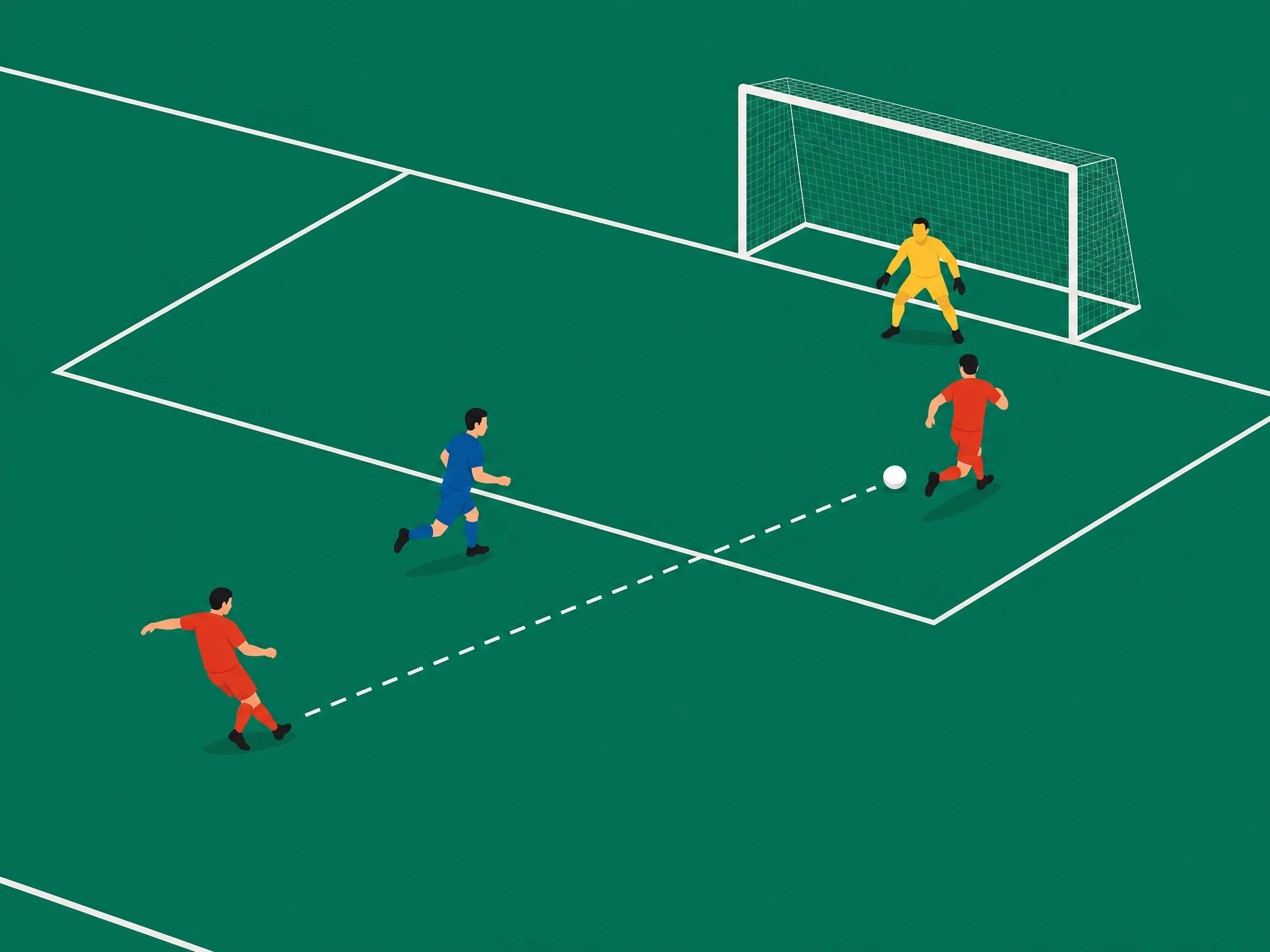
An assist is the final touch from a teammate that leads directly to a goal, whether that touch is a pass, a cross, a knock-down or a shot that a teammate finishes. A deflected pass still counts if it is judged to be travelling to the eventual scorer, but a rebound off a save, a block or the woodwork is handled separately from a normal assist.
Team FootyMetrics
Updated Jul 2026 · 6 min read
- An assist is the final touch from a teammate that leads to a goal. Opta's own wording is the final touch from a teammate which leads to the recipient of the ball scoring a goal.
- A pass that gets deflected by a defender still counts as an assist for the original passer, as long as the ball is judged to still be travelling toward the eventual scorer.
- Own goals, direct free kick goals and direct corner goals never carry an assist. A penalty only carries an assist if the taker passes it to a teammate instead of shooting themselves.
- A goal scored from a rebound off a save, a blocked shot or the woodwork does not give the original shooter a standard assist. It sits in a separate category, and different providers do not all treat it the same way.
That single sentence, the final touch before the goal, covers more ground than most people expect. Two edge cases account for most of the confusion in the assist count: a deflection, and a rebound, and they're also why a player’s assist total can genuinely differ between sources without either one being wrong.
What counts as an assist
Stats Perform, the company behind Opta, defines a goal assist as “the final touch from a teammate, which leads to the recipient of the ball scoring a goal.” That covers more than a straightforward pass. A cross, a knock-down header, a lay-off, or a shot that a goalkeeper cannot hold and a teammate finishes, all just need to be the final touch of the buildup before the goal. There is no separate rule limiting how many touches the goalscorer is allowed once the ball reaches them. What decides an assist is whether the assisting player’s touch was the last one by the scoring side before the ball went in, not how the goalscorer then finishes it.
Deflected assists
A pass does not stop being an assist just because a defender gets a touch on it first. Opta’s rule states that if the assist is deflected by an opposition player, “it must be deemed as travelling to the goal-scorer irrespective of the deflection.” So a through ball that clips a defender’s leg on the way through, but still reaches the forward it was intended for, who then scores, is recorded as an assist for the player who played the original pass. The judgement call sits with whether the deflection meaningfully changed where the ball was going, or the ball was always heading toward that scorer regardless.
Rebounds: the trickiest edge case
This is where most of the confusion comes from, because a rebound is handled differently from a normal assist. If a shot is saved by the goalkeeper, blocked by a defender, or comes back off the woodwork, and a teammate scores from the rebound, the original shooter is not given a standard assist for that phase of play. Opta instead records the player whose touch immediately preceded the goal, which in that case is the rebound itself, under a separate category it calls a fantasy assist. That category explicitly lists attempt saved, blocked shot or miss, and post as distinct rebound types, kept apart from the standard assist definition. In practice, a shot that gets saved and put back in by a teammate is not an assist for the original shooter in the standard match statistics, even though commentary often describes it as one.
- The final touch from a teammate that leads directly to the goal.
- A deflected pass, if still judged to be travelling to the eventual scorer.
- A cross, knock-down, lay-off or any other final touch before the goal.
- A shot saved by the goalkeeper that a teammate scores from the rebound.
- A blocked shot, or a shot off target, that a teammate turns in.
- A shot off the woodwork that a teammate finishes.
Rebounds still get tracked, just separately
Own goals and set pieces never carry an assist
Opta’s definition is explicit that “in the event of an own goal, direct free kick goal and direct corner goal, an assist will not be awarded.” If a defender turns a cross into their own net, nobody on the attacking side is credited with an assist for it, even if the delivery was excellent. A goal scored straight from a corner or a direct free kick works the same way, no assist is logged, because there was no teammate’s touch between the restart and the goal. Penalties follow the same logic: the taker only gets an assist if they pass the spot kick to a teammate to finish, not if they score it themselves, since scoring your own penalty cannot be your own assist.
Why different providers can disagree
Most public confusion about a player’s assist total comes down to the fact that not every organisation applies exactly the rules above. Some fantasy football competitions credit an assist to whichever teammate had the last touch before a goal regardless of the circumstances, which can include situations that a standard Opta count would treat as a separate rebound category rather than a normal assist. Other leagues and broadcasters draw their own lines too, and it is not unusual for a domestic competition’s own stats department to count a blocked shot that a teammate finishes as a decisive pass under its local rules, where a standard assist count would not. None of this means one number is simply wrong. It means the underlying rulebook is different, covering whether a rebound counts, how a deflection is judged, and whether a blocked shot can ever generate an assist. Opta’s own editorial team at The Analyst has written about exactly this gap between its match data rules and looser broadcast or fantasy conventions. When two outlets report different assist totals for the same player, it is almost always one of these definitional differences rather than a data error.
Assists as a stat
FootyMetrics tracks assists for every player and team across 115+ leagues, alongside key passes and goal involvements, so a creative player’s output can be checked beyond the headline assist number.
Player assist trends
Check a player's assist history before backing a line, filtered by home, away and opponent.
Goal involvements, which add a player’s goals and assists together, are worth checking alongside a straight assists line on player goal involvement trends. This page covers what an assist is in general. For the narrower question of how a key pass differs from an assist, and what that means for props markets built on either stat, see key passes vs assists.
Assists FAQs
What is an assist in football?
The final touch from a teammate that leads directly to a goal, whether it is a pass, a cross or a lay-off, as long as that touch is the last one by the scoring side before the ball goes in.
Does a deflected pass still count as an assist?
Yes. If a pass is deflected by a defender but is still judged to be travelling to the eventual goalscorer, the original passer keeps the assist.
Does a rebound off a save or a blocked shot count as an assist for the shooter?
No. A goal scored from a rebound off a save, a block or the woodwork is not a standard assist for the original shooter. It is tracked separately, and the credit typically goes to whoever's touch immediately preceded the goal.
Does an own goal ever give someone an assist?
No. Own goals never carry an assist for the attacking side, and neither does a goal scored directly from a corner or a direct free kick.
Why do different sites sometimes show different assist totals for the same player?
Because not every provider applies identical rules. Differences in how rebounds, deflections and blocked shots are treated mean the same match can be logged slightly differently depending on the source, even when neither figure is simply wrong.
Does a corner or free kick that isn't struck directly at goal still count as an assist?
Yes, as long as it's the final touch before the goal. The exemption only removes the assist when the goal comes straight from the corner or the free kick itself, with no other touch in between. A short corner played square, then crossed in by a teammate who wasn't the corner taker, is a normal assist for whoever delivered that second ball.
Does a rebound assist ever get counted as a normal assist by any provider?
Sometimes, depending on the source. Opta keeps rebounds in a separate fantasy assist category rather than the standard assist count, but some fantasy competitions and domestic broadcasters fold a rebound straight into their own assist total. That's one of the main reasons two outlets can show a different assist number for the same player without either one being a data error.