What is a big chance?
A big chance is a situation where a player should reasonably be expected to score, usually a one-on-one with the goalkeeper or a very close-range effort with a clear path to goal and low to moderate pressure. It is a judgement call made by a data analyst watching the game, not a number produced by a formula.
Team FootyMetrics
Updated Jul 2026 · 6 min read
- A big chance is a situation a player should reasonably be expected to score from, usually a one-on-one with the keeper or a very close-range shot with a clear path to goal and low to moderate pressure. Every penalty automatically counts as a big chance.
- It's a discrete yes or no tag applied by a human data analyst, not a number worked out by a formula. That's different from xG, which is a continuous probability calculated from many inputs.
- A big chance can be missed without a shot ever reaching the goal, so it's a different stat from a shot on target.
- Big chances created (the pass that sets one up) and big chances missed (a clear opportunity with no shot away) are two separate, opposite-facing stats, one for the creator, one for the finisher.
The confusing part is not the idea itself, it's how the tag gets applied and how it differs from the other numbers next to it on a stat sheet, particularly a shot on target and xG, and how it splits into created and missed.
What is a big chance?
A big chance is Opta's tag for a situation where a player should reasonably be expected to score. Opta's own wording is that it is "a situation where a player should reasonably be expected to score, usually in a one-on-one scenario or from very close range when the ball has a clear path to goal and there is low to moderate pressure on the shooter." Every penalty is automatically counted as a big chance, regardless of who is taking it or how the game is going.
The definition does not come with a fixed distance in yards or a specific angle in degrees. It is a judgement made by a human data analyst watching the match, weighing the same handful of factors every time: how much space the shooter has, how many defenders are in the way, and whether the goalkeeper has already been beaten to a more advanced position. Two shots from a similar spot on the pitch can get different tags if the pressure on the shooter is different, which is exactly why this is a judgement call rather than a formula.
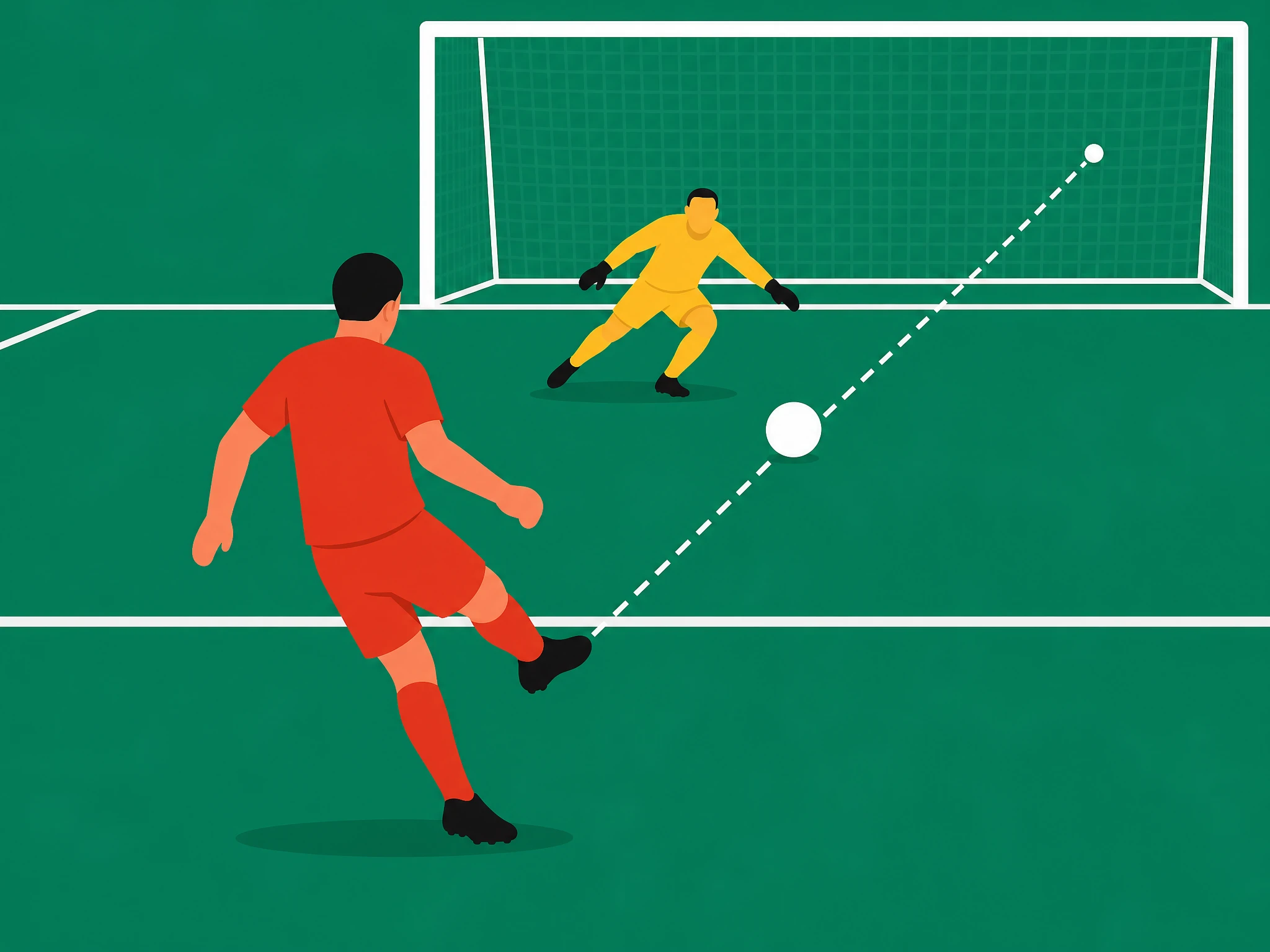
One-on-one with the keeper, clear path to goal, no defender in the way. A big chance.
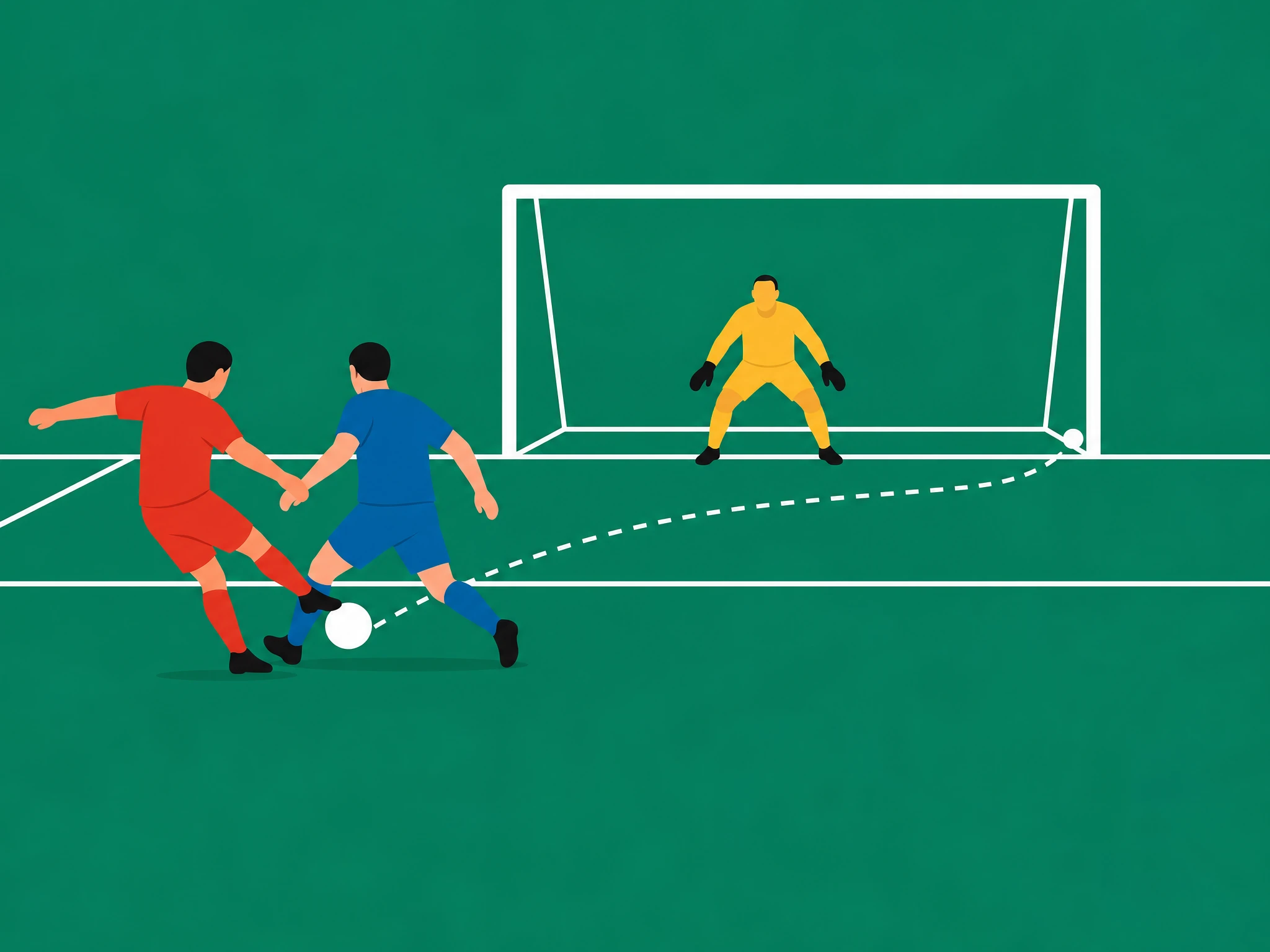
Tighter angle, defender closing the shooter down, moderate to heavy pressure. Not a big chance.
Big chance vs shot on target
A big chance and a shot on target measure different moments in the same passage of play, and mixing them up is the most common mistake reading these numbers.
A shot on target is only recorded once the player actually gets an attempt away that would have gone in without the goalkeeper stopping it. A big chance is tagged earlier, at the moment the opportunity itself exists. That gap matters because a big chance can be missed completely: the player fluffs the finish, scuffs it wide, or does not even manage a touch on the ball, and none of that produces a shot on target at all. A striker can be given three big chances in a match and finish the game with zero shots on target, if all three are botched before a shot is even struck.
The reverse can happen too. A shot on target does not have to come from a big chance. A speculative effort from distance that the goalkeeper has to save is a shot on target, but if the shooter was under real pressure and did not have a clear path to goal, it was never tagged as a big chance in the first place.
Big chance vs xG
A big chance and expected goals (xG) both describe chance quality, but they are not the same kind of number, and they are built differently.
xG is continuous. Every shot gets a value between 0 and nearly 1, worked out by comparing the shot to the historical outcomes of thousands of similar shots. A big chance is discrete. It is a yes or no tag applied to a situation, decided by a human analyst rather than calculated from a model. Opta explicitly lists big chance status as one of the inputs that feeds into its own xG number, alongside shot angle, distance and body part, so the two are related but not interchangeable. In practice a big chance usually carries a high xG value once the shot is actually taken, but a big chance is tagged on the opportunity itself, before or even without a shot happening, while xG only exists once a shot has been struck. The FootyMetrics guide to xG covers the model itself in full; this page is about the discrete tag that feeds into it.
Big chances created
Big chances created is the number of passes a player has made that directly led to a big chance for a team-mate, whether or not that team-mate actually scored. It is a subset of a player's key passes and assists, not a separate stat built from scratch: every big chance created also counts as a key pass, or an assist if the chance is scored, but not every key pass rises to the level of a big chance. A regular cutback that sets up a rushed, heavily pressured shot is a key pass. The same cutback landing at the feet of a player in space with a clear run at goal is a big chance created.
It is a useful way to separate a player who sets up genuinely clear-cut chances from one who racks up passing numbers from lower-quality attempts. A winger who finishes a run of matches with 4 assists but 9 big chances created is setting up the kind of openings a striker should be finishing well beyond that assist number, even if the end product hasn't shown up in the scoresheet yet. Checking a creator's big chances created total alongside their raw assist trends catches exactly that gap.
Big chances missed
Big chance missed is recorded against the player who had the opportunity, not the one who created it. Opta's definition covers two situations: the player gets a big chance and completely misses the ball without a shot going anywhere close to on target, or the player has a clear opportunity to shoot and instead does something else, holds it up, tries to pass, takes an extra touch, and the chance disappears with no attempt at all.
This is the stat that can make a good individual performance look worse than it was. A striker can play well for 90 minutes, get into two or three genuinely clear-cut positions, and still finish the match with a big chances missed total against their name, because missing a big chance now and then is normal, even for a clinical finisher. Nobody scores every one-on-one. A single missed big chance in an otherwise strong game says less about a player's overall performance than it looks like on a stat sheet, and it is worth reading alongside how many chances they had in total, not as a number on its own.
One miss isn't a pattern
Why the tag is judgement-based
Unlike a shot's distance or whether the ball crossed the line, whether a situation counts as a big chance is not something a camera or a tracking system measures directly. It is assigned by a trained data collector watching the match, applying the same criteria play to play: was the shooter close to one-on-one with the keeper or very close to goal, was the path to goal clear, was the pressure on them low to moderate rather than heavy.
That has a real consequence. Because it is a human judgement rather than a fixed formula, there is some inevitable variation in exactly where the line gets drawn between a big chance and a good chance that falls just short of it, in the same way two different match officials can see a foul challenge slightly differently. Opta trains its analysts against the same definition and reviews decisions to keep it consistent match to match and collector to collector, but it is still fundamentally a judgement call rather than a number that comes out of a calculation, which is worth knowing before treating a big chance count as a perfectly objective measurement.
Big chances as a stat
FootyMetrics tracks big chances created and big chances missed for every player across 115+ leagues, alongside shots, shots on target and the rest of the shooting picture. The full definitions for both, along with every other stat FootyMetrics tracks, sit on the stats glossary.
Shots on target leaderboard
Live shots on target ranks across 115+ leagues, the closest single number to a big chance that FootyMetrics ranks directly.
Big chance FAQs
What is a big chance in football?
A situation where a player should reasonably be expected to score, usually a one-on-one with the goalkeeper or a very close-range shot with a clear path to goal and low to moderate pressure on the shooter. Every penalty automatically counts as a big chance.
Is a big chance the same as a shot on target?
No. A big chance is tagged at the moment the opportunity exists, before any shot is struck. A player can be given a big chance and never get a shot away at all, which means it is not recorded as a shot on target either.
Is a big chance the same as a high xG shot?
Not exactly. xG is a continuous probability calculated for a shot from many inputs. A big chance is a discrete yes or no tag applied to the situation by a data analyst, and it is one of the inputs Opta's own xG model uses, rather than the same measurement as xG itself.
What is a big chance missed?
A big chance where the player does not get a shot away at all, either because they completely miss the ball or because they have a clear chance to shoot and choose to do something else instead.
Does missing a big chance mean a striker played badly?
Not necessarily. Missing a big chance now and then is normal, even for clinical finishers. One missed big chance in an otherwise strong performance says less than a pattern of missed big chances over a longer run of matches.
Is a big chance decided by a formula or by a person?
By a person. A trained data analyst watching the match applies the same criteria each time, one-on-one or very close range, a clear path to goal, low to moderate pressure, to decide whether a situation counts, rather than a camera or algorithm calculating it automatically.