Why chasing losses breaks bankrolls
Chasing losses means raising your stake after a losing run to win back what you have dropped, and it breaks bankrolls because a losing streak and a growing stake together are the fastest route to going broke. That holds whether or not your bets have a genuine edge.
Team FootyMetrics
Updated Jul 2026 · 6 min read
- Chasing means increasing your stake to recover past losses, so the bet is sized by what you are down rather than by any read on the game.
- The martingale plan, doubling after every loss, is the clearest version. Six losses at £10, £20, £40, £80, £160, £320 means you have staked £630 to chase a £10 profit, and the seventh bet needs £640.
- A table limit or the size of your own bankroll ends the sequence, and it always ends on a loss, wiping out everything the plan had recovered.
- A real edge doesn't rescue a chaser. Variance still produces long losing runs, and escalating stakes hit the bankroll wall before the edge has room to show up.
Chasing does not always look like doubling down at a roulette wheel. In football betting it usually starts small and reasonable. You are down for the day, there is one more game on, and instead of your usual £10 you put on £25 because a win at £25 gets you back to level and a £10 bet would not. The stake is now decided by the scoreboard of your own account, not by whether £25 is a sensible bet on that match.
What chasing looks like in practice
The tell is simple: the size of the bet moves with how much you are down, not with how good the bet is. A bettor sizing by edge stakes roughly the same on their best pick of the week as on a smaller one. A chaser stakes more precisely when things are going worst, which is the opposite of what the maths asks for. The sibling guide to bankroll management covers why staking by feel loses money over a season, and chasing is that habit in its most concentrated form.
The martingale trap
The purest form of chasing is the martingale. You pick a base stake, and every time a bet loses you double the next one, so the first win recovers every previous loss plus your original stake. On paper it looks unbeatable, because you always win back everything the moment a bet finally lands. In practice it is the classic worked example of how fast stakes and the bankroll behind them explode.
Take a £10 base stake at even money, decimal odds of 2.00, and double after each loss:
| Bet | Stake | Total staked if all have lost | What a win here recovers |
|---|---|---|---|
| 1 | £10 | £10 | £10 |
| 2 | £20 | £30 | £10 profit |
| 3 | £40 | £70 | £10 profit |
| 4 | £80 | £150 | £10 profit |
| 5 | £160 | £310 | £10 profit |
| 6 | £320 | £630 | £10 profit |
By the sixth bet you are risking £320 to claw back the £310 you are already down and end £10 in front. Six losses in a row is not rare over a season, even on near coin-flip bets. After those six losses you have staked £630 in total, all of it to chase a £10 profit, and the seventh bet in the sequence needs £640. To simply be allowed to place all seven bets you need a bankroll of £1,270 sitting behind a plan whose best-case outcome is being £10 up.
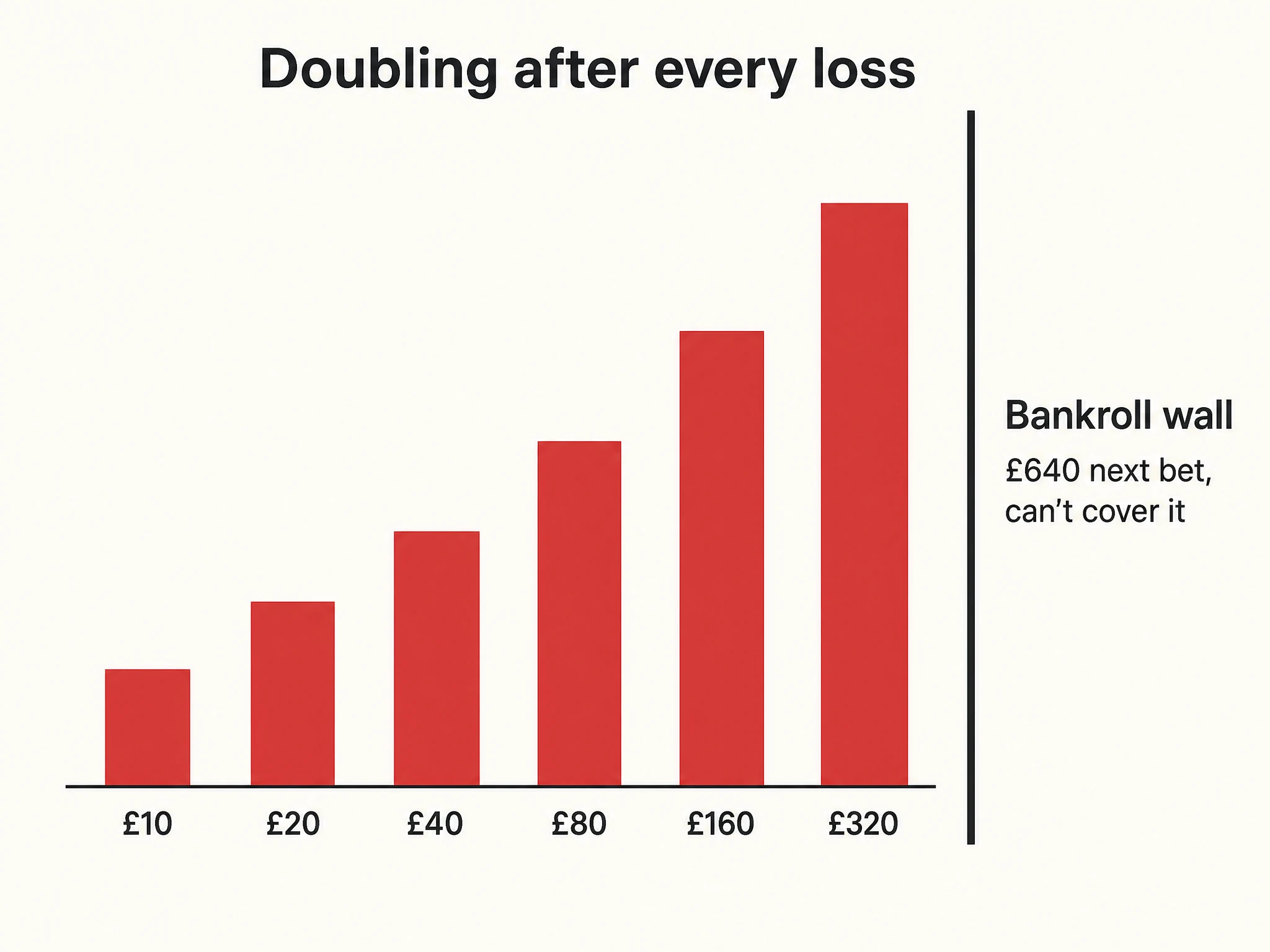
That is the trap. The downside grows exponentially while the prize stays fixed at your base stake. Wikipedia’s write-up of the martingale betting system sets out the same arithmetic: the strategy has the gambler double after every loss so the first win recovers all previous losses plus a profit equal to the original stake, and with a finite number of bets you can afford, the probability of losing all of them is small but the loss when it happens is enormous.
The bankroll wall
The reason the martingale is not a licence to print money is that the doubling cannot go on forever. Two walls stop it. The first is a table limit or a bookmaker’s maximum stake on the market, which caps how high you are allowed to go. The second, and the one most football bettors hit first, is your own bankroll running out. Either way the sequence ends, and it always ends on a loss, because the only reason you kept doubling was that the bets kept losing.
When it ends there, you do not lose your base stake. You lose the whole run. A sequence that reached £320 and then could not place the £640 bet has lost £630 in one unbroken slide. The martingale does not remove the risk of a big loss, it stores it up and delivers it all at once on the bet you cannot cover. Wikipedia’s summary of gambler’s ruin puts the general version plainly: a gambler who raises their bet after a loss but plays a game with non-positive expected value will eventually and inevitably go broke, whatever the betting system. The bookmaker’s margin makes every standard market exactly that kind of game.
The behavioural side
Chasing is a maths mistake, but it is also a predictable one, because two well-documented quirks of how people handle money push you straight into it.
The first is loss aversion: a loss of a given size feels worse than a win of the same size feels good, so being £100 down creates an urge to get back to zero that a £100 profit target never would. The pull is to act, to place the bet that squares the ledger, rather than to accept the loss and stop. The second is the sunk cost fallacy: the money already lost feels like it demands to be recovered, as if walking away now wastes it, when in truth it is gone either way and the next bet has nothing to do with it. Together they make raising the stake feel responsible, like you are fixing something, when you are adding to the hole.
The previous result carries no information about the next one. A bet that was a coin flip before your losing run is still a coin flip after it.
Your account being down does not make the next game more likely to go your way, so a bigger stake is simply more money on a bet with the same chance of losing as before.
A flat or percentage plan is the antidote
The fix is to size stakes by a rule you set before the run starts, not by how far down you are during it. A flat plan bets the same unit every time. A percentage plan bets a fixed share of the current bankroll, so the stake shrinks automatically after losses instead of growing. Both do the one thing chasing refuses to do: they scale stakes down through a bad run, not up. Staking plans compared walks through how flat, percentage and Kelly sizing behave against each other, and the bankroll management guide sets out how to ring-fence the pot in the first place.
- Sizes every stake by a rule set before the run starts.
- Scales stakes down through a losing run, never up.
- Caps the worst a bad streak can cost you in advance.
- Gives a genuine edge the run of bets it needs to show up.
- Sizes the bet by how much you are down on the day.
- Raises stakes exactly when the run is going worst.
- Stores up one large loss for the bet you can't cover.
- Hits the bankroll wall before any edge can play out.
Set a loss limit, not a recovery target
Even a real edge does not save a chaser
Here is the honest note. A staking rule protects a chaser even when their bets are good, and dropping the rule sinks them even when their bets are good. Chasing is dangerous whether or not you have an edge.
A genuine edge is an average over a long run of bets. It says nothing about any short stretch, and short losing runs happen constantly even to bettors who win more often than they lose. Variance and sample size covers why: a real edge can sit under a losing month without disappearing. The trouble is that a chaser’s stakes climb through exactly those normal losing runs, and the escalation reaches the bankroll wall long before the edge has had the number of bets it needs to pull the results back into the black. The variance ruins you first. Gambler’s ruin makes the same point at the limit: even a fair game, expected value of zero, sends a bettor with finite money broke against a book with effectively unlimited money if they keep pushing. An edge lengthens the odds of ruin, it does not remove them, and chasing shortens them straight back.
So the verdict is not that chasing is immoral, it is that the arithmetic does not work. A losing run is coming at some point whatever you bet on. A flat or percentage plan lets you sit through it on a stake you chose in the cold. Chasing hands the stake decision to the run itself, at the exact moment that decision does the most harm.
Size stakes by a rule, not by the scoreboard
Our betting tools cover staking, odds conversion and value checks, so your stake comes from the maths rather than from how much you are down on the day.
Chasing losses FAQs
What does chasing losses mean in betting?
Chasing losses means raising your stake after a losing run to try to win back what you have lost in fewer bets. The size of the bet is set by how much you are down rather than by how good the bet is, which is the opposite of how a staking plan works.
Why does the martingale system fail?
Doubling after every loss makes the stake grow exponentially while the prize stays fixed at your base stake. A table limit or your own bankroll running out eventually stops the doubling, and because the sequence only continues while bets keep losing, it always ends on a loss that wipes out the whole run at once.
Does chasing losses work if I have a betting edge?
No. A real edge only shows up over a long run of bets, and short losing runs are normal even for winning bettors. Escalating stakes hit your bankroll limit during one of those normal losing runs, before the edge has the sample of bets it needs to recover, so variance ruins you first.
Is it ever rational to increase my stake after a loss?
Not to recover the loss. The previous result carries no information about the next bet, so a losing run does not make the next game more likely to win. The only sound reason to change a stake is a change in your read of the bet or your bankroll, never the fact that you are down.
How do I stop chasing losses?
Set a staking rule before you bet and size every stake by that rule, not by your running total. A flat unit or a fixed percentage of your bankroll both scale stakes down through a losing run instead of up. A loss limit for the day and a ring-fenced bankroll help you walk away rather than place the recovery bet.
Is chasing losses the same as the martingale?
The martingale is the most extreme, formalised version of chasing, doubling after every loss. Chasing is the broader habit: any time you raise a stake to recover past losses, even by a smaller amount, you are doing the same thing the martingale does, just more slowly.