What is a professional foul or tactical foul?
Professional foul and tactical foul are not terms in the Laws of the Game. They are commentary shorthand for a deliberate foul used to stop an attack, and the real punishment depends on which of two Law 12 categories the foul falls into: a red card for denying an obvious goal-scoring opportunity, or a yellow card for stopping a promising attack.
Team FootyMetrics
Updated Jul 2026 · 5 min read
- Professional foul and tactical foul are informal, commentary terms. Neither appears in IFAB's Laws of the Game.
- What gets called a professional foul is usually one of two real Law 12 categories: DOGSO, a send-off, or the lesser stops-a-promising-attack offence, a caution only.
- The two categories carry very different punishments, which is why the same commentary phrase for both causes confusion about what should follow.
- Repeatedly fouling to stop attacks can itself become a caution under persistent infringement, separate from any card for the individual fouls.
What the terms mean
Neither phrase is defined anywhere in IFAB’s Law 12. “Professional foul” is commonly used for a deliberate foul committed to stop an opponent’s promising move, often because conceding a free kick or penalty is a better outcome for the defending side than letting the attack continue. “Tactical foul” is used the same way, usually for a calculated foul that breaks up a counter-attack or wastes time, rather than a mistimed or reckless challenge.
Because neither term is in the Laws, a referee is never applying a “professional foul rule” when a card comes out. They are applying one of two things that already exist in Law 12: DOGSO, or the caution for stopping a promising attack. Commentators use “professional foul” for both, which is exactly why the punishment can look inconsistent from one clip to the next when it is not.
DOGSO or a promising attack: which offence applies?
Denying an obvious goal-scoring opportunity (DOGSO) is the send-off level offence: a foul that stops an opponent who had a genuinely clear run at goal. It has its own four-factor test and a yellow-card exception inside the penalty area, covered in full on what is DOGSO in football.
Stopping a promising attack is a separate, lesser category, listed among Law 12’s cautionable offences for unsporting behaviour. IFAB’s wording covers a player who “commits any other offence which interferes with or stops a promising attack, except where the referee awards a penalty kick for an offence which was an attempt to play the ball or a challenge for the ball.” In practice, a defender fouls an attacker to break up a move that was going somewhere, but the chance was not obvious enough, or the attacker not clearly through, to meet the DOGSO bar. The bar for this category is lower than DOGSO, and the punishment is lower to match: a yellow card, not a red.
That same clause carries a narrow exception mirroring the DOGSO box exception: if the referee awards a penalty kick and the offence was a genuine attempt to play the ball or a challenge for the ball, no card is shown at all for stopping the attack in that specific case. It is the exception, not the general rule.
| DOGSO | Stopping a promising attack | |
|---|---|---|
| Card | Red | Yellow |
| The test | Four factors: distance to goal, direction of play, control of the ball, defenders' positions | Referee's judgement that the attack was promising, a lower bar |
| Penalty-area exception | Downgraded to yellow if the foul was an attempt to play the ball | No card at all if a penalty is awarded and the foul was an attempt to play the ball |
| VAR | Reviewable, straight red cards are a VAR category | Not reviewable, cautions are outside VAR's scope |
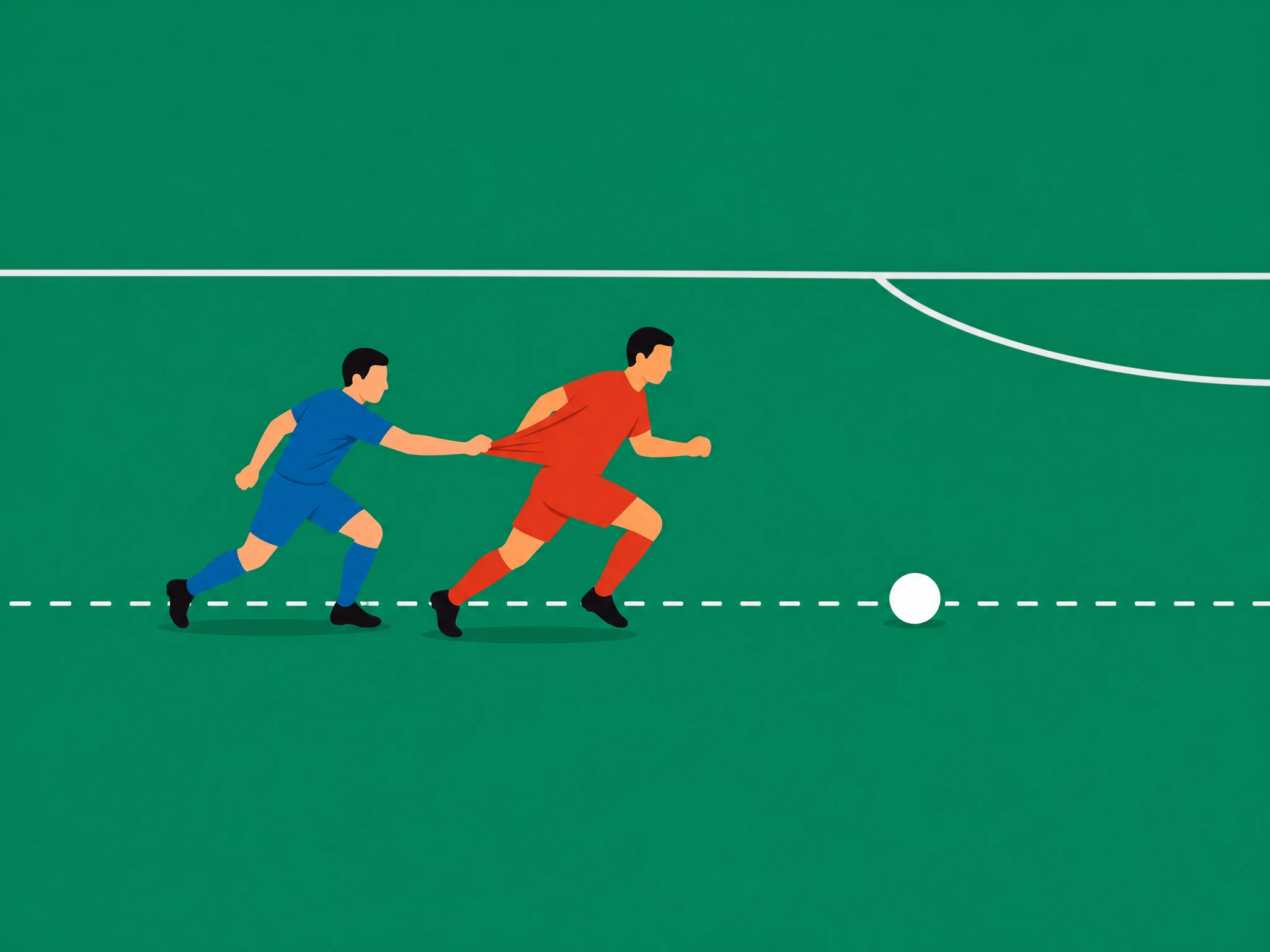
Commentary shorthand, not a Law
Why the distinction matters
Commentators reach for “professional foul” in both situations: a last-ditch drag-down on a striker clean through on goal, and a midfielder cynically fouling an opponent thirty yards out to stop a break. Both get called a professional foul on air. Only one of them is a sending-off offence. The other is a yellow card, full stop, because it never met the obvious goal-scoring opportunity bar in the first place, it just stopped the attack from developing.
This is why a foul described the same way on commentary can end in a straight red in one game and a routine yellow in another. The commentary term does not distinguish between the two outcomes. The Law does, based on how clear-cut and close to goal the chance actually was, using the four factors covered on the DOGSO page: distance to goal, direction of play, likelihood of keeping the ball, and the number of defenders and attackers.
Two famous incidents show the split. Luis Suárez’s deliberate handball on the line for Uruguay against Ghana in the 2010 World Cup quarter-final was the pure red-card version: a goal was otherwise certain, so it was a straight send-off. Giorgio Chiellini’s shirt pull on Bukayo Saka near halfway late in the Euro 2020 final was every bit as cynical, but Saka was fifty yards from goal with defenders back, so it stayed a yellow for stopping a promising attack. Commentary called both a professional foul. How often a team commits that kind of foul shows up in its card stats by team and fouls per match.
Persistent tactical fouling
A player who keeps committing the lesser, stops-a-promising-attack type of foul without ever reaching the DOGSO threshold is not automatically protected from further cards. Law 12 also lists persistent infringement of the Laws as its own cautionable offence: a pattern of repeated fouls, even when no single one of them is serious enough for a card on its own. There is no fixed count that triggers it, IFAB leaves the judgement to the referee, but a player who fouls to stop attacks over and over across a match can be cautioned for the pattern even if each individual foul looked minor.
Professional foul and tactical foul FAQs
Is a professional foul an official football term?
No. Professional foul does not appear anywhere in IFAB's Laws of the Game. It is a commentary and media term for a deliberate foul used to stop an attack, and the actual punishment comes from whichever real Law 12 offence the foul falls under.
Is a tactical foul the same as a professional foul?
They are used interchangeably in commentary. Both describe a deliberate, calculated foul, often to stop a counter-attack or break up a promising move, rather than an official Law 12 category.
Is a professional foul always a red card?
No. It is a red card only if the foul meets the DOGSO bar, denying an obvious goal-scoring opportunity. If the attack was promising but not obviously going to produce a goal, it is a caution under the separate stops-a-promising-attack offence, which is a yellow card.
What does IFAB actually say about stopping a promising attack?
Law 12 lists it among the cautionable offences for unsporting behaviour: a player who "commits any other offence which interferes with or stops a promising attack, except where the referee awards a penalty kick for an offence which was an attempt to play the ball or a challenge for the ball."
Can a player be booked for fouling to stop attacks repeatedly?
Yes. On top of any card for an individual foul, Law 12 treats persistent infringement of the Laws as its own cautionable offence. There is no fixed number of fouls that triggers it, IFAB leaves that to the referee's judgement, but a pattern of repeated fouling to break up attacks can earn a yellow card even if no single foul in the pattern was serious enough on its own.
Can a foul that stops an attack go completely unpunished by a card?
Yes, in one narrow case. If the referee awards a penalty kick and the offence was a genuine attempt to play the ball or challenge for it, no card is shown for stopping the attack. Outside that exception, stopping a promising attack is a caution.