Why in-play prop markets suspend and re-price
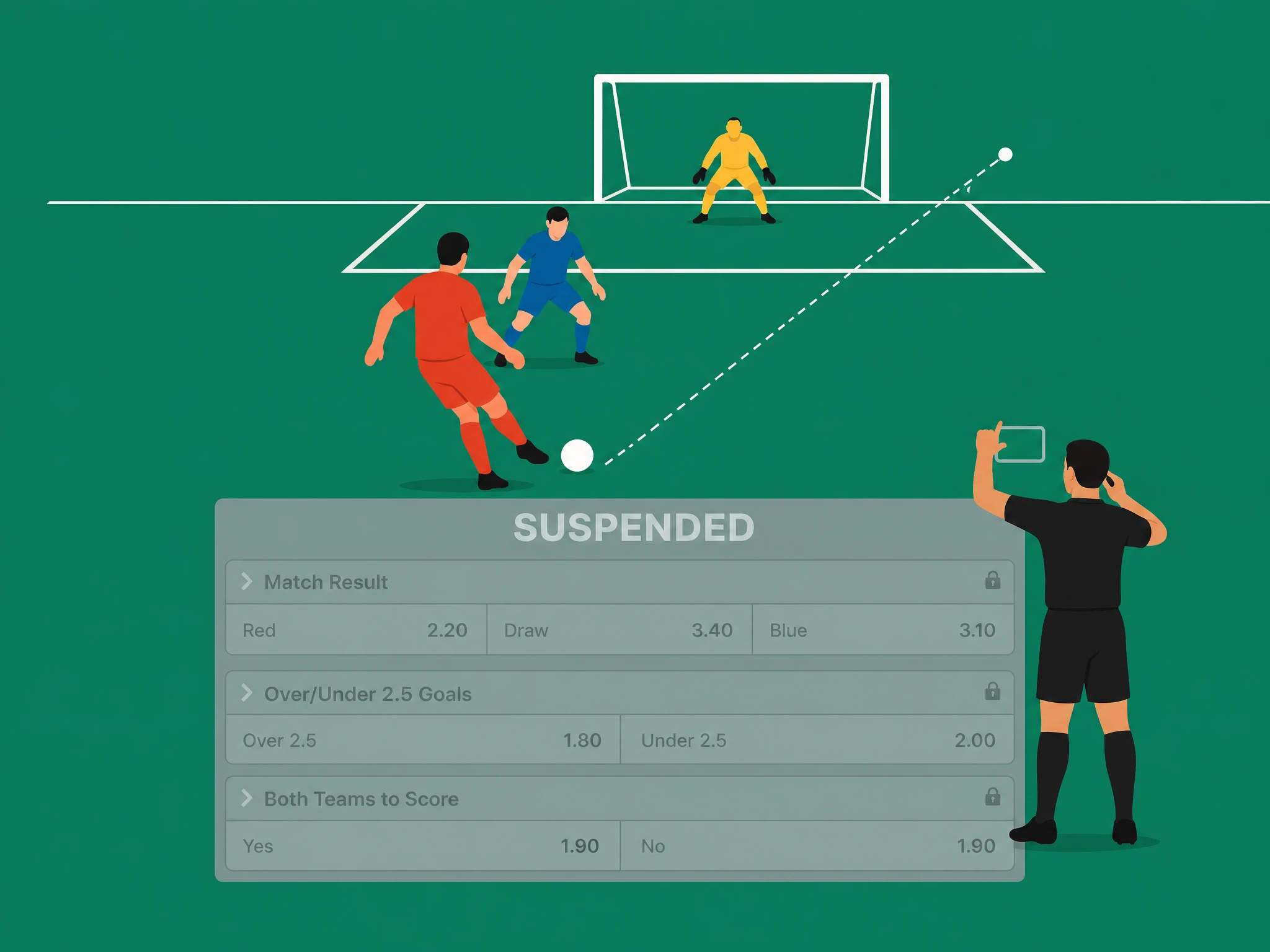
An in-play player prop market suspends the instant something happens that could move the price, a shot, a goal, a VAR check, a card, an injury or a substitution, and reopens a few seconds later at a new line once the bookmaker's model has caught up. The freeze exists to stop the bookmaker being picked off by anyone watching a faster feed than the one its own prices run on.
Team FootyMetrics
Updated Jul 2026 · 6 min read
- A market freezes the moment an event could change the price, a shot, goal, VAR check, card, injury or substitution, and reopens once the bookmaker has repriced.
- The suspension protects the bookmaker from being picked off during the seconds when its own price is stale, because someone on a faster feed can see the event first.
- Player prop lines move in bigger steps than match odds, because prop markets are thinner and the events that settle them are chunkier.
- If you click as it suspends, the bet is usually rejected or offered at a new price, but the exact rule differs by bookmaker.
- Once accepted, your bet settles at the line you took, not wherever the market reopens.
What triggers a suspension
Any event that changes the chance of a prop landing can freeze the market. For a shots-on-target line, a shot itself is the obvious trigger, because it either ticks the count up or comes close enough that the trader wants to reprice. Most suspensions, though, come from events that change the whole match state: a goal, a red card, a penalty award, an injury that stops play, or a substitution that takes your player off or brings a different one on. A VAR check freezes markets too, because until the referee’s decision is confirmed nobody knows whether the goal, penalty or red card actually stands.
The suspension isn’t a judgement about your bet. It applies to everyone at once. The market closes, no new bets go on, existing bets already accepted stay on the system, and the market reopens when the bookmaker is ready to quote again.
The danger window and the faster feed
The reason bookmakers suspend so aggressively is timing. The odds you see in-play are priced off a data feed and a model, and both run on a delay. Someone watching a quicker stream, or physically at the ground, can see a goal go in or a player limp off before the bookmaker’s price or live football scores have updated. In that gap the old price is wrong, and anyone who can act on it is getting a number the bookmaker would never knowingly offer.
So the market suspends the moment the trigger fires and stays shut until the new price is set. Bookmakers describe this plainly: markets close during live events like red cards or injuries, and bets placed just before a market closes are usually rejected with stakes refunded (Covers). The suspension is the bookmaker protecting itself from being picked off during the seconds when its own price is stale.
This is a specific case of line movement
Why prop lines move in bigger steps
Player prop markets are thinner than match odds, and the events that settle them are chunkier, so the lines move in bigger jumps.
Match odds sit on a large amount of money and a well modelled outcome, so they drift in small increments. A player prop, say total shots or shots on target for one named player, has far less liquidity behind it and a much lumpier set of outcomes. One shot on target is a large share of a two-or-three-shot line. When it lands, the whole market has to reprice around a discrete event, not a smooth probability shift, so the reopened line can be a noticeably different number rather than a fractional nudge. The thinner the market and the smaller the line, the harder each event hits it.
If you clicked as it suspended
If you tap a prop at the exact moment it suspends, the outcome depends on the bookmaker’s bet-acceptance rules, and those differ from book to book.
The common patterns are: the bet is rejected outright and your stake is returned, because the market closed before your bet was matched; or the price moved between your tap and the bookmaker processing it, and the bet is either rejected or offered back to you at the new number (Covers). Some bookmakers let you turn on a setting, usually called accept odds changes or accept price changes, so a bet still goes on if the price shortens instead of being rejected. That setting only covers movement between adding a selection and the bet being placed, not the whole match.
Rules differ by bookmaker
Settlement is on the line you took
Once a bet is accepted, it settles at the price and line you took, not wherever the market moves to afterwards. If you backed over 1.5 shots on target at a given price and the market later reopens at a shorter price because your player has already had a shot, your bet still stands on the original number. The reopened line is a fresh market for new bets, not a reprice of yours.
Watching the line move after you’re on doesn’t change your bet. It only shows how the bookmaker now rates the outcome.
That’s the part worth being clear about. The line reopening shorter or longer than the price you got is often why the number you took looks generous or mean in hindsight, but it has no bearing on how your bet settles.
Comparing prices before kickoff instead
Chasing an in-play line as it suspends and reopens is a poor way to find value, because you’re reacting to a number the bookmaker has already updated. Comparing prices before kickoff, when the market is settled and you can see where different books disagree, is the more controllable approach. FootyMetrics Props Edges compares pre-match player prop prices so you can see the spread before you commit, rather than clicking into a moving in-play market and hoping the price holds.
Compare pre-match prop prices
Props Edges lines up player prop prices across books before kickoff, so you can pick a settled number instead of chasing an in-play line.
In-play prop suspension FAQs
Why does a betting market suspend during a match?
It suspends when something happens that could change the price, a shot, goal, VAR check, card, injury or substitution, so the bookmaker isn't left offering a stale price to anyone watching a faster feed than its own. The market reopens once a new price is set.
How long does an in-play suspension last?
Usually a few seconds, long enough for the bookmaker's model to reprice around what just happened. A VAR check can take longer, because the market often stays shut until the referee's decision is confirmed and everyone knows whether the goal, penalty or card stands.
What happens to my bet if the market suspended as I clicked?
It depends on the bookmaker. Common outcomes are the bet being rejected with your stake refunded, or the price having moved so the bet is rejected or offered back at the new number. Some bookmakers have an accept-price-changes setting that lets a bet go on at a shifted price. Check your bookmaker's own bet-acceptance rules.
Does my bet re-price when the market reopens at a new line?
No. Once a bet is accepted it settles at the price and line you took. The reopened line is a new market for fresh bets. It doesn't change a bet that's already on.
Why do player prop lines move more than match odds in-play?
Player prop markets are thinner and the events that settle them are chunkier. One shot on target is a big share of a low shots line, so when it lands the market reprices around a discrete event rather than nudging like a heavily traded match-odds market.
Can I avoid in-play suspension risk altogether?
Yes, by betting pre-match instead of in-play, or by comparing settled pre-match prices before kickoff rather than clicking into a live market that can suspend mid-tap.
Keep learning
Line movement and steam
The slower, pre-match version of a price moving on you
Predicted vs confirmed lineups
Why a player being subbed or left out changes a prop
How Props Edges works
Comparing settled pre-match prop prices across books
How does VAR work
The check that keeps a market shut until it's resolved